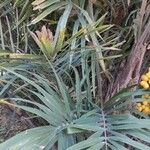
Arenga engleri
Formosan sugar palm · Dwarf sugar palm · Formosa palm · Taiwan arenga palm
Description
Source: leafsnapArenga engleri, commonly known as the dwarf sugar palm, is a species of palm tree native to Southeast Asia. This slow-growing plant can reach up to 6 meters in height and features a slender trunk adorned with dark brown fibers. Its pinnate leaves can extend up to 3 meters long, boasting numerous leaflets that are dark green on top and silvery underneath. The dwarf sugar palm blooms with small yellow flowers that grow in clusters on long stalks. These flowers give way to small black fruits, each containing a single seed. While the fruits are edible, they are not commonly consumed. Due to its attractive foliage and compact size, this plant is often used as an ornamental tree in gardens. It prefers well-drained soil and partial shade but can tolerate full sun exposure if provided with sufficient water. Beyond its ornamental value, the dwarf sugar palm has several practical uses. Its leaves can be woven into baskets or mats, and the sap from its trunk can be tapped to produce sugar or fermented into an alcoholic beverage. Overall, Arenga engleri is a versatile plant that offers both aesthetic appeal and practical benefits, making it valuable in various industries across Southeast Asia.
Care Guide
💧 Water Every 7 days
The Formosa palm thrives in subtropical climates characterized by consistent moisture and high humidity. While it can withstand moderate drought, it grows best with regular humidity. To mimic these optimal conditions, water the plant every two weeks. As an evergreen, the Formosa palm retains moisture throughout the year, making it suitable for both indoor and outdoor cultivation, depending on the local climate conditions.
☀️ Light Full sun
The Formosa palm grows best in places that receive abundant sunlight and tolerates locations with moderate light. Native to sun-drenched habitats, it prefers bright, unshaded light. Too much or too little illumination can result in stunted growth or a decline in the plant’s health.
🌡️ Temperature 20–37.8°C
The Formosa palm comes from tropical areas, where the climate is generally warm and humid. Because of this, it is well suited to high heat and moisture. It is sensitive to sudden temperature shifts and prefers a steady temperature, so it is important to avoid temperature swings indoors. It typically cannot tolerate cold and needs warmer conditions to grow. If the ambient temperature falls too low, the plant may stop growing or even die.
💨 Humidity
🪴 Soil 6-7
🌱 Fertilizer
The best time to fertilize a Formosa palm is in early spring as it breaks dormancy. This encourages overall growth and flower development. Fertilization improves the foliage, stems, and branches, while encouraging flowers that are large, vibrant, and long-lasting. It also helps transfer nutrients from the roots to the flowers and enhances the plant’s health and disease resistance.
🪴 Pot & Repot 1-2 years
Repot the Formosa palm every 1-2 years during the spring. Choose a larger pot and use well-draining soil to encourage healthy root growth. Water the plant moderately and place it in bright, indirect light to help it adjust and thrive.
✂️ Pruning
Pruning a Formosa palm in early spring can significantly improve its health and appearance. Begin by removing any dead fronds and thinning out crowded areas to enhance air circulation. Trim away spent flower stalks to encourage new growth. Always use clean, sharp tools to minimize the risk of infection, ensuring the plant remains vigorous.
🌿 Propagating
🐛 Diseases & pets
☠️ Toxicity
Characteristics
- Plant Type
- Shrub
- Life Cycle
- Perennial
- Genus
- Arenga
- Family
- Arecaceae
- Hardiness Zone
- 9-11
- Mature Height
- 2.13 m to 3.05 m
- Mature Spread
- 3.05 m to 4.57 m
- Leaf Color
- Dark Green, Forest Green
- Leaf Type
- Evergreen
- Flower Color
- Yellow, Cream
- Flower Size
- 0.51 cm
- Bloom Time
- Late spring, Summer, Early fall, Mid fall
- Planting Time
- Spring, Summer
- Harvest Time
- Late summer, Fall, Early winter, Mid winter
- Native Area
- Japan, China