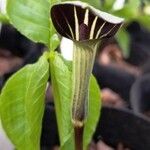
Arisaema triphyllum
Jack-in-the-pulpit · Indian-turnip · Jack In The Pulpit · Indian Jack-in-the-pulpit · Bog Turnip
Description
Source: leafsnapArisaema triphyllum, commonly known as Jack-in-the-pulpit, is a herbaceous perennial plant native to eastern North America. It belongs to the Araceae family and typically reaches a height of 1 to 2 feet. The plant is noted for its distinctive foliage, which consists of three leaflets often mottled with shades of green and brown. While its flowers are small and inconspicuous, the inflorescence is particularly striking. It features a spadix (the "Jack") surrounded by a hooded spathe (the "pulpit"), which can be green or purple-brown and can grow up to 10 inches in length. Jack-in-the-pulpit thrives in moist woodland habitats with well-drained, organic-rich soil. It usually blooms from April to June but may also produce fruit later in the season. Although it can take several years for plants grown from seed to mature and flower, established plants can live for many years. Historically, Native Americans used Jack-in-the-pulpit for both food and medicine. They roasted or boiled its corms before eating them, and its roots were used as an antiseptic and pain reliever. Overall, Arisaema triphyllum is an intriguing addition to any woodland garden, thanks to its unique inflorescence and attractive foliage.
💡 The jack-in-the-pulpit plant holds significant historical importance for the Meskwaki Indians. According to legend, they would chop up the corm of the jack-in-the-pulpit plant. A corm is similar to a root or bulb. They would then mix the chopped corm with strongly flavored meat and leave it for their enemies. Anyone who ate the meat would succumb to its poison.
🌳 The historic use of jack-in-the-pulpit demonstrates a surprising versatility. Indigenous Americans harvested its corm for starch during periods of food scarcity, despite its raw toxicity. To render it safe, they cleverly dried and roasted the corm to neutralize the poisonous calcium oxalate crystals. The plant was also used as an ingredient to produce deep purple to black dyes.
🎭 Ongoing happiness, love is eternal
Care Guide
💧 Water Every 7 days
Jack-in-the-pulpit flourishes in moist woodlands and prefers soil that remains consistently damp. To stay healthy, it needs weekly watering. As an herbaceous perennial, it efficiently absorbs water during its active growing season, which encourages strong foliage and distinctive flowers.
How should I water my Jack-in-the-pulpit plant?
There are a few ways to water your Jack-in-the-pulpit depending on its location. For potted plants indoors, you can bring them to the kitchen sink and use the faucet to add water. Hold the pot and stop watering when the water starts to drain out. Avoid doing this in cold climates as it can harm the roots. If your tap water has high levels of fluorine, chlorine, or salts, consider using rainwater or lake water. You can also water the plant overhead or directly into the soil using a watering can, hose, or any other tool you prefer.
What should I do if I give too much or too little water to my Jack-in-the-pulpit plant?
If you notice that your Jack-in-the-pulpit isn't getting enough water, the first step is to water it thoroughly until water runs out of the drainage holes. If it's growing outside, make sure the soil is completely moist. On the other hand, if your Jack-in-the-pulpit is getting too much water, start by reducing your watering schedule. Additionally, consider the soil and container it's in. If the soil or container doesn't drain well, your plant will likely become overwatered again. To fix this, transfer the plant to looser soil or a container with better drainage. Also, check the location of the plant. If it's in a spot with poor ventilation, like a corner, try moving it near a window or door to improve airflow. Ensuring that your plants are in a well-ventilated location can help prevent overwatering.
How frequently do I need to water my Jack-in-the-pulpit plant?
The Jack-in-the-pulpit is a plant that doesn't need consistently moist soil. It's actually better to let the soil dry out between waterings. If you have Jack-in-the-pulpits in containers, you can tell when it's time to water by checking how dry the soil is. For example, if the top half of the soil in your container is dry, then it's time to add water. You can check this by feeling the soil with your fingers or a stick, or by using a soil moisture meter. If you have Jack-in-the-pulpits planted outdoors, you can plan to water them about once every other week, as long as there hasn't been recent rainfall.
How much water does my Jack-in-the-pulpit plant need?
To water your Jack-in-the-pulpit plant, first let the top half of the soil become dry. Then, add enough water to make the soil moist again. The amount of water needed depends on the size of your plant and container. For a small plant in a small to medium-sized container, one to two cups of water should be enough. Adjust the amount accordingly for larger plants. To ensure the soil is sufficiently moist, you can check by sticking your finger or a trowel into it. Another method is to water until you see excess water draining from the bottom of the container.
How do I know if I'm giving enough water to my Jack-in-the-pulpit plant?
Both overwatering and underwatering are detrimental to the health of your Jack-in-the-pulpit plant, but they exhibit different symptoms. Insufficient watering can result in yellowing leaves, while also causing the leaf edges to turn brown and fragile. On the other hand, excessive watering will often cause yellow and brown marks simultaneously. Overwatering can also contribute to diseases like root rot, which may be visible on your plant. However, if you can recognize the signs of overwatering and underwatering, there is a good chance you can address these problems effectively.
☀️ Light Partial sun
The Jack-in-the-pulpit usually thrives in regions with moderate sun exposure but can also endure environments with excessive sunlight or scarce light without any negative consequences. Its typical surroundings are marked by speckled light. Nonetheless, too much or too little light could potentially harm its robust growth.
What are the sunlight requirements for Jack-in-the-pulpit?
Jack-in-the-pulpit requires partial sun, about 3-6 hours of sunlight, but it can also thrive in full sun or full shade conditions, where it receives over 6 hours of sunlight. The natural habitat of Jack-in-the-pulpit is characterized by dappled light, which indicates moderate sun exposure is ideal. However, the plant is versatile and can withstand both intense sunlight or minimal light without adverse effects. It's essential to watch how sunlight moves through your garden, choosing spots that offer a balanced light-shade mix to ensure the plant's happiness.
How can artificial lighting be used for indoor Jack-in-the-pulpit plants?
When natural sunlight is insufficient, specially during winter or in less sunny spaces, artificial lighting provides a vital solution for the healthy growth of indoor plants. Opt for LED lights as they can be tailored to emit specific wavelengths needed by plants. The amount of artificial light needed varies depending on the plant's sunlight needs: 30-50W/sq ft for full sun plants, 20-30W/sq ft for partial sun plants, and 10-20W/sq ft for full shade plants. The light source should be placed 12-36 inches above the plant to mimic natural sunlight effectively. Furthermore, most plants require 8-12 hours of light per day, so adjust the duration of artificial lighting to mimic natural daylight hours.
What are the symptoms of light deficiency or excess in Jack-in-the-pulpit?
Symptoms of light deficiency in Jack-in-the-pulpit include smaller new leaves, leggy or sparse growth, faster leaf drop, slower or no new growth, lighter-colored new leaves, and chlorosis (leaves losing their green color). Excessive sunlight exposure can cause sunscald, leaf curling, wilting, and leaf scorching. These symptoms highlight the plant's struggle with either insufficient or excessive light, affecting its ability to photosynthesize efficiently, maintain health, and grow robustly.
What are the solutions for managing inadequate or excessive sunlight exposure for Jack-in-the-pulpit?
If Jack-in-the-pulpit is suffering from inadequate light, gradually move it to sunnier spots each week until it receives 3-6 hours of direct sunlight daily for outdoor plants. For indoor plants, use artificial light, like desk or ceiling lamps on for at least 8 hours daily or invest in professional plant grow lights. To adapt to excessive sunlight, avoid sudden light intensity changes to prevent sunburn. Observe and reduce obstructions like overhanging trees by pruning. For relocating smaller plants, do so in their dormant period, ensuring a spot with ample sunlight and good drainage. It's crucial to note that parts of the plant affected by insufficient light may not recover, but new growth will be healthy post-adjustment.
🌡️ Temperature 5–35°C
The jack-in-the-pulpit naturally thrives in temperate woodland surroundings. It tends to favor temperatures between 41 and 95 degrees Fahrenheit (5 to 35 degrees Celsius). When winter comes, it enters a dormant state and necessitates a cooler climate ranging from 41 to 50 degrees Fahrenheit (5 to 10 degrees Celsius). Conversely, during summer, it requires a slightly heated atmosphere, with temperatures between 68 to 77 degrees Fahrenheit (20 to 25 degrees Celsius).
What is the native growth environment of Jack-in-the-Pulpit?
Jack-in-the-Pulpit thrives in temperate forests, where it enjoys a range of temperatures from 41 to 95°F (5 to 35°C). It is adapted to go dormant during winter, preferring cooler temperatures between 41 to 50°F (5 to 10°C). In the summer season, it requires warmer temperatures, ideally between 68 to 77°F (20 to 25°C). Due to its strong cold resistance, Jack-in-the-Pulpit usually doesn't need special frost protection measures during winter. However, in exceptionally cold winters where temperatures are expected to drop below its tolerance limit, providing cold protection with soil or straw coverage is beneficial. Additionally, watering the plant abundantly before the first freeze in autumn helps it remain healthy through winter and early spring.
How does Jack-in-the-Pulpit respond to low temperatures?
Jack-in-the-Pulpit is remarkably cold-tolerant and functions best when temperatures stay above its minimum growth threshold. Throughout winter, maintaining temperatures above its dormancy threshold is crucial. If temperatures fall below this critical threshold, while the plant might not show immediate damage during winter, there could be a noticeable decline in vigorous sprouting or even a complete absence of new growth in spring. The best approach to manage these potential issues is to carefully remove any parts of the plant that fail to sprout when the warmer weather returns.
What are the effects of high temperatures on Jack-in-the-Pulpit, and how can they be mitigated?
During the summer, it's important to ensure that Jack-in-the-Pulpit's environment does not exceed its maximum temperature tolerance. Exposing the plant to temperatures beyond this range can lead to leaves becoming lighter in color, curling, and in severe cases, the leaves can experience sunburn or the entire plant may wilt and dry out. To counteract the effects of high temperatures, one can trim away the sunburned or dried parts of the plant, relocate it to a spot with afternoon shade, or employ a shade cloth to protect it from the sun's most intense rays. Additionally, watering the plant during cooler parts of the day, like mornings and evenings, can help keep the soil adequately moist.
💨 Humidity normal (40-60%)
This plant will thrive in moderate humidity, which is probably the level in your home. However, misting it a few times a week can be very beneficial. Make sure the room has good ventilation.
🪴 Soil 5-6
🌱 Fertilizer
One application of fertilizer in spring is generally enough for Jack-in-the-pulpit, though repeated feedings can boost growth. Fertilize every month to six weeks. Feeding improves the leaves' appearance and function, helping preserve uniform color and a healthy texture. It also encourages root development and nutrient uptake, supporting the plant's long-term health.
Why do I have to add plant food to my Jack-in-the-pulpit?
The Jack-in-the-pulpit relies heavily on its leaves for structure, and fertilization is a key way to ensure that the leaves are both beautiful and functional. By fertilizing properly, you can help your Jack-in-the-pulpit maintain consistent leaf color and a healthy texture. Fertilization also has benefits beneath the surface, as it encourages the growth of new roots and supports the existing root system. This means that fertilization not only keeps the plant healthy in the present, but also improves its ability to absorb nutrients from the soil in the future.
When should I fertilize my Jack-in-the-pulpit?
If you choose to grow your Jack-in-the-pulpit outdoors, it will start growing new shoots in early spring. This is a signal that it's time to fertilize it for the year. Typically, a single application of fertilizer in the spring is sufficient for the plant to do well. However, if you want to promote maximum growth, you can fertilize it multiple times throughout the spring and early summer. In this case, you can feed your Jack-in-the-pulpit every month to a month and a half.
When is it not a good idea to fertilize my Jack-in-the-pulpit plant?
During the late fall and winter, your Jack-in-the-pulpit will go into a dormant phase, where it stops growing. It's important not to fertilize it during this time. In the spring and summer, if you choose to fertilize, start reducing the amount as summer approaches because the Jack-in-the-pulpit's growth rate slows down. It is never a good idea to fertilize when it's unusually hot or when the soil is very dry, as it can stress the plant and cause it to die before its time.
What kind of fertilizer does my Jack-in-the-pulpit plant need?
Choosing the best fertilizer for a Jack-in-the-pulpit is actually quite simple. They thrive on a general-purpose garden fertilizer that has equal amounts of nitrogen, phosphorus, and potassium, such as a 10-10-10 ratio. Avoid fertilizers high in nitrogen if you're unsure. The most effective fertilizers for these plants typically come in granular form and should be slow-release for easier application. Additionally, using organic soil amendments like compost can be beneficial when feeding your Jack-in-the-pulpit.
How can I make my Jack-in-the-pulpit plant grow better?
To ensure optimal growth for your Jack-in-the-pulpit plant, wait until its first leaves start emerging from the soil in early spring. Once you notice this, apply a granular slow-release fertilizer with a balanced formula to the soil around the base of the plant. You can choose to repeat this process later in the season if desired. When applying fertilizer, make sure to focus on the soil at the base of the plant rather than directly on the plant itself. Sometimes, you may need to move the leaves to access the soil above the roots. It is also recommended to water the plant before and after feeding it for best results.
🪴 Pot & Repot Once a year
In the warmer months of spring or summer, consider repotting your Jack-in-the-pulpit into a slightly bigger container that offers adequate drainage. Upon repotting, water the plant thoroughly and situate it in a location that receives bright, indirect sunlight. As the plant expands, think about incorporating a moss pole for additional support.
✂️ Pruning
The Jack-in-the-pulpit has a distinctive flower structure and three-part leaves. To keep the plant healthy, prune it in early spring to remove dead foliage and improve airflow, which helps reduce the risk of fungal infections. Minimal pruning is key to promoting healthy growth without stressing the plant, allowing it to maintain its unique appearance.
🌿 Propagating
🐛 Diseases & pets
☠️ Toxicity
Characteristics
- Plant Type
- Herb
- Life Cycle
- Perennial
- Genus
- Arisaema
- Family
- Araceae
- Hardiness Zone
- 4-9
- Mature Height
- 30 cm to 61 cm
- Mature Spread
- 30 cm to 46 cm
- Leaf Color
- Green
- Leaf Type
- Deciduous
- Flower Color
- Green, Brown
- Flower Size
- 7.62 cm
- Bloom Time
- Mid spring, Late spring, Early summer
- Planting Time
- Spring, Autumn
- Harvest Time
- Mid summer
- Native Area
- Eastern North America