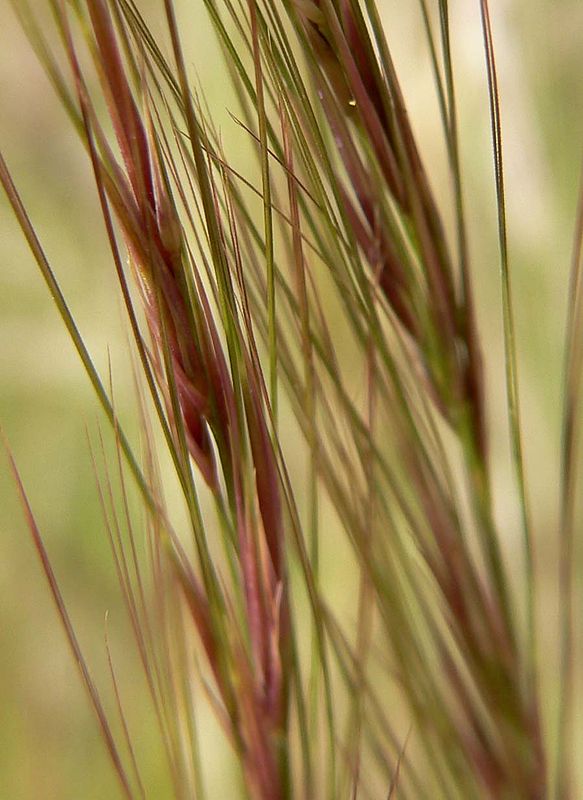
Aristida purpurea
Purple threeawn · Purple 3-awn · Purple threeawn grass · Democrat Grass · Wiregrass
Description
Source: leafsnapAristida purpurea, commonly known as purple three-awn or red three-awn, is a perennial grass species in the Poaceae family. Native to North America, this grass thrives in diverse habitats, including prairies, savannas, and open woodlands. The plant is characterized by its long, slender leaves, which can grow up to 30 cm in length. These green leaves have a rough texture due to the presence of small hairs on their surfaces. The stems of Aristida purpurea can reach up to 1 meter in height and feature multiple branches at the top. From June through September, Aristida purpurea produces small flowers that are purple or reddish-brown in color. These flowers are arranged on long spikes that emerge from the tips of the stem branches. This grass species is vital for maintaining ecological balance. It provides food for various herbivores, including deer, elk, and bison, and serves as a habitat for many insects, such as butterflies. Overall, Aristida purpurea is a crucial component of many ecosystems across North America, celebrated for both its distinctive appearance and its ecological importance.
Care Guide
💧 Water Every 7 days
Purple three-awn thrives in arid environments due to its high drought tolerance and minimal water requirements. It typically needs watering only every two weeks. Although it is more commonly grown outdoors, purple three-awn shows remarkable resilience by staying healthy even during dry spells in the growing season.
☀️ Light Full sun
The purple three-awn prefers locations that receive abundant sunlight throughout the day. Naturally thriving in areas with plentiful sun exposure, its growth and vibrancy depend on ample light. Shading hinders its development, while even excessive sunlight does not diminish its vitality because it is highly tolerant.
What are the sunlight requirements for Purple three-awn?
Purple three-awn requires full sun, which means it needs above 6 hours of sunlight daily to thrive. Observing how sunlight moves through your garden helps in choosing spots that provide a perfect balance of light and shade, ensuring the plant's happiness. Originally flourishing in abundantly sunny areas, its growth and vibrancy heavily depend on plentiful light, although it shows exceptional tolerance and its vitality is not compromised by excessive exposure.
What essentials should I know about providing light for Purple three-awn?
The Purple three-awn plant has a strong preference for locations that are well-lit by the sun throughout the day. When natural sunlight is insufficient, especially during winter or in spaces that receive less sun, artificial lighting can be a vital solution to promote optimal growth. LED lights are recommended for their ability to be customized to the specific light wavelengths needed by plants. For full sun plants, 30-50W/sq ft of artificial light is needed, 20-30W/sq ft for partial sun plants, and 10-20W/sq ft for full shade plants. Artificial lights should be placed 12-36 inches above the plant and turned on for 8-12 hours per day to mimic natural daylight hours.
What are symptoms of inadequate lighting in Purple three-awn?
Inadequate lighting can lead to several symptoms in Purple three-awn, including smaller new leaves, leggy or sparse growth, faster leaf drop, slower or no new growth, lighter-colored new leaves, chlorosis, sunscald, leaf curling, wilting, and leaf scorching. These symptoms indicate that the plant is not receiving enough light for optimal growth, leading to a reduction in chlorophyll and essential nutrients, stretching out to seek more light, and ultimately affecting the plant's overall health.
What solutions can I apply for light-related issues in Purple three-awn?
For indoor Purple three-awn plants, gradually moving them to a location that receives at least 6 hours of direct sunlight daily is crucial. Consider using a south-facing window and keeping curtains open. If the plant is large or not easily movable, artificial lighting such as desk or ceiling lamps, kept on for at least 8 hours daily, or professional plant grow lights can provide ample light. Outdoors, moving the plants gradually to sunnier spots helps them adapt without risk of sunburn. Reducing obstructions like pruning trees or moving smaller plants during their dormant period can also increase sunlight exposure. Note that parts of the plant affected by insufficient light may not recover, but new growth will be healthy with improved lighting.
🌡️ Temperature 10–25°C
Purple three-awn is native to regions with temperatures between 68 and 95 °F (20 to 35 °C). It prefers warmth and tolerates seasonal changes within that temperature range. In cooler conditions, providing extra heat or moving it indoors may be necessary to maintain optimal health.
What is the ideal temperature range for Purple Three-awn?
Purple three-awn, also known as Aristida purpurea, thrives in climates where temperatures fluctuate between 68 to 95 °F (20 to 35 °C). It enjoys warm conditions and adapts well to seasonal changes within this range. While it is notably cold-tolerant and doesn't need special frost protection measures in winter, in cooler conditions, it may require added warmth or protection indoors to stay healthy. To prepare for winter, it's advisable to water the plant generously before the first freeze to keep the soil moist and prevent drought and water scarcity during colder months.
How does Purple Three-awn react to temperatures below its tolerance level?
Purple three-awn is exceptionally cold-tolerant and can withstand winter temperatures down to -25°C (-13°F). However, if temperatures drop below this threshold, there may not be any noticeable impact during the winter itself. Yet, come spring, there could be a significant decrease in sprouting, or the plant may fail to sprout altogether. The recommended solution for this is to remove any parts that haven't sprouted in the spring to promote the health and appearance of the plant.
What should be done if Purple Three-awn experiences high temperatures?
When exposed to temperatures above its tolerance of 35°C (95°F), the growth of Purple three-awn halts and it becomes more prone to rot. To combat the effects of high temperature, it's important to trim away any sunburned and dried-out areas of the plant. Relocating the plant to a shaded area or using a shade cloth can offer protection from intense midday and afternoon sun. Additionally, watering the plant during cooler times of the day, such as in the morning and evening, helps keep the soil moist and supports the plant's well-being under excessive heat conditions.
💨 Humidity
🪴 Soil 6-7
🌱 Fertilizer
One fertilizer application in spring is generally enough for Purple three-awn, though repeated feedings can optimize growth. Apply fertilizer every month to a month and a half. Fertilizing improves the leaves' appearance and function, encouraging a more uniform color and a healthy texture. It also promotes root development and nutrient uptake for sustained plant health.
🪴 Pot & Repot 2-3 years
When repotting Purple three-awn, choose a pot 1–2 inches (2.5–5.1 cm) larger with ample drainage. Use a well-draining potting mix. Repot in spring or fall, ensuring that the root ball sits slightly lower than the rim of the flower pot. Water thoroughly after repotting and place in a warm spot with indirect sunlight.
✂️ Pruning
Purple three-awn is a plant known for its wiry, upright growth and distinctive purple awns. It requires minimal pruning to thrive. The best time to prune is in early spring, which encourages vigorous growth and helps reduce the risk of disease. During pruning, remove any dead stems and cut back older growth to allow new shoots to emerge. This will also improve airflow and sunlight exposure, promoting healthier plant development.
🌿 Propagating
🐛 Diseases & pets
☠️ Toxicity
Characteristics
- Plant Type
- Herb
- Life Cycle
- Perennial, Annual
- Genus
- Aristida
- Family
- Poaceae
- Hardiness Zone
- 6
- Mature Height
- 49 cm to 91 cm
- Mature Spread
- 61 cm
- Leaf Color
- Green
- Leaf Type
- Deciduous
- Flower Color
- Purple
- Flower Size
- 0.51 cm to 2.54 cm
- Bloom Time
- Late spring, Early summer, Mid summer
- Planting Time
- Spring, Summer, Autumn
- Harvest Time
- Mid summer, Late summer, Early fall
- Native Area
- Mexico, Bolivia, Cuba, Canada