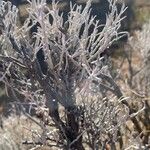
Artemisia tridentata
Basin sagebrush · Sagebrush · Big sagebrush · Common sagebrush · Bonneville big sagebrush
Description
Source: leafsnapArtemisia tridentata, commonly called big sagebrush, Great Basin sagebrush or (locally) simply sagebrush, is an aromatic shrub from the family Asteraceae, which grows in arid and semi-arid conditions, throughout a range of cold desert, steppe, and mountain habitats in the Intermountain West of North America. The vernacular name "sagebrush" is also used for several related members of the genus Artemisia, such as California sagebrush (Artemisia californica). Big sagebrush and other Artemisia shrubs are the dominant plant species across large portions of the Great Basin. The range extends northward through British Columbia's southern interior, south into Baja California, and east into the western Great Plains of New Mexico, Colorado, Nebraska, and the Dakotas.Several major threats exist to sagebrush ecosystems, including human settlements, conversion to agricultural land, livestock grazing, invasive plant species, and wildfires. Sagebrush provides food and habitat for a variety of species, such as sage grouse, pronghorn antelope, grey vireo, pygmy rabbit, and mule deer. It is especially important to game animals during the winter.Native Americans used the plant medicinally. It is also useful as firewood.
🎭 Purification, Exorcism
Care Guide
💧 Water
☀️ Light Full sun
🌡️ Temperature 5–35°C
💨 Humidity
🪴 Soil 6-8
🌱 Fertilizer
🪴 Pot & Repot
✂️ Pruning
🌿 Propagating
🐛 Diseases & pets
☠️ Toxicity
Characteristics
- Plant Type
- Shrub
- Life Cycle
- Perennial
- Genus
- Artemisia
- Family
- Asteraceae
- Hardiness Zone
- 4-9
- Mature Height
- 0.91 m to 2.13 m
- Mature Spread
- 0.91 m to 3.05 m
- Leaf Color
- Green, Silver
- Leaf Type
- Evergreen, Semi-evergreen
- Flower Color
- Yellow
- Flower Size
- 30.48 cm
- Bloom Time
- Mid summer
- Planting Time
- Spring
- Harvest Time
- Late summer, Early fall
- Native Area
- Depends on variety, but A. absinthium is native to Eurasia and North Africa, A. tridentata to the North American West