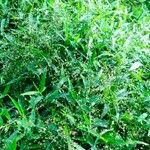
Arthraxon hispidus
Jointhead · Small carpet grass · Small Carpgrass · Small carpetgrass · Jointhead arthraxon
Description
Source: leafsnapArthraxon hispidus, commonly known as hispid carpetgrass, is a perennial species in the Poaceae family. Native to Asia, this grass thrives in various habitats, including grasslands, forests, and wetlands. The plant features a creeping growth habit, with stems that can reach up to 60 cm in length. Its leaves are narrow and pointed, characterized by a rough texture on the upper surface and a hairy underside. The inflorescence comprises spikelets arranged in clusters at the ends of the stems. Arthraxon hispidus is frequently employed for erosion control due to its ability to form dense mats that stabilize soil surfaces. Additionally, its attractive foliage offers some ornamental value. While the plant prefers moist soils, it is capable of tolerating drought conditions once established. It thrives best in full sun but can also grow in partial shade. In summary, Arthraxon hispidus is a versatile plant with practical applications for erosion control and aesthetic value for landscaping.
Care Guide
💧 Water Every 7 days
Small carpetgrass thrives in conditions with moderate moisture, needing weekly watering to prevent drought stress. It is well-suited as a ground cover and benefits from rainwater that provides natural irrigation and essential nutrients. While it is less tolerant of prolonged dry periods, it can endure short stretches without water.
☀️ Light Full sun
Small carpetgrass comes from sunny, open habitats and grows best in full sunlight. Although it can tolerate some partial shade, it favors direct sun for optimal growth. This plant, which can be annual or biennial, is noted for its sun-loving nature.
What are the sunlight requirements for Small carpetgrass (Arthraxon hispidus)?
Small carpetgrass (Arthraxon hispidus) thrives in environments with full sun, requiring above 6 hours of sunlight daily for optimal growth. It can also tolerate partial sun, needing about 3-6 hours of sunlight. When planning where to place your Small carpetgrass, either in the garden or indoors, consider spots that offer a perfect balance of light and shade to ensure the plant's happiness and health.
Can artificial lighting be used for Small carpetgrass, and if so, how?
Yes, artificial lighting can be used to support the growth of Small carpetgrass, especially when natural sunlight is insufficient, such as during winter or in spaces that do not receive enough sunlight. Suitable artificial lights, like LED lights, can be adjusted to provide specific wavelengths needed by the plant. Full sun plants require 30-50W/sq ft, partial sun plants need 20-30W/sq ft, and full shade plants need 10-20W/sq ft of artificial light. The lights should be placed 12-36 inches above the plant and turned on for 8-12 hours per day to mimic natural daylight hours.
What symptoms indicate Small carpetgrass is getting inadequate light?
Symptoms of inadequate light for Small carpetgrass include smaller new leaves compared to mature ones, leggy or sparse growth, faster leaf drop, slowed or halted new growth, and lighter-colored or yellowing leaves (chlorosis). Overexposure symptoms include sunscald, leaf curling, wilting, and leaf scorching. These signs suggest the plant is struggling with the light conditions, either too little or too much, affecting its health and growth.
How can I address light-related issues for Small carpetgrass indoors?
To address light deficiency in Small carpetgrass indoors, gradually increase sunlight exposure by moving the plant closer to a south-facing window each week until it receives at least 6 hours of direct sunlight daily. If moving the plant is not feasible or for additional support, consider using artificial light. Keep a lamp on for at least 8 hours a day or use professional plant grow lights. For plants affected by too much light, gradually adjust them to optimal light levels, avoiding sudden changes to prevent sunburn.
What steps should be taken to optimize sunlight for Small carpetgrass outdoors?
For Small carpetgrass grown outdoors, gradually acclimate the plants to the best sun exposure by moving them to sunnier spots each week. This method helps avoid shock from sudden changes in sunlight intensity. If trees or other obstructions limit sunlight, consider pruning to allow more light through. For smaller plants or those in unfavorable locations, transplanting during their dormant period (late winter or early spring) to a sunnier location with good drainage can improve growth and health.
🌡️ Temperature 5–35°C
Small carpetgrass has strong adaptability to temperature, able to endure high heat and wide temperature fluctuations. In hot conditions, attention should be paid to watering and providing suitable shade to avoid sunburn. Conversely, small carpetgrass is relatively sensitive to low temperatures: it can tolerate some cold, but excessively cold conditions may cause frost damage.
💨 Humidity
🪴 Soil 5-7
🌱 Fertilizer
🪴 Pot & Repot
✂️ Pruning
Small carpetgrass is a low-growing grass with hairy stems. Prune it from early to late spring to improve its growth and appearance. Regular trimming helps prevent overcrowding and disease, so it is important to use clean, sharp tools. Consistent care encourages healthy development and keeps your garden space looking well-maintained.
🌿 Propagating
🐛 Diseases & pets
☠️ Toxicity
Characteristics
- Plant Type
- Grass
- Life Cycle
- Annual
- Genus
- Arthraxon
- Family
- Poaceae
- Hardiness Zone
- 5-9
- Mature Height
- 46 cm
- Mature Spread
- 20 cm to 40 cm
- Leaf Color
- Light Green, Olive Drab
- Leaf Type
- Semi-evergreen
- Flower Color
- Yellow, Green, Purple, Brown
- Flower Size
- 2.54 cm to 7.62 cm
- Bloom Time
- Late summer, Early fall, Mid fall
- Planting Time
- Spring, Autumn
- Harvest Time
- Fall
- Native Area
- Sri Lanka, Somalia, Turkey, Malaysia, India, Angola, Madagascar, Rwanda, Pakistan, Eritrea, Nigeria, Yemen, Kenya, Uganda, Tanzania, Uzbekistan, Russia, Sierra Leone, Indonesia, Equatorial Guinea, Cameroon, Burundi, Mozambique, Oman, Ghana, Ethiopia, South Korea, Central African Republic, Nepal, Malawi, Tajikistan, Philippines, Zambia, Bangladesh, Laos, Guinea, China, Kyrgyzstan, Kazakhstan, Vietnam, Myanmar, Japan, Papua New Guinea, Bhutan, Congo (DRC), Thailand