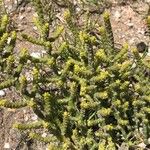
Arthrocaulon macrostachyum
Glaucous Glasswort · Large-spiked glasswort
Description
Source: wikipedia (CC BY-SA)Arthrocaulon macrostachyum, synonym Arthrocnemum macrostachyum, is a species of flowering plant in the amaranth family. It is native to coastal areas of the Mediterranean Sea and the Red Sea and parts of the Middle East, where it grows in coastal and inland salt marshes, alkali flats, and other habitats with saline soils.
Care Guide
💧 Water
The large-spiked glasswort is well adapted to saline environments and excels at retaining moisture and tolerating drought. It thrives in conditions that mirror its natural coastal habitats. For optimal growth, it should be watered weekly. Its unique ability to survive in saline soils allows the large-spiked glasswort to effectively manage water availability.
☀️ Light Full sun
Large-spiked glasswort is a perennial, herbaceous plant that prefers sunny conditions and originates in open habitats, commonly occurring in meadows and grasslands. It favors full sun but can also tolerate partial sun.
🌡️ Temperature 15–37.8°C
Large-spiked glasswort is fairly adaptable to temperature, able to withstand higher heat and significant temperature fluctuations. In hot conditions, attention should be paid to watering and providing some shade to prevent sunburn. Its tolerance of low temperatures is comparatively limited; it can endure a certain amount of cold, but excessively low temperatures can cause frost damage.
💨 Humidity
🪴 Soil 6-8
🌱 Fertilizer
A single fertilizer application in spring is generally enough for Large-spiked glasswort, though multiple feedings can maximize growth. Feed about once a month to every six weeks. Fertilization improves leaf appearance and function, maintaining uniform color and a healthy texture. It also encourages root development and nutrient uptake for the plant’s long-term health.
🪴 Pot & Repot
✂️ Pruning
To promote healthy growth and maintain an attractive shape, large-spiked glasswort benefits from regular pruning, preferably from early to late spring. During this time, remove any dead or weak stems and trim back any leggy growth. This practice encourages a compact form, reduces the risk of disease, and supports the development of thicker foliage and a stronger structure.
🌿 Propagating
🐛 Diseases & pets
☠️ Toxicity
Characteristics
- Plant Type
- Herb
- Life Cycle
- Perennial
- Genus
- Arthrocaulon
- Family
- Amaranthaceae
- Hardiness Zone
- 8-11
- Mature Height
- 30 cm to 61 cm
- Mature Spread
- 30 cm to 49 cm
- Leaf Color
- Dark Green
- Leaf Type
- Evergreen
- Flower Size
- 0.20 cm to 0.25 cm
- Bloom Time
- Early summer, Mid summer
- Planting Time
- Spring, Summer, Autumn
- Harvest Time
- Late summer, Early fall
- Native Area
- Libya, Somalia, Egypt, Turkey, India, Angola, United Arab Emirates, Eritrea, Pakistan, Slovenia, Morocco, Croatia, Yemen, Iraq, Oman, Qatar, Portugal, France, Saudi Arabia, Tunisia, Sudan, Mauritania, Cyprus, Greece, Lebanon, Syria, Italy, Spain, Israel, Senegal, Iran, Albania, Ireland, United Kingdom, Algeria, Kuwait