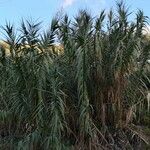
Arundo donax
قمیش، نی هندی · Bamboo reed · Giant-reed · Spanish-reed · Arundo grass
Description
Source: leafsnapArundo donax, commonly known as giant reed or elephant grass, is a tall perennial grass native to the Mediterranean region. It can grow up to 6 meters in height and has a thick stem that can reach up to 10 centimeters in diameter. The leaves are long, narrow, and bluish-green with sharp edges. Giant reed is renowned for its rapid growth rate and its ability to tolerate various environmental conditions, such as drought, flooding, and poor soil quality. Historically, it has been used for multiple purposes, including paper production, thatching roofs, and making musical instruments. However, due to its invasive nature, giant reed has become problematic in many regions where it has been introduced outside its native range. The plant spreads rapidly through underground rhizomes, making it difficult to control once established. Despite being considered an invasive species in many parts of the world because of its ability to outcompete native vegetation, Arundo donax still holds potential uses, such as in bioenergy production and phytoremediation (using plants to clean up contaminated soil).
🌳 Many people are unaware that the giant reed has a special ability to bridge the worlds of music and energy. It is not merely a reed but a material used to craft reeds for wind instruments, most notably for saxophones and clarinets, tying it to a rich cultural fabric of musical genres. Additionally, its high biomass productivity makes it a promising source for biofuel production, addressing contemporary sustainability challenges.
Care Guide
💧 Water Every 7 days
Giant reed flourishes in wetlands, where it prefers consistently moist soil. During the growing season, it should be watered every 1-2 weeks to promote its lush growth and tall, bamboo-like stalks. The plant also thrives in the humid conditions typical of its natural habitats near bodies of water.
What should I do if I give my Giant reed plant too much or too little water?
Proper watering is essential for the health of this beautiful ornamental grass. When planted in the ground, watering issues are usually solvable. However, if the grass is in a container, it is important to avoid giving it too much or too little water, as this can quickly kill the Giant reed. When not receiving the right amount of water, the grass may stop growing. Overwatering can cause yellow leaves with brown tips, while underwatering can result in drooping leaves, weak seed head production, and browned foliage. If you suspect improper watering, the first step is to determine if there is too much or too little water. If there is too much water, stop watering immediately and allow the soil to dry out. It may take several weeks for heavy soils to dry, so patience is key. Once new growth appears, test the soil for moisture and determine whether it needs additional water. If the Giant reed is not receiving enough water, the solution is simple - provide a deep watering and observe if it perks up. Remember that a long, deep watering is better than frequent shallow waterings. This encourages the growth of deep roots, making the grass more resistant to drought and less vulnerable to watering problems.
How regularly should I water my Giant reed?
The watering needs of Giant reed vary depending on the planting location. Generally, watering this grass once a week is recommended. In hot climates, watering once or twice a week in the summer may be necessary. In moderate climates, watering once every seven days or more may be sufficient. Grass in containers typically require more frequent watering compared to grasses planted in the ground. However, the watering frequency also depends on the specific species and the amount of sunlight it receives. Shaded grasses require less frequent watering compared to those planted in the ground. It is important to only water Giant reed when the soil is dry. You can check the soil moisture by pressing your finger into the soil or by weighing the pot if the grass is in a container. If the roots lack sufficient water, the grass blades may fold along their centers and appear thinner. Despite being drought-tolerant, regular and deep waterings will yield vibrant color. In its natural habitat, Giant reed thrives in open scrubland with extreme heat, bright sun, and intermittent rain. Although this grass is drought-resistant, it still requires care and attention. Consistent watering is recommended by gardeners for optimal growth. When newly planted, Giant reed needs more frequent watering until it establishes deep roots. Potted Giant reed in direct sunlight and hot conditions may require watering every 3 to 4 days. When planted in the ground, Giant reed generally needs less watering, but this depends on the soil type. Clay soils hold water for longer periods, so they may feel dry at the surface while retaining moisture below ground. Sandy soils drain quickly and may require more frequent watering.
What do I need to be careful of when watering my Giant reed in different seasons, climates, or during different stages of growth?
To determine if you are watering enough, pay attention to how fast your grass is growing. For example, giant reed can double in size within a year during the hottest months. If the weather is hot but the grass isn't growing well, you may need to adjust your watering schedule. In winter, you might only need to water once a month, but it's still important to check the soil for moisture. Generally, grass needs more water during warmer months and less during winter. The key with giant reed is to always let the soil dry out completely before watering it.
☀️ Light Full sun
The giant reed performs best when it receives light throughout the entire day, though it can tolerate situations where light is not fully abundant. In its native habitats it commonly receives plentiful sun, which promotes optimal growth. Excessive or insufficient sunshine can hinder its healthy development, reducing its lushness and vitality.
What are the sunlight requirements for giant reed (Arundo donax)?
Giant reed thrives best with day-long illumination, as its native environments typically have plentiful sun, promoting optimal growth. However, it can also withstand conditions where light saturation is incomplete. Full sun, which is defined as above 6 hours of sunlight, or partial sun, about 3-6 hours of sunlight, is ideal. It's important to observe how sunlight moves through your garden to ensure you choose spots that provide the right balance of light and shade, ensuring the plant's happiness.
How can artificial lighting support giant reed growth indoors?
Indoor giant reed plants require adequate lighting to grow optimally, especially when natural sunlight is insufficient, such as in winter or less sunny spaces. Artificial lights, like LED lights that can be customized to provide specific wavelengths of light, offer a solution. For plants needing full sun, 30-50W/sq ft of artificial light is recommended, 20-30W/sq ft for partial sun plants, and 10-20W/sq ft for full shade plants. Ensure the light source is placed 12-36 inches above the plant to mimic natural sunlight and keep it on for 8-12 hours per day to simulate natural daylight hours.
What symptoms indicate insufficient or excessive sunlight in giant reed plants?
Symptoms of light deficiency in giant reed include smaller new leaves, leggy or sparse growth, faster leaf drop, slower or no new growth, and lighter-colored or irregularly patterned new leaves indicating a lack of chlorophyll and essential nutrients. Excessive sunlight can cause chlorosis, where leaves turn yellow due to chlorophyll breakdown, sunscald with pale or necrotic areas on plant tissue, leaf curling as a defense mechanism against water loss, wilting due to increased water loss through transpiration, and leaf scorching characterized by brown, dry edges on leaves.
How can I improve the sunlight conditions for an indoor or outdoor giant reed plant?
To optimize growth for indoor giant reed plants, gradually move them to sunnier locations each week to receive at least 6 hours of direct sunlight daily, ensuring maximum exposure by using south-facing windows and keeping curtains open. Artificial lighting, such as desk or ceiling lamps for at least 8 hours daily or professional grow lights, can also provide additional light. For outdoor plants, gradually acclimatize them to sunnier spots to avoid sunburn, noting that parts of the plant affected by insufficient light may not recover, but new growth will be healthy. Minimizing obstructions such as pruning trees or transplanting to sunnier locations with good drainage can also help outdoor and ground-planted giant reeds receive more sunlight.
🌡️ Temperature 10–35°C
The native temperature regime for giant reed features warm days and cooler nights. It prefers temperatures between 50 and 95℉ (10 to 35℃). Its temperature needs vary by season, requiring lower temperatures during the winter months.
What are the essential temperature requirements for giant reed growth?
Giant reed, scientifically known as Arundo donax, thrives in an environment with a significant temperature difference between day and night, favoring temperatures that range from 50 to 95°F (10 to 35°C). It is adaptable to seasonal temperature adjustments, necessitating cooler temperatures during winter. Although it has a strong resistance to cold, extreme winter temperatures below -25°C require the implementation of cold protection measures, such as covering the plant with soil or straw and ensuring the soil is moist before the first freeze of autumn. These steps help the plant to avoid drought and water scarcity throughout the winter and early spring months.
How does low temperature affect giant reed and what are the solutions?
Giant reed is cold-tolerant, with optimal growth temperatures above 10°C. It should not be exposed to temperatures lower than -15°C during winter. If temperatures fall below -25°C, the plant may not exhibit noticeable changes immediately, but come spring, a reduction or absence of sprouting may occur. To manage these effects, any parts of the plant that have failed to sprout in spring should be removed to promote new growth.
What impact does high temperature have on giant reed and how can it be mitigated?
During the summer, it is crucial to keep the giant reed's environment below 35°C to avoid heat stress. Exposure to temperatures exceeding 41°C can cause the leaves to lighten in color, become prone to curling, suffer sunburn, and in severe cases, lead the entire plant to wilt and dry out. To mitigate these effects, sunburned and dried-up parts of the plant should be trimmed away. Additionally, moving the plant to a shaded location or using a shade cloth to protect it from the midday and afternoon sun is beneficial. Watering the plant in the morning and evening will also help keep the soil adequately moist.
💨 Humidity normal (40-60%)
This plant will thrive in moderate humidity, which is probably the level in your home. However, misting it a few times a week can be very beneficial. Make sure the room has good ventilation.
🪴 Soil 6-7
🌱 Fertilizer
Giant reed needs extra nutrients to encourage healthy new growth. In spring, spreading compost around the plant’s base can supply the necessary nutrition. Fertilizing promotes vigorous growth and helps the plant resist diseases and pests.
Why is it necessary to put fertilizer on my Giant reed?
Fertilizing Giant reed is essential for its overall health. By providing the plant with extra nutrients, you enable it to produce robust new growth and maintain the well-being of existing growth. Moreover, the added nutrients contribute to the plant's ability to combat diseases and pests.
When should I fertilize my Giant reed for the best results?
To ensure the survival of Giant reed in your garden, it is important to understand when to fertilize. Giant reed does not require extra nutrients while it is dying back, as it is not a heavy feeder. Although you can use diluted fertilizer at the beginning of the growing season, it is not advisable. Instead, consider applying mulch or compost around the base of the plant.
When is it not a good idea to fertilize my Giant reed?
If you choose not to use packaged fertilizers, there is no need to be concerned about when to stop feeding the Giant reed. Simply adding a layer of compost or mulch in the spring will be sufficient to keep the plant happy all year long. During the winter when the plant is dormant, there is no need to worry about mulching or composting.
What kind of plant food does my Giant reed need?
Instead of rushing out to buy fertilizer for your giant reed, you can simply put down a layer of compost in the spring. This will provide the necessary nutrients for the plant. If you mulch your garden regularly, the bark will also help keep your plant well-nourished.
How should I put fertilizer on my Giant reed plant?
The steps for using mulch or compost for Giant reed are the same. First, put down a layer of either material, making sure to cover the base of the plant. If you choose to use both mulch and compost, make sure to reduce the amount of compost used. Adding a layer of mulch has dual benefits - it helps the soil retain moisture and provides nourishment for the plant.
🪴 Pot & Repot 2-3 years
When repotting Giant reed, select a pot 1–2 inches (2.5–5.1 cm) larger that has good drainage. Use a well-draining potting mix. Repot in spring or fall, making sure the root ball is slightly lower than the rim of the pot. Water thoroughly after repotting and place it in a warm spot with indirect sunlight.
✂️ Pruning
When the leaves die in late autumn, they can be clipped off. The plant can be pruned to the gardener's preference.
🌿 Propagating
🐛 Diseases & pets
☠️ Toxicity
Characteristics
- Plant Type
- Grass
- Life Cycle
- Perennial
- Genus
- Arundo
- Family
- Poaceae
- Hardiness Zone
- 6-10
- Mature Height
- 4.27 m to 6.1 m
- Mature Spread
- 1.52 m to 2.74 m
- Leaf Color
- Green, Blue, White, Gray, Variegated, Silver
- Leaf Type
- Evergreen
- Flower Color
- Purple, White, Brown
- Flower Size
- 7.62 cm to 15.24 cm
- Bloom Time
- Mid summer, Late summer
- Planting Time
- Spring, Summer
- Harvest Time
- Late summer, Fall
- Native Area
- Sri Lanka, Libya, Egypt, Turkey, Malaysia, India, United Arab Emirates, Pakistan, Morocco, Yemen, Uzbekistan, Russia, Iraq, Indonesia, Cambodia, Koppen, Oman, South Korea, Qatar, Nepal, Saudi Arabia, Tajikistan, Tunisia, Philippines, Cyprus, Laos, Turkmenistan, Greece, Lebanon, China, Afghanistan, Syria, Kazakhstan, Vietnam, Myanmar, Japan, Bhutan, Iran, Azerbaijan, Algeria, Thailand