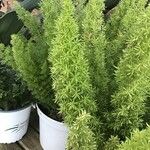
Asparagus densiflorus
دم روباهی · Asparagus fern · Fox tail fern · Sprenger asparagus · Cwebe asparagus fern
Description
Source: leafsnapAsparagus densiflorus, commonly known as the Asparagus Fern, is a popular ornamental plant belonging to the Asparagaceae family. Native to South Africa and Mozambique, it has gained popularity as a houseplant due to its attractive foliage. The plant features long, thin stems that can grow up to 2-3 feet in length, adorned with small, needle-like leaves resembling fern fronds. The leaves of the Asparagus Fern are bright green and have a delicate texture. During the summer months, the plant produces small white or pink flowers, which are followed by red berries in autumn. It is an easy-to-grow plant that requires minimal care, making it an ideal choice for beginners. Asparagus densiflorus prefers bright, indirect light but can also tolerate low light conditions, making it suitable for indoor environments with limited natural light. It thrives in well-draining soil with regular watering but can also withstand periods of drought. The Asparagus Fern offers several health benefits as well; its roots have been traditionally used for medicinal purposes, such as treating urinary tract infections, kidney stones, and other ailments due to their diuretic properties. Overall, this versatile houseplant adds beauty and elegance to any indoor space while providing numerous health benefits, making it an excellent choice for homes or offices.
💡 The most striking feature of the plume foxtail fern is its vibrant green color. It's not just an ordinary green; it is teeming with vigor and vitality, much like a charismatic person.
🌳 Aside from being valued for its appearance, asparagus fern provides shelter for various symbiotic ants, attracting them with its protective foliage. This surprising coexistence could be used for natural pest control in gardens, taking advantage of the ants' predation on other insects.
🎭 Aristocracy, riches, fruitfulness
Care Guide
💧 Water Every 7 days
The foxtail fern grows best in humid conditions, favoring consistent moisture but avoiding waterlogging. Water it weekly for optimal growth, as it is somewhat drought-tolerant. To prevent root rot, well-draining soil is essential. For indoor cultivation, increase humidity by misting the plant or using a pebble tray.
When Should I Water My Foxtail Fern?
Watering your foxtail fern is essential for its health and appearance, requiring attention to soil moisture, leaf condition, weather, pot weight, and specific growth stages. To determine the right time to water, check the soil's moisture by inserting your finger up to 1-2 inches deep; dry soil indicates the need for watering. Leaves that are wilted or losing their vibrant green color suggest the plant is under-watered. In hot and dry weather, increase your watering frequency, and for potted ferns, a lighter pot signifies it's time to water. During the pre-flowering stage, adequate watering supports healthy bloom development. Be cautious not to water too early or too late, as this can lead to issues like root rot or plant stress, affecting the plant's health and longevity.
How Should I Water My Foxtail Fern?
Watering your foxtail fern properly involves using specific techniques and tools to maintain the right moisture level without causing harm. A narrow-spouted watering can is ideal for controlled watering at the base of the plant, avoiding water on the foliage. Bottom-watering by placing the pot in a tray of water for 15-30 minutes helps when the soil is overly dry, while occasional misting in a well-ventilated area can maintain humidity. However, too much misting is not recommended due to the potential for fungal growth. It's important to focus watering near the soil to avoid diseases caused by damp foliage. Using a moisture meter can help prevent over-watering. These methods support the foxtail fern's preference for moist but well-drained soil.
How Much Water Does Foxtail Fern Really Need?
The foxtail fern requires consistent moisture due to its shallow root system, necessitating about 1 inch (2.5 cm) of water weekly, depending on the plant and pot size. The goal is to keep the soil evenly moist without waterlogging. Healthy hydration is marked by vibrant green, upright leaves and slightly damp soil. Overwatering causes yellow or limp leaves, while underwatering leads to wilting or drooping. To balance moisture, use a well-draining potting mix, water thoroughly until it runs out from the bottom, and remove excess water from trays to mimic the fern's natural humid environment. Occasional misting can provide additional humidity.
What Kind of Water is Best for Foxtail Fern?
Foxtail fern thrives on filtered, rainwater, or distilled water, with tap water being an option if it's been allowed to sit for at least 24 hours to dissipate chlorine. This plant is sensitive to chlorine and prefers soft water due to its sensitivity to minerals, which can lead to leaf damage. High mineral content in hard water can cause leaf marks. To mitigate these issues, let tap water sit before use and periodically rinse leaves with distilled water. Always use room-temperature water to avoid shocking the plant.
How Do Foxtail Fern's Watering Needs Change with the Seasons?
Seasonal changes affect the watering needs of your foxtail fern. In spring, as the fern exits winter dormancy, increase watering gradually, keeping the soil moist to support new growth. Summer requires more regular watering due to heat and growth, ensuring the top layer of soil dries slightly between sessions. Autumn's approach means slowing down water frequency as growth diminishes, but maintaining moist soil. Winter significantly reduces the fern's water needs; water sparingly once the top layer of soil is dry, and avoid over-watering to prevent root rot during this semi-dormant period.
☀️ Light Partial sun
Asparagus fern grows best in locations with partly filtered sunlight, though it can tolerate both full sun and complete shade. Its native environment, which features varying light levels, underpins this toughness. Nonetheless, too much or too little light can hinder healthy growth, leading to stress or thin, sparse fronds.
What are the sunlight requirements for a Foxtail Fern?
Foxtail Fern (Asparagus densiflorus) requires partial sun, about 3-6 hours of sunlight daily, but it can also thrive in full sun or full shade conditions, which means above 6 hours of sunlight. The plant's tolerance to varying light conditions is a testament to its origin habitat that experiences fluctuating light levels. It's important to watch how sunlight moves through your garden to ensure spots chosen for your plants provide a perfect balance of light and shade.
How does light affect the growth of Foxtail Fern?
Light is essential for the healthy growth of the Foxtail Fern. While it can tolerate both complete exposure to the sun and absence of it, extreme conditions can compromise its growth by causing stress or resulting in sparse fronds. Therefore, the right amount of natural or artificial light is crucial. If natural sunlight is insufficient, especially during winter or in less sunny spaces, artificial lighting can be an effective solution. Using LED lights, which can be customized to provide specific wavelengths, helps promote faster and healthier growth. Depending on the plant's sunlight needs, the wattage of artificial light required varies.
What are the symptoms of inadequate light for a Foxtail Fern?
Inadequate light conditions can lead to several symptoms in a Foxtail Fern, including the growth of smaller new leaves, leggy or sparse growth, faster leaf drop, slower or halted new growth, lighter-colored new leaves, chlorosis (leaf yellowing due to breakdown of chlorophyll), sunscald (damage from intense light exposure), leaf curling, wilting, and leaf scorching. These symptoms indicate that the plant is under stress and not receiving the optimal light conditions for its growth.
How can I manage light conditions for my indoor or outdoor Foxtail Fern?
To optimize growth for your Foxtail Fern, gradually introduce it to sunnier spots if indoor, until it receives 3-6 hours of direct sunlight daily. Use artificial lighting like desk lamps or invest in professional grow lights if natural light is inadequate. For outdoor plants, adapt them to sunnier locations gradually each week to prevent sunburn. Minimize obstructions that block sunlight, and consider transplanting smaller plants to sunnier spots with good drainage during their dormant period. It's important to note that damaged parts from insufficient light may not recover, but new growth should be healthy.
🌡️ Temperature 20–37.8°C
The Asparagus fern grows best at temperatures between 68 and 100 ℉ (20 to 38 ℃). Native to South Africa, it does well in warm, humid tropical conditions. In summer, it should be kept out of direct sunlight and have sufficient moisture. In winter, the Foxtail fern prefers cooler conditions and can tolerate temperatures as low as 50 ℉ (10 ℃).
What are the optimal growing conditions for Foxtail fern?
Foxtail fern, or Asparagus densiflorus, thrives in temperatures ranging from 68 to 100°F (20 to 38°C), characteristic of its native warm and humid tropical environment in South Africa. During summer, it's crucial to protect the plant from direct sunlight while ensuring it receives adequate moisture. In contrast, winter months demand cooler conditions, with the fern tolerating temperatures as low as 50°F (10°C). It's particularly sensitive to cold, so keeping it above certain temperature thresholds during the colder months is beneficial. Autumn requires bringing the plant indoors, positioning it near a bright window but away from direct heat sources.
How should I care for my Foxtail fern in varying temperatures?
In response to low temperatures, Foxtail fern displays a preference for warmth, thriving significantly above specific lower temperature limits. Exposure to temperatures below these limits can lighten leaf color, leading to browning or blackening and potential wilting or drooping after frost damage. To combat cold damage, trim the affected areas and move the plant to a warmer, indoor location, ideally near a south-facing window, but away from direct heat sources to prevent air dryness. In high temperatures, especially above certain thresholds, Foxtail fern's leaves may lighten, increasing sunburn risk. Address this by removing sun-damaged parts, relocating the plant to a shaded area during peak sun hours, and ensuring the soil remains moist with morning or evening watering.
💨 Humidity normal (40-60%)
This plant will thrive in moderate humidity, which is probably the level in your home. However, misting it a few times a week can be very beneficial. Make sure the room has good ventilation.
🪴 Soil 6-7
🌱 Fertilizer
The asparagus fern needs the most fertilizer during its active growth period, which is mainly in spring, summer, and early fall. Fertilizing supplies essential nutrients the soil might be lacking, supporting healthy root and stem development as well as the attractive foliage that is a defining trait of this plant.
Why should I put fertilizer on my Foxtail fern?
The Foxtail fern, like all plants, relies on soil nutrients for its growth. However, it is not always guaranteed that the soil will have all the required nutrients. Fertilization and soil amendments are important to ensure that your plants have both the basic nutrients they need and the specific nutrients necessary for their growth. For the Foxtail fern, fertilizer is essential to support the development of its roots and stems throughout the growing season. It also helps the plant produce a beautiful set of leaves, which is crucial since the foliage is what makes it ornamental.
When should I fertilize my Foxtail fern for the best results?
During the active growth phase of a Foxtail fern, which generally occurs during the spring, summer, and early fall, it will require the highest amount of fertilizer. After winter, you should feed the plant every two to four weeks until the fall season. As fall approaches, gradually decrease the frequency and amount of fertilizer until you stop feeding the plant entirely in preparation for the low growth period during winter.
When is it best not to put fertilizer on my Foxtail fern?
For most of the year, including spring, summer, and most of fall, it is important to regularly feed your Foxtail fern. However, if you notice that your fern has received too much fertilizer or if you have fertilized it incorrectly, causing fertilizer burn or other issues, you will need to correct the problem before resuming regular feeding. The only time you should not fertilize a Foxtail fern is during winter. If you grow this plant indoors in a cold winter area, it will go into dormancy during this time. Feeding the plant during its dormant phase is unnecessary and harmful to its growth, as it is likely to cause fertilizer burn.
What kind of fertilizer does my Foxtail fern need?
When fertilizing a Foxtail fern, it is important to choose a fertilizer with a specific blend of nutrients, each present in small amounts. The ideal fertilizer will have an N-P-K ratio of 3-1-2, but in some cases, a general-purpose fertilizer with an even nutrient blend can also work well. However, even with a balanced fertilizer, the volume of each nutrient should be at 10 or lower. The fertilizer can be either granular or liquid-based. If opting for a liquid-based fertilizer, it is recommended to dilute the strength by half. While granular fertilizer has few drawbacks, using liquid fertilizer, especially when watering the Foxtail fern, is often the most sensible choice.
How should I give nutrients to my Foxtail fern?
When you purchase fertilizer for your Foxtail fern, it will usually come with instructions for how to apply it. For this type of fern, it is important to fertilize while watering the soil to avoid damaging the roots. If you are using slow-release granular fertilizer, sprinkle it on the soil and then water immediately. If you are using liquid fertilizer, dilute it with water, apply it to the soil, and then water a bit more. In the spring and fall, it is particularly important to dilute the fertilizer by at least half as the plant's growth increases or decreases.
🪴 Pot & Repot 2-3 years
When repotting an Asparagus fern, select a pot 1-2 inches (2.5–5.1 cm) larger that has plenty of drainage. Use a well-draining potting mix. Repot in spring or fall, making sure the root ball sits slightly below the rim of the flower pot. Water thoroughly after repotting and put it in a warm location with indirect sunlight.
✂️ Pruning
To keep a Foxtail Fern healthy, it's important to prune it annually in early spring. This involves removing any yellowing fronds and cutting back overly long stems to improve its shape and air circulation. Be sure to use sharp, disinfected tools to minimize stress on the plant and reduce the risk of infections. This will encourage new growth and help maintain a tidy appearance.
🌿 Propagating
🐛 Diseases & pets
☠️ Toxicity
Characteristics
- Plant Type
- Herb
- Life Cycle
- Perennial
- Genus
- Asparagus
- Family
- Asparagaceae
- Hardiness Zone
- 9-11
- Mature Height
- 0.3 m to 1.52 m
- Mature Spread
- 0.91 m to 1.22 m
- Leaf Color
- Green
- Leaf Type
- Evergreen
- Flower Color
- White
- Flower Size
- 0.25 cm to 0.51 cm
- Bloom Time
- Mid summer
- Planting Time
- Spring, Summer, Autumn, Winter
- Harvest Time
- Mid summer, Late summer
- Native Area
- Mozambique, South Africa, Eswatini, Uganda, Tanzania