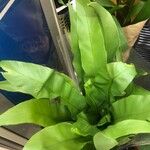
Asplenium antiquum
Bird’s-nest fern · Japanese bird's-nest fern · Ō-tani-watari
Description
Source: leafsnapAsplenium antiquum is a fern of the group known as bird's-nest ferns. In Japanese it is known by ō-tani-watari and tani-watari.
💡 The sprouts of the Japanese Bird's Nest Fern are edible, and their bland taste can be enhanced by frying them with traditional Asian chili and garlic. Due to overharvesting and the destruction of forests, Asplenium antiquum has become endangered in its natural habitat. However, nurseries in the US and Europe have successfully cultivated an abundant supply.
🌳 Beyond its appeal as a houseplant, the japanese Bird's Nest Fern is increasingly being adopted as a functional element in vertical gardens and green walls, particularly in urban areas where space is limited. Its lush foliage not only decorates urban architecture but also helps improve air quality by filtering pollutants, offering a natural way to create greener, more sustainable cities.
Care Guide
💧 Water Twice per week
The Japanese Bird's Nest Fern flourishes in high humidity and requires consistent moisture, ideally being watered twice a week. While it can tolerate moderate drought, the fern greatly benefits from regular misting. This practice helps mimic its natural tropical rainforest habitat, encouraging vibrant fronds and optimal growth.
☀️ Light Full shade
The Japanese Bird's Nest Fern prefers low to moderate light, similar to the forest floor environment where it naturally occurs. It can tolerate some sunlight but should be kept away from strong, intense rays. Excessive exposure can cause leaf burn, whereas insufficient light can limit or prevent growth.
What are the sunlight requirements for a Japanese Bird's Nest Fern?
Japanese Bird's Nest Fern requires minimal to moderate light exposure, similar to its natural habitat on the forest floor. It can tolerate some sunlight but thrives best when protected from intense rays. Overexposure may cause leaf burn, while insufficient light could hinder growth. Sunlight needs are classified as follows: Full shade indicates less than 3 hours of sunlight per day, and partial sun means about 3-6 hours of sunlight. It's essential to watch how sunlight moves through your garden to choose spots that provide a full shade or partial sun environment, ensuring the plant's health and happiness.
How can artificial lighting be used for indoor plants like the Japanese Bird's Nest Fern?
Indoor plants, including the Japanese Bird's Nest Fern, require adequate lighting for optimal growth. When natural sunlight is insufficient, especially in winter or less sunny spaces, artificial lights become essential, promoting healthier, faster growth. LED lights are recommended because they can be customized to provide specific wavelengths needed by plants. The requirement for artificial light varies: full sun plants need 30-50W/sq ft, partial sun plants 20-30W/sq ft, and full shade plants 10-20W/sq ft of light. Positioning the light source 12-36 inches above the plant can mimic natural sunlight effectively. Most plants benefit from 8-12 hours of light per day.
What are the symptoms of light exposure issues in the Japanese Bird's Nest Fern, and how can they be addressed?
The Japanese Bird's Nest Fern displays specific symptoms when facing light exposure issues. Symptoms include slower or no new growth, chlorosis (leaves turn yellow due to breakdown of chlorophyll), sunscald (damage from intense sunlight exposure), leaf curling as a defense against water loss, wilting from increased water loss, and leaf scorching characterized by brown, crispy leaf edges. To address these issues, for indoor plants, move them to spots with ample filtered light, use artificial lights if needed for at least 8 hours daily. For outdoor plants, gradually adapt them to sunlight to prevent sunburn. Removing obstructions and transplanting to sunnier locations can help increase light exposure. Note that parts of the plant damaged by insufficient sunlight may not recover, but new growth should be healthy with increased light.
🌡️ Temperature 20–37.8°C
The natural growing environment of the Japanese bird's nest fern is typically warm and humid, with a preferred temperature range of 68 to 100 ℉ (20 to 38 ℃). To cope with cooler winter temperatures, it can benefit from being placed near a humidifier or kept in an enclosed space with higher humidity.
What are the essential care tips for a Japanese Bird's Nest Fern?
The Japanese Bird's Nest Fern thrives in a humid and warm environment, with an ideal temperature range between 68 and 100°F (20 to 38°C). It's vital to maintain a warm condition, especially during winter, either by placing the fern near a humidifier or in an enclosure with high humidity levels to simulate its native growth environment. Since it's extremely heat-loving, temperatures falling near or below freezing can be detrimental. In colder months, bringing the fern indoors and placing it by a bright window, yet not too close to heaters, helps in keeping it healthy while ensuring it remains above 20°C for optimal growth.
What should I do if my Japanese Bird's Nest Fern is exposed to low temperatures?
The Japanese Bird's Nest Fern is sensitive to low temperatures and performs best when the temperature is above 20°C, needing to be kept above 0°C during winter to avoid damage. Exposure to temperatures below -5°C may cause the leaves to lighten in color, which gradually turn brown or black following frost damage, leading to wilting and drooping. To mitigate frost damage, trim away the damaged parts of the plant and move it to a warmer indoor setting promptly. Placing it near a south-facing window while avoiding proximity to heaters or air conditioning vents will ensure it receives enough sunlight without the air becoming excessively dry.
How do I protect my Japanese Bird's Nest Fern from high temperatures?
To protect your Japanese Bird's Nest Fern from high temperatures, particularly in the summer months when temperatures might exceed 38°C, it's important to ensure the plant is not exposed to temperatures above 43°C as it may lead to lighter leaf colors and increased susceptibility to sunburn. You should trim any sunburned or dried-up parts and move the plant to a cooler, shaded area, especially away from the harsh midday and afternoon sun. Additionally, watering the plant in the morning and the evening will help keep the soil consistently moist and aid in reducing the temperature stress on the plant.
💨 Humidity
🪴 Soil 5-7
🌱 Fertilizer
During the growing season (April through September), fertilize about once a month with weak liquid fertilizer. Don't put fertilizer pellets in the central cup or "nest." Withhold any fertilizer during the winter, when most plants are in their resting phase. Too much food will cause deformed leaves and/or brown or yellow-spotted leaves.
🪴 Pot & Repot 2-3 years
When repotting Japanese Bird's Nest Fern, select a pot 1-2 inches (2.5–5.1 cm) larger with ample drainage. Use a well-draining potting mix. Repot in spring or fall, ensuring the root ball is slightly lower than the rim of the flower pot. Water thoroughly after repotting and place in a warm spot with indirect sunlight.
✂️ Pruning
The Japanese Bird's Nest Fern is known for its broad, wavy fronds. To promote growth and improve air circulation, prune dead or damaged fronds in early spring. Regularly remove any yellowing leaves, but avoid heavy pruning. Always use sterilized tools for maintenance to encourage healthy growth and prevent disease.
🌿 Propagating
🐛 Diseases & pets
☠️ Toxicity
Bird's nest ferns are non-poisonous plants. They are safe for humans, dogs, and cats.
Characteristics
- Plant Type
- Fern
- Life Cycle
- Perennial
- Genus
- Asplenium
- Family
- Aspleniaceae
- Hardiness Zone
- 9-11
- Mature Height
- 46 cm to 61 cm
- Mature Spread
- 30 cm to 61 cm
- Leaf Color
- Green
- Leaf Type
- Evergreen
- Planting Time
- Spring, Autumn
- Native Area
- South Korea, Japan, China