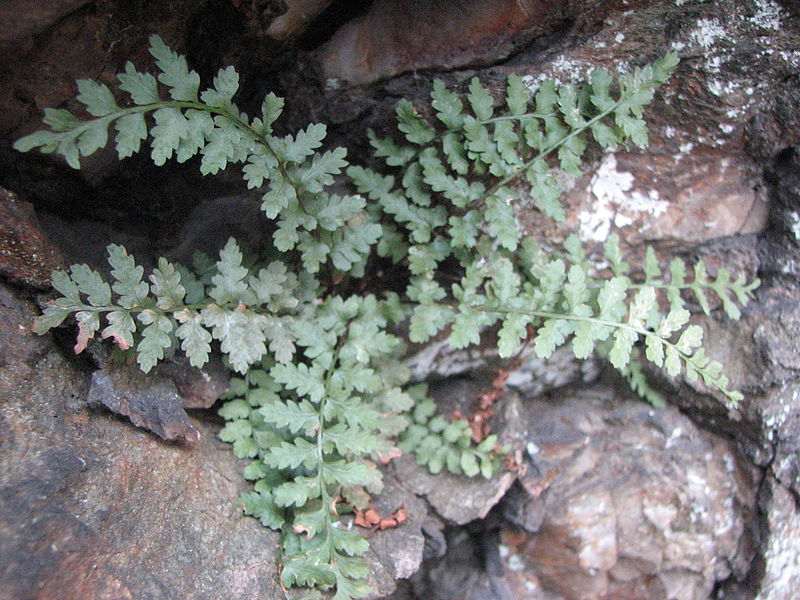
Asplenium bradleyi
Bradley's spleenwort
Description
Source: leafsnapAsplenium bradleyi, commonly known as Bradley's spleenwort or cliff spleenwort, is a rare epipetric fern of east-central North America. Named after Professor Frank Howe Bradley, who first collected it in Tennessee, it may be found infrequently throughout much of the Appalachian Mountains, the Ozarks, and the Ouachita Mountains, growing in small crevices on exposed sandstone cliffs. The species originated as a hybrid between mountain spleenwort (Asplenium montanum) and ebony spleenwort (Asplenium platyneuron); A. bradleyi originated when that sterile diploid hybrid underwent chromosome doubling to become a fertile tetraploid, a phenomenon known as allopolyploidy. Studies indicate that the present population of Bradley's spleenwort arose from several independent doublings of sterile diploid hybrids. A. bradleyi can also form sterile hybrids with several other spleenworts. While A. bradleyi is easily outcompeted by other plants in more fertile habitats, it is well adapted to the thin, acidic soil and harsh environment of its native cliffs, where it finds few competitors. Its isolated situation on these cliffs protects it from most threats, but quarrying and mining of the cliffs, rock climbing, and other activities that disturb the cliff ecosystem can destroy it.
Care Guide
💧 Water
☀️ Light Partial sun
Bradley's spleenwort is native to habitats such as forest understories or rocky areas that provide natural shade. It prefers Full Shade but can tolerate Partial Sun.
What are the sunlight requirements for Bradley's spleenwort (Asplenium bradleyi)?
Bradley's spleenwort (Asplenium bradleyi) requires full shade, meaning it should receive less than 3 hours of sunlight daily. It's essential to monitor the movement of sunlight through your garden carefully and select locations that offer an ideal mix of light and shade, ensuring the plants thrive.
🌡️ Temperature 5–32.2°C
💨 Humidity
🪴 Soil 6-7
🌱 Fertilizer
🪴 Pot & Repot
✂️ Pruning
Bradley's spleenwort is a compact fern known for its lace-like fronds. To encourage growth, prune it from early to late spring by removing any dead fronds. Be careful not to prune heavily, as this fern grows slowly. Regular light trimming can improve air circulation and help reduce the risk of disease. Always use sharp, sterile scissors for pruning tasks.
🌿 Propagating
🐛 Diseases & pets
☠️ Toxicity
Characteristics
- Plant Type
- Fern, Herb
- Life Cycle
- Perennial
- Genus
- Asplenium
- Family
- Aspleniaceae
- Hardiness Zone
- 5-8
- Mature Height
- 10 cm to 20 cm
- Mature Spread
- 15 cm to 25 cm
- Leaf Color
- Dark Green
- Leaf Type
- Evergreen
- Planting Time
- Spring, Autumn