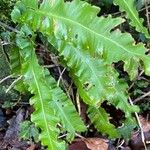
Asplenium scolopendrium
سرخس آشیانه پرنده · Hart's-tongue Fern · Hart's-tongue · Hart's tonguefern · Hartstonque
Description
Source: leafsnapAsplenium scolopendrium, commonly known as the Hart's tongue fern, is a species of fern native to Europe and parts of Asia. This perennial plant grows up to 60 cm in height and features long, narrow fronds that are glossy green. The fronds are undivided and have a distinctive tongue-like shape with wavy edges. Hart's tongue fern thrives in shady areas with moist soil, such as woodlands or rocky regions. It can also grow on walls or rocks where there is sufficient moisture. For centuries, Asplenium scolopendrium has been used for its medicinal properties, particularly its anti-inflammatory effects. Ancient cultures also believed it possessed magical properties and incorporated it into various rituals. This plant can be grown both indoors and outdoors as long as it receives adequate moisture and shade. It requires minimal care but should be protected from direct sunlight, which can damage its leaves. Overall, Asplenium scolopendrium is an attractive fern species with unique foliage that adds interest to any garden or indoor space. It also offers potential health benefits due to its medicinal properties.
🌳 Commonly used to beautify parks and homes, the bird's-nest fern also has a little-known but practical role. In Asia, gardeners and farmers use the fern's fronds, which collect and retain nutrients. As the fronds decompose, they become an effective natural fertilizer, helping recycle nutrients and preserve soil in agriculture.
🎭 Sleek and graceful, aromatic and always green
Care Guide
💧 Water Every 7 days
Hart's-tongue fern, which comes from humid woodlands, thrives in consistently moist soil and high humidity. For optimal growth, it should be watered regularly, about twice a week. While moderately drought-tolerant, this fern is usually grown indoors, where it benefits from shade to promote lush foliage and vitality.
What do I do if I give my Hart's-tongue fern too much or too little water?
The Hart's-tongue fern can be overwatered if it is left sitting in water or in a planter without drainage holes. This will make the roots unable to absorb nutrients and moisture and can lead to fungal or bacterial diseases. Signs of overwatering include wilted and yellow leaves, drooping or soft stems. However, it's important to check for other causes as well since it's hard to give this plant too much water. On the other hand, the Hart's-tongue fern can also become underwatered if not monitored closely. In dry conditions, it can quickly turn brown and crispy. In extreme cases, it may seem completely dry, but if some roots are still healthy, the plant can be saved. To save it, cut off dry and dead stems, water thoroughly, and return it to its usual location. The plant can recover and grow back to its previous size with proper care over several months.
How should I properly water my Hart's-tongue fern?
To keep your Hart's-tongue fern happy, it is important to maintain consistently moist soil resembling its natural environment. This may require watering every one or two days. Remember, this plant should never be allowed to dry out. When the top layer of soil starts to feel even slightly dry, it's a sign to water again. However, it's not enough to simply give it a few drops of water. Instead, thoroughly soak the soil until water drains out from the bottom of the pot. Afterward, make sure to discard the excess water to prevent the pot from sitting in a puddle. This method is crucial to ensure that the soil remains adequately moist at all times.
What should I think about when watering my Hart's-tongue fern?
The humidity levels in the air affect how often you should water your Hart's-tongue fern. Higher humidity means less frequent watering because evaporation is slower. Avoid placing the plant near heating or cooling vents, as this can cause it to dry out quickly. It is best to choose a location that is protected from drafts. These ferns prefer dappled and indirect sunlight with temperatures between 55-80 degrees F (13-27 degrees C). Placing them in a warm and sunny spot on a windowsill can lead to quick dehydration. Rainwater or distilled water is ideal for this plant, but tap water in most places will also work fine. Tap water may contain minerals and chemicals that can cause brown leaf tips, especially since Hart's-tongue fern has delicate leaves. Small pots can be problematic for this plant as they dry out more quickly due to their limited potting medium. It is recommended to give these ferns more space in the pot compared to other houseplants. You may want to consider using a self-watering planter for your Hart's-tongue fern. This type of pot has a wicking system that allows the soil to continually absorb water from a central reservoir. This helps maintain a consistent moisture level in the soil. Not only does this pot save you from constantly watering the fern, but it also provides a steady supply of water to the roots, which is beneficial compared to alternating between dry and wet conditions.
☀️ Light Full shade
The bird's-nest fern does best in areas with only low light, reflecting its origin on the forest floor. It can also tolerate locations that get a bit of sun. However, strong light can harm the plant, causing fronds to become pale or scorched. Maintaining steady light conditions through its different growth stages supports the best development.
What are the sunlight requirements for Hart's-tongue fern?
Hart's-tongue fern thrives in environments that offer modest light exposure. It can grow well in areas with less intense sunlight, showcasing its adaptable nature. The plant prefers dappled light conditions, similar to its native habitat, which helps prevent issues like leaf scorch from too much light and poor growth or dull foliage from insufficient light. Remember, the positioning of your garden and the movement of sunlight plays a crucial role in ensuring your plants receive the right balance of light and shade for optimal growth.
How can I use artificial lighting for indoor plants?
When natural sunlight is not enough for indoor plants, especially during winter or in less sunny locations, artificial lighting becomes critical for maintaining optimal growth. LED lights are highly recommended for their ability to provide specific wavelengths needed by plants. Full sun plants require 30-50 watts per square foot, partial sun plants need 20-30 watts per square foot, while full shade plants need 10-20 watts per square foot of artificial light. The light source should be placed 12-36 inches above the plant to simulate natural sunlight, and most plants will benefit from 8-12 hours of light per day.
What symptoms indicate poor lighting conditions for Hart's-tongue fern?
Hart's-tongue fern may show several symptoms if it's not receiving adequate light. Slower or halted growth indicates the plant is in survival mode due to insufficient light. Chlorosis, or the yellowing of leaves, occurs when the plant suffers from excessive light, affecting its photosynthesis. Sunscald, leaf curling, wilting, and leaf scorching are other symptoms that can arise from improper lighting, each affecting the plant's health in different ways. Leaf curling and wilting are defense mechanisms against extreme sunlight, while sunscald and leaf scorching indicate direct damage from intense light exposure.
What are the solutions for poor lighting conditions for Hart's-tongue fern?
Addressing poor lighting conditions for Hart's-tongue fern involves several strategies. Indoors, gradually increasing sunlight exposure or using artificial light can improve the situation. For outdoor plants, moving them to sunnier spots gradually helps them adapt without the risk of sunburn. It's important to note that parts of the plant damaged by insufficient light may not recover, but new growth should be healthy with improved lighting. Reducing obstructions, like pruning trees, or transplanting smaller plants to sunnier locations are other effective solutions for plants on the ground.
🌡️ Temperature 20–37.8°C
Bird's-nest fern thrives in temperatures of 68 to 100 ℉ (20 to 38 ℃) and comes from tropical regions with high humidity and warm climates. To cope with colder seasons, this plant can tolerate slightly lower temperatures of 60 to 65 ℉ (15.5 to 18.3 ℃) provided watering and humidity are reduced.
What is the optimal growing temperature for Hart's-tongue fern?
Hart's-tongue fern, also known by its botanical name Asplenium scolopendrium, thrives in woodland habitats that provide cool temperatures ranging from 5 to 35°C (41-95°F). The optimal temperature for its growth is around 15°C (59°F) during the growing season. Although it can tolerate occasional frosts during winter, extra care, such as shading or misting, is required during hotter months to prevent heat stress.
How does Hart's-tongue fern handle frost and winter conditions?
Hart's-tongue fern exhibits strong cold resistance, and special frost protection measures are generally not necessary. However, if temperatures are expected to plummet below -25°C, it's crucial to safeguard the plant by covering it with soil or straw to provide cold protection. To prepare for winter, it's advisable to water the plant thoroughly before the first freeze in autumn, helping the soil to stay moist and freeze, which in turn prevents drought and water scarcity during the cold months.
What should be done if Hart's-tongue fern is exposed to temperatures below -20°C or above 35°C?
For low temperatures below -20°C, Hart's-tongue fern can typically withstand the cold but should ideally be kept above -20°C. If temperatures drop below -25°C, you may not notice immediate damage, but the plant could experience a decline in sprouting or fail to sprout at all in spring. In such cases, removing the unsprouted parts in spring is recommended. For high temperatures exceeding 35°C, take caution as the leaves can become lighter, curl, or suffer from sunburn if temperatures hit above 38°C. It's advisable to trim away any sunburned or dried parts, provide shade during the midday and afternoon sun or use a shade cloth, and ensure the plant is watered in the morning and evening to keep the soil moist.
💨 Humidity normal (40-60%)
This plant will thrive in moderate humidity, which is probably the level in your home. However, misting it a few times a week can be very beneficial. Make sure the room has good ventilation.
🪴 Soil 5-7
🌱 Fertilizer
To care for hart's-tongue fern, apply a high-nitrogen fertilizer at half strength every two months during the growing season. Make sure the soil remains damp to prevent root burn. Stop fertilizing in the winter to allow the plant to go dormant. This balanced approach helps maintain the fern's health and vibrancy while preventing weak growth caused by over-fertilization.
Why should I put fertilizer on my Hart's-tongue fern?
Fertilizing Hart's-tongue fern is important for a few reasons. First, it provides the necessary nutrients for your plant to grow strong and healthy. Additionally, the extra nutrients help protect your plant from diseases and pests, benefiting both the old and new growth.
When should I fertilize my Hart's-tongue fern?
The feeding schedule of Hart's-tongue fern depends on its location. This plant doesn't need a lot of food, but it does require some additional nutrients. If it's an outdoor plant, it needs to be fertilized once in the spring. On the other hand, if it's an indoor plant, it needs to be fed monthly, starting in the spring and continuing throughout the summer.
When should I not put fertilizer on my Hart's-tongue fern?
To avoid excessive growth before winter, do not fertilize the Hart's-tongue fern after early autumn. In hot and dry times of year, avoid fertilizing the fern as dry soil is not as effective in delivering fertilizer. Fertilizing during this time can also stimulate growth that requires more water, which may not be readily available. It's advisable to apply fertilizer earlier in the season when temperatures are cooler. Additionally, take caution not to inadvertently give the fern a double-dose of fertilizer as it can absorb fertilizer from neighboring plants or lawns.
What kind of plant food does my Hart's-tongue fern need?
When deciding on a fertilizer for Hart's-tongue fern, consider the options based on whether the plant is grown indoors or outdoors. For outdoor plants, using a layer of mulch or compost will greatly benefit their growth. On the other hand, indoor plants will benefit from a fertilizer with an N-P-K ratio of 3-1-2. In certain situations, a general-purpose fertilizer with a balanced blend of nutrients can also be effective. However, it is important to ensure that the ratio number representing the volume of each nutrient is 3 or lower, even when using a balanced fertilizer.
How do I make my Hart's-tongue fern grow better?
Fertilizing Hart's-tongue fern depends on the plant's location. For outdoor garden plants, adding a layer of mulch or compost around the base of the plant works best. As for indoor plants, a diluted liquid fertilizer can be applied before watering, monthly during the spring and summer to help them thrive.
🪴 Pot & Repot 2-3 years
When repotting Bird's-nest fern, select a pot 1–2 inches (2.5–5.1 cm) larger with ample drainage. Use a well-draining potting mix. Repot in spring or fall, making sure the root ball sits slightly below the rim of the flower pot. Water thoroughly after repotting and place it in a warm spot with indirect sunlight.
✂️ Pruning
The Hart's-tongue fern has glossy, undivided fronds and requires very little pruning. In early spring, trim any damaged fronds to promote healthy growth. Removing debris is also important to prevent fungal problems. Avoid heavy pruning to reduce the risk of stress on the plant. Always use sharp tools for maintenance to keep your Hart's-tongue fern healthy and attractive.
🌿 Propagating
🐛 Diseases & pets
☠️ Toxicity
May be toxic to animals and humans. Plants should not be consumed.
Characteristics
- Plant Type
- Fern
- Life Cycle
- Perennial
- Genus
- Asplenium
- Family
- Aspleniaceae
- Hardiness Zone
- 9-12
- Mature Height
- 49 cm to 91 cm
- Mature Spread
- 49 cm to 91 cm
- Leaf Color
- Green
- Leaf Type
- Evergreen
- Planting Time
- Spring, Summer, Autumn, Winter
- Native Area
- Sri Lanka, Malaysia, Indonesia, Vietnam, Japan, Vanuatu, Philippines, Singapore, Bangladesh, Laos, Fiji, Thailand, China