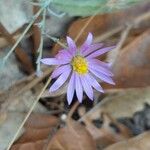
Aster laevis
Aster lisse · Glaucous Michaelmas-daisy · Michaelmas Daisy · Smooth aster · Delicate michaelmas daisy
Description
Source: wikipedia (CC BY-SA)Symphyotrichum laeve is a flowering plant native to Canada, the United States, and Coahuila (Mexico). It has the common names of smooth blue aster, smooth aster, smooth-leaved aster, glaucous Michaelmas-daisy and glaucous aster.
🌳 The bright, delicate blossoms of the New York aster can serve as bioindicators for certain soil metals, including zinc, copper, and lead. Their presence frequently signals elevated concentrations of these metals, which can aid bioremediation studies and ecological assessments.
🎭 Lively, tell an untruth
Care Guide
💧 Water
☀️ Light Full sun
The New York aster thrives best in an environment rich in sunlight for optimal growth. Its natural habitat has conditioned it to absorb substantial amounts of sun, however, it can also do well in places with moderate sunlight exposure. Its growth can be adversely impacted by either too little or excessive exposure to sunlight.
🌡️ Temperature 5–32.2°C
The New York aster flourishes best in its natural habitat with temperature ranges between 41 and 86℉ (5 to 30℃). Its comfort zone is typically between 41 to 90 ℉(5 to 32 ℃). In hotter seasons, continuous soil hydration is necessary to manage temperature fluctuations. During chillier seasons, the plant can withstand brief spells of freezing temperatures, but it is crucial to protect it from extended exposure to cold winds.
💨 Humidity
🪴 Soil 5-7
🌱 Fertilizer
Typically, a one-time application of fertilizer in the spring is enough for New York aster. However, if you want to optimize its growth, it is advisable to fertilize it once every 30 to 45 days. Fertilization not only improves the look and function of the leaves by maintaining consistent color and healthy texture, but it also encourages root development and nutrient uptake, fostering the overall well-being of the plant in the long run.
🪴 Pot & Repot 2-3 years
When repotting New york aster, select a pot 1–2 inches (2.5–5.1 cm) larger with ample drainage. Use a well-draining potting mix. Repot in spring or fall, making sure the root ball is slightly lower than the rim of the flower pot. Water thoroughly after repotting and place in a warm spot with indirect sunlight.
✂️ Pruning
🌿 Propagating
🐛 Diseases & pets
☠️ Toxicity
Characteristics
- Plant Type
- Herb
- Life Cycle
- Perennial
- Genus
- Aster
- Family
- Asteraceae
- Hardiness Zone
- 4-8
- Mature Height
- 49 cm to 91 cm
- Mature Spread
- 30 cm to 40 cm
- Leaf Color
- Green
- Leaf Type
- Deciduous
- Flower Color
- Purple, Lavender, White
- Flower Size
- 7.62 cm
- Bloom Time
- Mid summer, Late summer, Early fall
- Planting Time
- Spring, Summer
- Harvest Time
- Fall