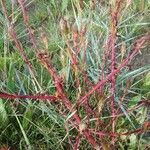
Aster tripolium
Sea Aster · Seashore aster · Tripoli aster
Description
Source: leafsnapTripolium pannonicum, called sea aster or seashore aster and often known by the synonyms Aster tripolium or Aster pannonicus, is a flowering plant, native to Eurasia and northern Africa, that is confined in its distribution to salt marshes, estuaries and occasionally to inland salt works. It is a perennial growing up to 50 cm tall with fleshy lanceolate leaves and purple ray florets flowering from July to September. The plants tend to be short-lived and populations need significant new recruitment each year from new seedlings. There are rayed as well as rayless varieties and only the former have long blue or white florets. The rayless form is yellow. The plant flowers well into autumn and hence provides a valuable source of nectar for late-flying butterflies such as painted lady and red admiral. Young leaves of this plant are edible and are collected for consumption on the floodplains of the Dutch province of Zeeland. The leaves are typically sauteed in butter and consumed as a vegetable.
Care Guide
💧 Water
☀️ Light Full sun
Seashore Aster does best in places that get full-day sunshine, which supports healthy growth. This requirement for sunlight remains the same at every stage of its development. Coming from coastal habitats, the plant is accustomed to plentiful light. Too little sun can hinder its growth, while too much is not harmful.
🌡️ Temperature 5–35°C
Seashore Aster is adapted to conditions resembling its native habitat, favoring temperatures from 32 to 70 °F (0 to 21 °C). Seasonal adjustments in temperature benefit its development.
💨 Humidity
🪴 Soil 6-7
🌱 Fertilizer
Early spring, when the Seashore Aster is coming out of dormancy and beginning active growth, is the best time to fertilize. Fertilizing supplies essential nutrients for healthy growth. Although the Seashore Aster has fairly low fertilizer requirements, applying fertilizer annually can improve its survival and encourage better, longer-lasting flowers.
🪴 Pot & Repot
✂️ Pruning
🌿 Propagating
🐛 Diseases & pets
☠️ Toxicity
Characteristics
- Plant Type
- Herb
- Life Cycle
- Perennial
- Genus
- Aster
- Family
- Asteraceae
- Hardiness Zone
- 2
- Mature Height
- 10 cm to 61 cm
- Mature Spread
- 20 cm to 40 cm
- Leaf Color
- Green
- Leaf Type
- Deciduous
- Flower Color
- Lavender
- Flower Size
- 1.52 cm to 2.54 cm
- Bloom Time
- Mid summer, Late summer, Early fall
- Planting Time
- Spring, Summer, Autumn
- Harvest Time
- Early fall, Mid fall
- Native Area
- Turkey, Sweden, Austria, Slovakia, Slovenia, Croatia, Uzbekistan, Russia, Iraq, Germany, Estonia, Koppen, Romania, Latvia, South Korea, Belgium, Moldova, Portugal, Netherlands, France, Tajikistan, Tunisia, Czech Republic, Bulgaria, Poland, Greece, Ukraine, Serbia, China, Lithuania, Norway, Kyrgyzstan, Kazakhstan, Italy, Spain, Denmark, Japan, Mongolia, Finland, Iran, Albania, Ireland, United Kingdom, Hungary, Algeria, Azerbaijan, Turkmenistan