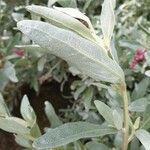
Atriplex cinerea
Grey saltbush · Coast saltbush · Gray saltbush
Description
Source: leafsnapAtriplex cinerea, commonly known as Gray Saltbush, is a perennial shrub belonging to the family Amaranthaceae. This plant is native to the western regions of North America and can be found in arid and semi-arid habitats such as deserts, grasslands, and sagebrush areas. The plant features a woody stem that can grow up to 3 meters tall and has numerous branches. Its leaves are small and grayish-green with a thick waxy coating that aids in moisture retention under dry conditions. The flowers are small and inconspicuous, lacking petals and sepals. Gray Saltbush is an important plant for wildlife, providing food for various herbivores including deer, rabbits, rodents, and birds. Additionally, it has medicinal properties and was traditionally used by Native Americans to treat various ailments such as diarrhea. The plant is well adapted to harsh environments due to its ability to tolerate high levels of salt in the soil. This makes it an ideal candidate for soil conservation efforts on degraded lands. Overall, Atriplex cinerea is an ecologically and economically important species. Its unique adaptations make it well-suited for arid environments, while it also offers benefits through its medicinal properties and its role in conservation efforts on degraded lands where other plants may struggle to thrive without additional support measures.
Care Guide
💧 Water Every 7 days
☀️ Light Full sun
Grey saltbush is native to open habitats, such as sunlit meadows and forest margins, which offer plenty of light. It prefers Full Sun but can also tolerate Partial Sun, adapting well to different light conditions.
🌡️ Temperature 15–37.8°C
Grey saltbush is highly adaptable to a range of climate conditions, from scorching summers to cold winters. Nonetheless, it has a preferred temperature range for healthy growth. If temperatures become too high, the plant is vulnerable to heat and humidity stress, which can lead to its death. In areas where temperatures approach the lower limit of its cold tolerance, it is essential to provide insulation to protect the plant.
💨 Humidity
🪴 Soil 6-8
🌱 Fertilizer
To encourage healthy growth, fertilize your Grey saltbush in early spring. Regular feeding boosts the plant’s overall health, producing vigorous growth, better tolerance of harsh conditions, and enhanced resistance to pests and diseases. Keep to a consistent fertilization schedule for your Grey saltbush to maintain foliage that is vibrant, deeply colored, and lush.
🪴 Pot & Repot
✂️ Pruning
The grey saltbush is a hardy shrub with silvery leaves that thrives in coastal areas. To keep it healthy and well-shaped, prune it in early spring. Remove any dead or overcrowded branches, and cut back the plant by one-third. This encourages denser growth and helps maintain its shape. Regular pruning enhances the shrub's vitality and prevents it from becoming too leggy.
🌿 Propagating
🐛 Diseases & pets
☠️ Toxicity
Characteristics
- Plant Type
- Shrub
- Life Cycle
- Perennial
- Genus
- Atriplex
- Family
- Amaranthaceae
- Hardiness Zone
- 8-11
- Mature Height
- 0.49 m to 1.52 m
- Mature Spread
- 0.91 m to 2.13 m
- Leaf Color
- Silver, Gray
- Leaf Type
- Evergreen
- Flower Size
- 0.20 cm to 0.25 cm
- Bloom Time
- Winter
- Planting Time
- Spring, Summer
- Harvest Time
- Late winter, Early spring, Mid spring
- Native Area
- Namibia, Lesotho, New Zealand