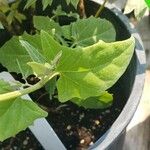
Atriplex prostrata
Fat-hen · Spear-leaved Orache · Thin-leaf orach · Spear-leaf orache · Spear-scale
Description
Source: leafsnapAtriplex prostrata, commonly known as creeping saltbush, is a low-growing shrub that belongs to the Amaranthaceae family. Native to Australia, it thrives in various habitats such as coastal dunes, salt marshes, and rocky outcrops. This plant features a prostrate growth habit with stems that can extend up to 1 meter in length. Its small, succulent leaves are grey-green, a coloration that aids in water conservation in arid environments. The flowers are small and inconspicuous, with a greenish-yellow hue. Atriplex prostrata is significant for soil conservation due to its deep roots, which help stabilize soil on slopes and areas prone to erosion. It also plays a vital role in coastal ecosystems by providing habitat for various animals, including birds and insects. Traditionally, Indigenous Australians have used Atriplex prostrata for medicinal purposes, such as treating skin conditions and respiratory problems. Overall, Atriplex prostrata is an adaptable plant species that plays an essential ecological role while also holding cultural significance within Indigenous Australian communities.
🌳 Although it appears unremarkable, triangle Orache functions as an unexpected bioindicator, showing the salt level of the soil where it grows. This trait makes it useful to agronomists and environmental scientists who wish to evaluate and manage saline soils in various environments, providing a natural indicator of salt concentrations that often harm other crops.
Care Guide
💧 Water Every 7 days
Triangle Orache thrives in coastal, saline environments, where it can tolerate salt spray and needs consistent moisture without becoming waterlogged. To support its growth, it requires weekly watering and well-draining soil that retains moisture, mimicking its natural seaside habitat. Usually grown outdoors, Triangle Orache is resilient to various environmental stresses.
How should I water my Triangle Orache plant to make sure it gets enough water?
To water Triangle Orache, there are various options you can choose from. You can use a garden hose with a spray nozzle, a watering can, or any other common watering tool. This plant is not too particular about the type of water it receives, as it can survive on rainwater, tap water, or filtered water. However, it's best to avoid watering it from overhead, as this can harm the leaves and flowers and potentially cause disease. A good method for watering Triangle Orache is to set up a drip irrigation system, which delivers water evenly and directly to the soil. If you have a container-grown Triangle Orache, you can follow a similar approach but use a cup, watering can, or tap to directly water the soil.
What do I need to do if I give my Triangle Orache plant too much or too little water?
To prevent underwatering Triangle Orache, water it regularly when you notice it lacks moisture. Overwatering, however, can be more serious. It can lead to diseases and the decline of your plant. To avoid this, choose a sunny location with good drainage. If your Triangle Orache is in a pot, consider transferring it to a new pot with better drainage. Use loose soil and a pot that drains efficiently.
How often should I water my Triangle Orache plant?
Triangle Orache needs regular watering throughout the growing season. In spring, water once a week. As the weather gets warmer, increase watering to two to three times a week. However, be careful not to exceed this rate as it can harm the plant. Regardless of watering frequency, make sure the soil remains moist but not wet. Watering a potted Triangle Orache is different. Potted soil can dry out faster, so increase watering frequency to a few times per week. In contrast, an in-ground plant only needs watering once per week.
How much water does my Triangle Orache plant need?
There are a few ways to decide how much water your Triangle Orache needs. Some gardeners prefer to feel the soil to gauge its moisture level. They suggest watering until the top six inches of soil feel moist. Another option is to use a specific measurement. Typically, Triangle Orache requires about two gallons of water per week depending on temperature and soil dryness. However, sticking strictly to this guideline can cause overwatering if your plant needs less. When growing Triangle Orache in a container, a different approach is needed. You should water enough to moisten all dry soil layers. You can check this by feeling the soil with your finger or observing water draining from the pot's holes.
How can I know if I'm giving enough water to my Triangle Orache plant?
Avoiding overwatering Triangle Orache can be tricky. These plants have deep roots that need weekly soil moisture, but they are also highly susceptible to root rot. Overwatering can cause browning and other issues for your Triangle Orache. Underwatering is less of a concern as these plants can survive without regular watering, but neglecting water for too long can lead to wilting and dry leaves.
☀️ Light Full sun
Triangle Orache prefers full sun exposure for healthy growth. Not getting enough sun leads to weak growth, while too much can cause scorching. Its native habitat receives abundant sunlight, indicating this preference. The plant’s light requirements remain the same throughout all growth stages.
What are the sunlight requirements for Triangle Orache?
Triangle Orache requires above 6 hours of sunlight daily to maintain healthy growth. It thrives in full sun, which is a testament to its origins in environments with extensive exposure to sunlight. The plant's needs for sunlight remain consistent throughout its growth stages. When selecting a location for Triangle Orache in your garden, observe the movement of sunlight throughout the day to ensure that the plant will receive a balance of light and shade optimal for its growth.
How can artificial lighting support Triangle Orache growth indoors?
When natural sunlight is insufficient, especially during winter or in less sunny spaces, artificial lighting can be a critical solution for the growth of Triangle Orache indoors. LED lights are recommended due to their customizable wavelengths, which cater to the plant's specific light needs. For plants that require full sun, 30-50W per square foot of artificial light is needed. The light source should be placed 12-36 inches above the plants to mimic natural sunlight, and the plants should be exposed to artificial light for 8-12 hours per day to simulate the length of natural daylight hours.
What are common symptoms of inadequate sunlight in Triangle Orache?
Common symptoms of inadequate sunlight in Triangle Orache include smaller new leaves, leggy or sparse growth, faster leaf drop, slower or halted growth, lighter-colored new leaves, chlorosis (yellowing leaves), sunscald, leaf curling, wilting, and leaf scorching. These symptoms can result from both too little and too much sunlight exposure, indicating the need for a balanced lighting environment for optimal plant health.
How can I address sunlight issues with indoor and outdoor Triangle Orache plants?
For indoor Triangle Orache plants, gradually move them to sunnier locations each week until they receive at least 6 hours of direct sunlight daily. Use south-facing windows for natural light and consider supplementing with artificial light if necessary. For outdoor plants, also gradually move them to sunnier spots while avoiding sudden changes to prevent sunburn. If plants are obstructed by shade, consider pruning or transplanting to reduce obstructions and provide ample sunlight. Note that parts of the plant affected by previous poor light conditions may not recover, but new growth should be healthy with improved light exposure.
🌡️ Temperature 10–25°C
Triangle Orache is native to temperate regions and thrives at temperatures between 68 and 95°F (20 to 35°C). Its growth can be stunted in colder climates. During the height of summer or winter, adjusting temperatures accordingly can best support its health.
What is Triangle Orache and where does it thrive?
Triangle Orache, also known by its botanical name Atriplex prostrata, is native to temperate environments and thrives in temperatures ranging from 68 to 95°F (20 to 35°C). This plant is suited for growth in regions that maintain these temperate conditions and may experience stunted growth in colder climates. However, it is highly cold-tolerant and does not generally require additional frost protection measures during winter.
How should Triangle Orache be cared for in winter?
Despite its high cold tolerance, it is recommended to water Triangle Orache generously before the first freeze in autumn to ensure that the soil remains moist and enters a frozen state. This precaution helps to prevent drought and water scarcity for the plant during the winter and early spring months, supporting its health throughout the colder season.
What should be done if the temperature falls below -25°C for Triangle Orache?
Triangle Orache is extremely cold-tolerant, but it's important to maintain winter temperatures above -25°C. If temperatures drop below this threshold, the plant may not show noticeable changes during the winter, but there could be a decrease in sprouting or a complete lack of sprouting in spring. In this case, remove any parts of the plant that have failed to sprout in the spring.
How does high temperature affect Triangle Orache and what are the solutions?
Triangle Orache is not tolerant of high temperatures. When temperatures exceed 35°C, its growth will stop, and the plant becomes more susceptible to rot. To mitigate these effects, trim away any sunburned and dried-up parts of the plant. Moving the plant to a shaded location or using a shade cloth can protect it from the midday and afternoon sun. Additionally, watering the plant in the morning and evening can help keep the soil moist, further supporting the plant's health in high temperatures.
💨 Humidity
🪴 Soil 6-8
🌱 Fertilizer
Triangle Orache benefits from frequent, weak fertilizer applications to encourage healthy leaf growth. You should apply fertilizer to Triangle Orache about once a month during the summer. Nitrogen is essential for foliage, and supplementing with nitrogen-rich sources helps Triangle Orache thrive.
🪴 Pot & Repot
✂️ Pruning
🌿 Propagating
🐛 Diseases & pets
☠️ Toxicity
Characteristics
- Plant Type
- Herb
- Life Cycle
- Annual, Perennial
- Genus
- Atriplex
- Family
- Amaranthaceae
- Hardiness Zone
- 6
- Mature Height
- 10 cm to 61 cm
- Mature Spread
- 76 cm
- Leaf Color
- Green, Light Green
- Leaf Type
- Semi-evergreen
- Flower Color
- Green
- Flower Size
- 0.10 cm
- Bloom Time
- Early summer, Mid summer
- Planting Time
- Spring, Summer
- Harvest Time
- Mid summer, Late summer
- Native Area
- Egypt, Turkey, Sweden, Austria, Morocco, Belarus, Uzbekistan, Russia, Germany, Ethiopia, Romania, Belgium, Netherlands, Portugal, France, Tunisia, Cyprus, Bulgaria, Poland, Greece, Ukraine, China, Norway, Italy, Kazakhstan, Spain, Switzerland, Denmark, Finland, Israel, Albania, Ireland, United Kingdom, Hungary, Algeria, Turkmenistan