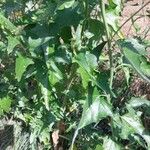
Atriplex sagittata
Hoary orache · Purple Orache · Glossy-leaved orache
Description
Source: leafsnapAtriplex sagittata, commonly known as arrowleaf saltbush, is a perennial shrub belonging to the family Amaranthaceae. Native to western North America, this plant thrives in arid and semi-arid regions such as deserts, grasslands, and sagebrush habitats. The shrub can grow up to 3 feet tall with a spread of 4 to 6 feet. Its silvery-green leaves are arrow-shaped with toothed edges and are covered in fine hairs that help the plant retain moisture under dry conditions. Arrowleaf saltbush is an important resource for wildlife, offering food and shelter to various animals, including deer, rabbits, birds, and insects. Additionally, its seeds are edible for humans. Traditionally, Native Americans have used arrowleaf saltbush for medicinal purposes, particularly for treating diarrhea and stomach ailments. The plant is also utilized in land restoration projects due to its ability to withstand harsh environmental conditions, including drought and poor soil quality. Overall, Atriplex sagittata plays a significant ecological role by providing essential food sources for wildlife and contributing to land restoration efforts through its resilience in challenging environments.
Care Guide
💧 Water Every 7 days
Purple orache thrives with a moderate watering routine. It benefits from being watered weekly, being careful to avoid oversaturation. Since it originates from regions with varying moisture levels, it adapts well to temperate climates that have distinct wet and dry seasons, enduring both rain and dry spells effectively.
☀️ Light Full sun
Purple orache comes from areas with plentiful sunlight, such as open fields and sunlit meadows. It prefers full sun but can also tolerate partial sun.
🌡️ Temperature 5–35°C
Purple orache does best in moderate temperatures, similar to the range most people find comfortable. It favors conditions that are neither overly hot nor overly cold. The main problem with high temperatures is the chance of sunburn, so providing some shade in summer is advisable to prevent excessive heat. When temperatures fall, Purple orache becomes dormant. If you want it to keep growing, you need to keep temperatures higher during winter. Frost can damage the plant and should be avoided.
💨 Humidity
🪴 Soil 6-7
🌱 Fertilizer
To maximize Purple orache's yield and flavor, provide adequate nitrogen throughout the entire growth period, from pre-planting through harvest. Plants that are well-watered and fertilized develop abundant, healthy leaves and have less bitterness. Before planting, improve the soil with organic matter such as compost or manure, ideally 2 to 8 weeks ahead.
🪴 Pot & Repot
✂️ Pruning
To ensure healthy growth and prevent legginess, prune purple orache from early to late spring. Remove any dead stems and thin out congested areas to improve air circulation. Use sharp, clean tools for pruning, and make your cuts just above a node to encourage robust new growth and enhance the plant's shape.
🌿 Propagating
🐛 Diseases & pets
☠️ Toxicity
Characteristics
- Plant Type
- Herb
- Life Cycle
- Perennial
- Genus
- Atriplex
- Family
- Amaranthaceae
- Hardiness Zone
- 5-9
- Mature Height
- 0.3 m to 1.52 m
- Mature Spread
- 20 cm to 61 cm
- Leaf Color
- Light Green, Gray
- Leaf Type
- Semi-evergreen
- Flower Size
- 0.20 cm to 0.25 cm
- Bloom Time
- Mid summer, Late summer, Early fall
- Planting Time
- Spring, Summer, Autumn
- Harvest Time
- Fall
- Native Area
- Tajikistan, Turkey, India, Austria, Czech Republic, Slovakia, Bulgaria, Armenia, Poland, Greece, Croatia, Belarus, Ukraine, Uzbekistan, Russia, Lithuania, Hungary, Iraq, Germany, Italy, Kazakhstan, Estonia, Israel, Iran, Azerbaijan, Romania, Latvia, Turkmenistan