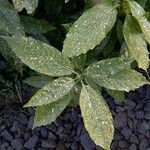
Aucuba japonica
آکوبا · شمشاد ژاپنی آکوبا، · Japanese Aucuba · Spotted-laurel · Gold Dust
Description
Source: leafsnapAucuba japonica, commonly known as the Japanese Aucuba or Gold Dust Plant, is a popular evergreen shrub native to Japan and East Asia. This slow-growing plant can reach up to 10 feet in height and 6 feet in width. Its glossy, leathery leaves are dark green with yellow spots or speckles and are oval-shaped, growing up to 8 inches long. In the spring, Aucuba japonica produces small clusters of purple flowers, which are followed by bright red berries in the fall. Note that these berries are toxic if ingested by humans or pets. The plant thrives best in partial shade with well-draining soil that is consistently moist but not waterlogged. While it can tolerate a range of soil types, it prefers slightly acidic conditions. Aucuba japonica serves many purposes, especially as an ornamental shrub for landscaping due to its attractive foliage and its ability to thrive in shaded areas. It also has a history of medicinal use, such as treating rheumatism and other ailments due to its anti-inflammatory properties. Overall, Aucuba japonica is an appealing evergreen shrub with unique foliage patterns, making it a popular choice for gardens in many regions. It thrives under partial shade with consistent moisture levels, provided through regular watering during dry periods from spring through fall. It grows well when temperatures are warm enough for growth without the risk of frost damage during winter months. Local climate factors, such as latitude and elevation, can affect its growing conditions, and these variations are well-documented through scientific studies on climate change.
💡 Japanese laurel is a popular garden plant because it is easy to care for and offers a wide variety of interesting cultivars. Some variants feature leaves with light speckling, while others display more yellow than green.
🌳 Spotted laurel, also known as Japanese laurel, has leaves that, when turned into a viscous ink, are favored by wordsmiths. This leaf-derived ink is uncommon among plants and is prized by artisans for use in refined calligraphy and art, delighting art enthusiasts worldwide.
🎭 Cleanliness, renewal, plenty, hardiness
Care Guide
💧 Water Every 7 days
Japanese laurel, which originates from the forests of East Asia, thrives in humid environments but is also tolerant of drought. It should be watered every 1-2 weeks, ensuring the soil remains moderately damp. This plant is ideal for both shaded outdoor areas and indoor settings, as it retains its foliage throughout the year and efficiently manages water during seasonal changes.
When should I water my Japanese Laurel?
Timely and appropriate watering is crucial for the health and growth of Japanese Laurel. The key indicators to water this plant include the top layer of soil appearing dry and crumbly, drooping or wilting leaves, color changes in leaves to yellow or gold, slow growth or dropped leaves, and understanding the balance between early or late watering to avoid underwatering or overwatering consequences, both of which can harm the plant's health.
How should I water my Japanese Laurel?
Japanese Laurel thrives with consistent moisture but dislikes being overly watered. The best practice involves using a watering can with a long, thin spout to direct water at the base, avoiding foliage to prevent fungal diseases. Employing a moisture meter can help ensure the soil is kept at an optimal moisture level without becoming too dry or overly moist. It's crucial to water slowly and evenly at the root zone while avoiding quick watering that can lead to runoff or uneven soil moisture.
How much water does Japanese Laurel really need?
The amount of water required by Japanese Laurel varies with the plant size, pot size, and root depth. Typically, 250-500 milliliters of water per session might suffice for small pots, while larger or mature plants might require around 1-2 liters. Signs of proper hydration include glossy, dark green leaves and firm, upright stems. Overwatering and underwatering can both cause adverse effects such as root rot or stressed plants, suggesting the importance of balanced watering and good drainage practices.
What kind of water is best for Japanese Laurel?
Rainwater is the ideal water type for Japanese Laurel due to its pH and mineral content, though filtered and dechlorinated tap water can serve as substitutes. Constant use of alkaline tap water can slow growth and cause leaf yellowing. To mitigate risks associated with chlorine or fluoride in tap water, letting it sit out for 24 hours before use can help. Additionally, water temperature should be maintained at room temperature to avoid shocking the plant's roots.
How do Japanese Laurel's watering needs change with the seasons?
Watering needs for Japanese Laurel vary with the seasons. In spring, increased water supports new growth. Summer demands consistent soil moisture due to higher evaporation rates, though overwatering should be avoided. Autumn brings cooler weather, decreasing the plant's water requirements, and in winter, during dormancy, minimal watering is needed, with a focus on avoiding soggy conditions and root damage. Monitoring direct moisture levels before watering is advisable across all seasons.
☀️ Light Full shade
Spotted laurel does best beneath the canopy of taller trees, protected from intense sunlight. It flourishes in places that imitate its native setting where light is diffused. Limited sun exposure boosts its vigor, while excessive sun can produce signs of burning.
What are the sunlight requirements for Japanese laurel?
Japanese laurel requires careful attention to sunlight exposure. For full shade areas, less than 3 hours of sunlight is enough, while partial sun areas should receive about 3-6 hours of sunlight. It's crucial to observe how sunlight moves through your garden to ensure plants are placed in locations that provide a balance of light and shade. This will contribute to the overall happiness and health of your Japanese laurel. The plant thrives best under the canopy of taller trees, shielded from intense sunlight, mimicking its natural habitat where it benefits from diffused light. Too much direct sunlight can lead to signs of burn.
What are the essential care tips for Japanese laurel in terms of lighting?
For optimal growth, especially indoors or in low light conditions, adequate lighting is crucial. Artificial lighting becomes necessary when natural sunlight is not enough, such as in winter or less sunny spaces. Utilize artificial lights, like LED, which can be customized to cater to the plant's specific light wavelength needs. Full sun plants require 30-50W/sq ft, partial sun plants 20-30W/sq ft, and full shade plants 10-20W/sq ft of artificial light. Lights should be placed 12-36 inches above the plant to mimic natural sunlight, and most plants benefit from 8-12 hours of light per day. This strategy promotes healthier, faster growth in environments lacking natural sunlight.
What are the symptoms of inadequate light exposure in Japanese laurel?
While Japanese laurel tolerates shaded and low-light conditions well, inadequate light can lead to several growth challenges and symptoms. These include smaller new leaves, leggy or sparse growth, faster leaf drop, slower or halted new growth, lighter-colored new leaves, and symptoms of extreme sunlight exposure like chlorosis, sunscald, leaf curling, wilting, and leaf scorching. These signs indicate the plant's struggle with the current light conditions, whether due to too little or too much light.
How can I mitigate insufficient light exposure for my Japanese laurel?
To address insufficient light for indoor Japanese laurel, move the plants to spots receiving ample filtered light, including brief direct morning sunlight, ideally 1-2 meters from a window. If the plant is too large or not easily movable, providing additional light through a desk or ceiling lamp for at least 8 hours daily, or using professional plant grow lights, can be beneficial. For outdoor plants, gradually acclimatize them to sunnier spots each week to prevent sunburn. If sunlight is obstructed by trees or other objects, consider pruning or transplanting during the plant's dormant period to a sunnier location with good drainage. Note that parts of the plant affected by insufficient sunlight may not fully recover, but new growth should be healthy with proper light adjustment.
🌡️ Temperature 15–37.8°C
Spotted laurel thrives in moderate temperatures between 15 and 38 ℃ (59 to 100.4 ℉). In its native habitat it needs mild winters because it cannot withstand frost. In summer, give it partial shade to avoid sunscald. In autumn, cut back on watering to encourage dormancy.
What are the preferred temperature conditions for Japanese laurel?
Japanese laurel, or Aucuba japonica, thrives in moderate temperatures ranging between 15°C (59°F) and 38°C (100.4°F). It originates from regions where winter temperatures are mild and cannot tolerate frost. During the summer months, it's beneficial to provide partial shade for the plant to avoid sunscald. In the fall, it's advisable to reduce watering to encourage the plant into dormancy. Although the Japanese laurel has some cold tolerance, if temperatures are expected to drop below its tolerable growing temperature minimum, it's necessary to employ temporary cold protection measures, such as wrapping the plant in plastic film, fabric, or other materials. As soon as temperatures rise, these protective measures should be promptly removed.
How does Japanese laurel respond to low temperature, and how can it be protected?
Japanese laurel has a moderate tolerance to low temperatures but prefers conditions above its suitable growth temperature minimum. During winter, keeping it above its tolerable growing temperature minimum is crucial. Exposure to temperatures below its limit for growth can cause leaves to droop; while they may recover from mild exposure, severe cases lead to wilting and leaf loss. Protection from low temperatures can be achieved by trimming off frost-damaged parts and preparing the plant for lower temperatures by wrapping it with non-woven fabric or cloth and constructing a wind barrier to shield it from cold winds.
How does Japanese laurel react to high temperatures, and what care should be taken?
In the summer, it's important to ensure that Japanese laurel is kept below its suitable growth temperature maximum to avoid stress from high temperatures. Exceeding its tolerable high temperature can lead to symptoms such as lighter leaf color, dry and withered leaf tips, curling leaves, and increased susceptibility to sunburn. To care for Japanese laurel in high temperatures, trim away any sunburned or dried-up parts of the plant. Relocate the plant to a shaded area or use shade cloth to protect it from midday and afternoon sun. Additionally, maintain soil moisture by watering the plant in the morning and evening.
💨 Humidity normal (40-60%)
This plant will thrive in moderate humidity, which is probably the level in your home. However, misting it a few times a week can be very beneficial. Make sure the room has good ventilation.
🪴 Soil 6-7
🌱 Fertilizer
Fertilize your Spotted laurel in early spring to encourage healthy growth. Regular feeding boosts overall health, leading to vigorous growth, better tolerance of harsh conditions, and increased resistance to pests and diseases. Keep a set fertilization schedule for your Spotted laurel to maintain vibrant, deeply colored foliage and a lush appearance.
Why should I use fertilizer on my Japanese laurel?
No matter what type of Japanese laurel you have, regularly fertilizing it will improve its overall health. By providing the right nutrients, you can promote stronger growth and make your Japanese laurel more resistant to difficult conditions, diseases, and pests. Since the foliage of your Japanese laurel is one of its most appealing characteristics, it is important to prioritize its preservation. This involves establishing and following a specific fertilization routine designed for your Japanese laurel. By doing so, your Japanese laurel will produce leaves with vibrant color and a luxurious appearance.
When should I fertilize my Japanese laurel?
To keep your Japanese laurel healthy and promote growth, it's best to fertilize it twice a year. The first time should be in late winter or early spring, providing nutrients for the upcoming warmer seasons. If you live in a warm climate, it's helpful to give it another round of fertilizer in early fall. This not only supports growth for the following season, but also helps the plant withstand the winter. By fertilizing earlier, the new branches will have enough time to grow and withstand the cold temperatures.
When is it not a good idea to fertilize my Japanese laurel?
There are specific times of the year when you should avoid fertilizing your Japanese laurel. First, during the early and mid-winter months when the plant is dormant and not in need of nutrients. Additionally, it is not advisable to fertilize the plant in late spring and throughout summer, which is typically hotter and drier. Fertilizing during these times can have a negative impact on the Japanese laurel. To avoid any problems, it is best to follow a fertilization schedule that only involves feeding in early spring and early fall.
What kind of fertilizer should I use for my Japanese laurel?
Nitrogen is the most important nutrient for Japanese laurel, but phosphorus and potassium are also necessary. A balanced fertilizer like 10-10-10 can be effective because Japanese laurel typically requires a decent amount of all three main nutrients. However, achieving optimal growth often requires a more nuanced ratio of nutrients, with higher nitrogen content being beneficial. A ratio of 10-6-4, for instance, can work well. When fertilizing, you have the option of using granular or liquid-based fertilizer.
How can I fertilize my Japanese laurel?
To fertilize your Japanese laurel, you have two options: using granular fertilizer or liquid fertilizer. If you choose granular fertilizer, simply sprinkle it onto the soil at the appropriate time. This type of fertilizer releases nutrients slowly over time, so it's effective in nourishing your plant. Before applying the granular fertilizer, it's recommended to lightly water your Japanese laurel. Alternatively, you can opt for liquid fertilizer, although this method is less common. To use this approach, mix the liquid fertilizer with water and pour it onto the soil around the base of your Japanese laurel. In some cases, it's beneficial to perform a soil test before fertilizing. This test allows you to check the pH levels and determine if any adjustments are needed.
🪴 Pot & Repot 2-3 years
When repotting Spotted laurel, select a pot 1-2 inches (2.5–5.1 cm) larger with good drainage. Use a well-draining potting mix. Repot in spring or fall, making sure the root ball sits slightly below the rim of the pot. Water thoroughly after repotting and place the plant in a warm spot with indirect sunlight.
✂️ Pruning
Japanese laurel is an evergreen shrub known for its glossy leaves and vibrant red berries. To maintain its health and appearance, it is best to prune the plant from early to late winter. Use clean tools and cut at a 45-degree angle just above a node. Light trimming encourages fuller growth and better air circulation, which helps reduce the risk of disease. Be cautious with heavy pruning, as Japanese laurel grows slowly.
🌿 Propagating
🐛 Diseases & pets
☠️ Toxicity
Characteristics
- Plant Type
- Shrub
- Life Cycle
- Perennial
- Genus
- Aucuba
- Family
- Garryaceae
- Hardiness Zone
- 8-12
- Mature Height
- 0.91 m to 4.88 m
- Mature Spread
- 1.52 m to 2.74 m
- Leaf Color
- Green, Yellow, Variegated
- Leaf Type
- Evergreen
- Flower Color
- Purple, Red
- Flower Size
- 0.51 cm to 0.76 cm
- Bloom Time
- Early spring, Mid spring
- Planting Time
- Spring, Autumn
- Harvest Time
- Mid summer, Late summer, Early fall
- Native Area
- South Korea, Japan, China