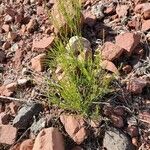
Baccharis sarothroides
Desertbroom · Broom baccharis · Greasewood · Groundsel · Rosin-brush
Description
Source: leafsnapBaccharis sarothroides, commonly known as desert broom or broom baccharis, is a shrub native to the southwestern United States and northern Mexico. It belongs to the Asteraceae family and can grow up to 10 feet tall with a spread of 6-8 feet. The plant features slender branches with small green leaves that are covered in fine hairs, giving it a fuzzy appearance. In late summer and early fall, Baccharis sarothroides produces small white flowers arranged in clusters at the tips of its branches. These flowers attract bees and butterflies as pollinators. After flowering, the plant produces fluffy seeds that are dispersed by the wind. Desert broom commonly thrives in arid regions such as deserts or dry washes, where it can tolerate extreme heat and drought conditions. It is also used for erosion control due to its deep root system, which helps stabilize soil on slopes. Native American tribes have used the plant for medicinal purposes for centuries. Its anti-inflammatory properties have been found effective for arthritis pain relief when applied topically to affected areas. Overall, Baccharis sarothroides is ecologically significant due to its ability to provide habitat for wildlife, such as birds, and as an important food source during droughts when other plants may not be available.
🌳 In the arid landscapes where desertbroom thrives, indigenous peoples have long used its stiff, sturdy branches to make natural brooms. This sustainable practice highlights the plant's usefulness beyond its usual ecological roles. The branches' resilience to harsh desert conditions also gives the brooms durability, providing an eco-friendly alternative to synthetic versions and tipping the balance toward a more environmentally conscious way of life.
🎭 Modesty, Tidiness
Care Guide
💧 Water Every 7 days
Desertbroom is native to arid environments and is exceptionally drought-tolerant, needing watering only once every 2-3 weeks. This makes it an ideal choice for outdoor planting and xeriscaping, as it can thrive in dry soil conditions across various climate zones.
☀️ Light Full sun
Desertbroom thrives with maximum sunlight, which supports healthy growth and vigor, while also being fairly tolerant of spots that receive a considerable amount of shade. Native to areas where the sun is unobstructed for most of the day, desertbroom requires a substantial amount of light for optimal growth; however, reduced sunlight hours can stunt growth and affect its overall health.
What are the sunlight requirements for Desertbroom?
Desertbroom needs significant amounts of sunlight each day for optimal growth, thriving best in full sun conditions, which mean above 6 hours of sunlight daily. It can also tolerate partial sun, about 3-6 hours of sunlight, but limited sunlight may stunt the plant's growth and affect its health. Observing your garden's light patterns and choosing areas that offer a balance of light and shade will ensure your Desertbroom's happiness.
How does artificial lighting affect Desertbroom growth indoors?
Indoor Desertbroom plants require adequate lighting for optimal growth. When natural sunlight is insufficient, especially during winter or in less sunny spaces, artificial lighting provides a vital solution. It's recommended to use LED lights, which can be customized to the specific wavelengths needed by plants. Full sun plants need 30-50W/sq ft of artificial light, partial sun plants 20-30W/sq ft, and full shade plants 10-20W/sq ft. Placing the light source 12-36 inches above the plant for 8-12 hours a day mimics natural sunlight conditions well.
What are the common symptoms of inadequate light for Desertbroom?
Desertbroom may show several symptoms when not getting enough light, such as small or lighter-colored new leaves, leggy or sparse growth, faster leaf drop, slower or no new growth. On the other side, excessive sunlight can cause symptoms like chlorosis, sunscald, leaf curling, wilting, and leaf scorching. These symptoms range from changes in leaf color and size to physical damages due to overexposure to sunlight.
How can you address light-related issues for Desertbroom both indoors and outdoors?
To address light-related issues for Desertbroom, gradually increase its sunlight exposure if it's lacking. For indoor plants, move them closer to a south-facing window or use artificial lighting to provide at least 6 hours of direct sunlight daily. Outdoor plants should be shifted to sunnier spots gradually to avoid shock. Removing obstructions that block sunlight and considering transplanting to a better-lit location are also effective strategies. Note that parts of the plant already affected by light issues might not recover, but new growth should be healthy with proper light adjustments.
🌡️ Temperature 15–37.8°C
Desertbroom comes from tropical areas, where the climate is usually warm and humid. Consequently, it is well-suited to high temperatures and humidity. It does not tolerate sudden temperature shifts and prefers a steady temperature, so avoiding indoor temperature fluctuations is important. It typically cannot withstand cold and needs warmer conditions to grow. If the ambient temperature falls too low, the plant may stop growing or even die.
What is the common name of Baccharis sarothroides?
The common name of Baccharis sarothroides is Desertbroom.
What is the botanical name of Desertbroom?
The botanical name of Desertbroom is Baccharis sarothroides.
💨 Humidity
🪴 Soil 6-7
🌱 Fertilizer
The best time to fertilize a Desertbroom is in early spring, when it breaks dormancy. This supports overall growth and flower development. Fertilizing improves the foliage, stems, and branches, and encourages flowers that are larger, more vibrant, and longer-lasting. It helps transport nutrients from the roots to the flowers and boosts the plant's health and disease resistance.
🪴 Pot & Repot 2-3 years
When repotting Desertbroom, choose a pot 1-2 inches (2.5–5.1 cm) larger with ample drainage. Use a well-draining potting mix. Repot in spring or fall, ensuring that the root ball sits slightly lower than the rim of the flower pot. Water thoroughly after repotting and place it in a warm spot with indirect sunlight.
✂️ Pruning
Desertbroom is a hardy shrub that thrives in dry environments and grows quickly. To ensure its healthy development, it's best to prune the shrub in late spring. Start by removing any dead branches, and then trim back about one-third of the plant. This will help maintain its shape, encourage thicker foliage, and improve air circulation.
🌿 Propagating
🐛 Diseases & pets
☠️ Toxicity
Characteristics
- Plant Type
- Shrub
- Life Cycle
- Perennial
- Genus
- Baccharis
- Family
- Asteraceae
- Hardiness Zone
- 8-10
- Mature Height
- 1.83 m to 3.66 m
- Mature Spread
- 3.05 m
- Leaf Color
- Green
- Leaf Type
- Evergreen
- Flower Color
- White
- Flower Size
- 2.54 cm
- Bloom Time
- Mid summer, Late summer, Early fall
- Planting Time
- Spring
- Harvest Time
- Fall, Winter
- Native Area
- Mexico