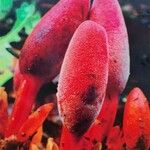
Balanophora laxiflora
Care Guide
💧 Water
Balanophora laxiflora thrives in humid environments, needing consistent moisture without becoming waterlogged. To mimic its natural habitat, water it weekly. If grown indoors, you can increase humidity by using a pebble tray filled with water to boost the surrounding moisture levels.
☀️ Light Partial sun
The Balanophora laxiflora clade is indigenous to habitats like forest understories or rocky regions where it naturally occurs in shady conditions. It thrives best in partial sunlight, but it has the adaptability to withstand full sun or complete shade, which shows its robust and flexible characteristics.
🌡️ Temperature 20–37.8°C
The Balanophora laxiflora group has its roots in tropical areas, characterized by hot and damp climates. Consequently, it's accustomed to thriving in high heat and moisture conditions. It doesn't fair well with abrupt shifts in temperature and prefers consistent temperature settings, so it's crucial to keep indoor temperature stable. It generally doesn't endure cold temperatures and needs warmer conditions for growth. A significant dip in ambient temperature could lead to halted growth or even the death of the plant.
💨 Humidity
🪴 Soil 5-7
🌱 Fertilizer
The most fertilizer is required by the Balanophora laxiflora clade during its peak growth season, mostly seen in spring, summer, and the initial part of fall. It is crucial to fertilize as it supplies vital nutrients that the soil may be deficient in, thereby fostering robust root and stem growth, plus appealing foliage, a notable characteristic of this specific plant.
🪴 Pot & Repot
✂️ Pruning
To maintain Balanophora laxiflora, light pruning is recommended from early to late spring. This helps remove damaged stems, improve air circulation, and maintain the plant's shape. Pruning encourages healthy growth, prevents disease, and supports vibrant blooms while safeguarding its delicate structure.
🌿 Propagating
🐛 Diseases & pets
☠️ Toxicity
Characteristics
- Plant Type
- Herb
- Life Cycle
- Perennial
- Genus
- Balanophora
- Family
- Balanophoraceae
- Hardiness Zone
- 10-12
- Mature Height
- 10 cm to 20 cm
- Mature Spread
- 5 cm to 15 cm
- Leaf Color
- Brown
- Leaf Type
- Semi-evergreen
- Flower Color
- Red
- Flower Size
- 0.76 cm to 2.03 cm
- Bloom Time
- Summer
- Planting Time
- Spring, Summer, Autumn
- Harvest Time
- Late summer, Early fall, Mid fall
- Native Area
- Vietnam, Myanmar, Laos, Thailand, China