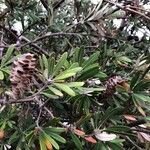
Banksia marginata
Silver banksia
Description
Source: leafsnapBanksia marginata, commonly known as the silver banksia, is a species of tree or woody shrub in the plant genus Banksia found throughout much of southeastern Australia. It ranges from the Eyre Peninsula in South Australia to north of Armidale, New South Wales, and across Tasmania and the islands of Bass Strait. It grows in various habitats, including Eucalyptus forest, scrub, heathland and moorland. Banksia marginata varies widely in habit, ranging from a 20-centimetre (7.9 in) shrub to a 12-metre (40 ft) tree. The narrow leaves are linear and the yellow inflorescences (flower spikes) occur from late summer to early winter. The flower spikes fade to brown and then grey and develop woody follicles bearing the winged seeds. Originally described by Antonio José Cavanilles in 1800, further collections of B. marginata were designated as several separate species by Robert Brown in 1810. However, all were reclassified as a single species by George Bentham in 1870. No distinct subspecies have been recognised by Banksia expert Alex George, who nonetheless concedes that further work is needed. Many species of bird, in particular honeyeaters, forage at the flower spikes, as do native and European honeybees. The response to bushfire varies. Some populations are serotinous: they are killed by fire and regenerate from large stores of seed which have been held in cones in the plant canopy and are released after a fire. Others regenerate from underground lignotubers or suckers from lateral roots. Although it has been used for timber, Banksia marginata is most commonly seen as a garden plant, with dwarf forms being commercially propagated and sold.
Care Guide
💧 Water Every 2-3 weeks
The silver banksia is a drought-tolerant plant that thrives with watering every 2 to 3 weeks. It prefers sandy soils and does particularly well in coastal areas and temperate climates. Its growth cycles benefit from natural rainfall and good drainage.
How should I water my Silver banksia plant?
The Silver banksia is not particular about how you water it, so you can use any common watering tool. Watering cans, hoses, or even cups are all suitable for moistening the plant's soil. Regardless of the tool you choose, it's important to water directly onto the soil and ensure equal moisture for all areas. Using filtered water is recommended as tap water may contain harmful particles. It's also best to use water at or slightly above room temperature since extremely hot or cold water may shock the Silver banksia. However, this plant generally responds well to various types of water.
What do I do if I give my Silver banksia too much or too little water?
Outdoor plants, especially newly planted ones or seedlings, are susceptible to water shortage. It's important to consistently water them for several months while they are still small or fresh in the ground. Once the roots are established, Silver banksia plants can mostly rely on rainfall. However, when Silver banksia is potted, it is more likely to be overwatered. If you accidentally overwater your Silver banksia, act promptly to rectify the situation. Immediately stop watering the plant to minimize the effects. Then, remove the Silver banksia from its pot and examine its roots. If there are no signs of root rot, you can put it back in the container. But if root rot is present, trim the affected roots and apply a fungicide. Repot the Silver banksia in well-draining soil. In the case of underwatering, simply water the plant more frequently. Underwatering is usually a quick and easy fix. When you notice the leaves drooping, drying out, or falling off, increase your watering frequency. Correct any watering mistakes as soon as you recognize underwatering.
How frequently should I water my Silver banksia?
Most plants can be left to grow naturally outdoors with rainfall. However, if your area lacks rainfall, you should water your plants adequately every 2 weeks during the spring and fall. In the summer, you will need to water them more often. In the winter, when growth is slower and plants require less water, you should water them sparingly or not at all. But if you have a young or newly planted Silver banksia, it will need more frequent watering to help it establish and grow. For potted plants, there are two ways to determine how often to water your Silver banksia. The first is to follow a predetermined watering schedule, such as once a week or once every other week. However, this may not consider the specific conditions of your growing environment. Alternatively, you can adjust your watering frequency based on the moisture level of the soil. It is generally best to wait until the top two to four inches of soil have completely dried out before watering again. This method may be particularly useful during the summer when the plant's water needs are highest.
How much water does my Silver banksia plant need?
When watering your Silver banksia, remember that it doesn't always require a large amount of water. If only a few inches of soil have dried since the last watering, giving it about five to ten ounces of water should be sufficient for healthy growth. You can also assess the soil moisture to determine the appropriate water volume. Take note of how many inches of soil have dried out between waterings. To ensure your Silver banksia gets enough moisture, water it enough to dampen all the dry soil layers since the last watering. If more than half of the soil is dry, it's advisable to give more water than usual. In such cases, continue watering until you see excess water draining from the pot's drainage holes. If your Silver banksia is planted in a well-watered outdoor area, additional watering may not be necessary. For young or newly established plants, provide 1-2 inches of rain per week. As the plant grows and establishes, it can survive solely on rainwater. Only in hot weather conditions without rain for 2-3 weeks should you consider giving your Silver banksia a full watering to prevent stress.
How do I know if I'm giving enough water to my Silver banksia?
The Silver banksia is often overwatered, which can be identified by yellowing leaves, leaf drop, and shriveling of the plant's structure, as well as potential root rot. On the other hand, underwatering can cause wilting, brown or brittle leaves. Regardless of whether you observe signs of overwatering or underwatering, taking action to restore the health of your Silver banksia is essential.
☀️ Light Full sun
The silver banksia does best in direct sunlight, which is essential for its healthy development. Coming from habitats with strong sunlight, it can tolerate stretches of reduced light. However, prolonged insufficient light or excessive exposure can harm its vigor.
How many hours of sunlight does a Silver banksia need each day to grow well?
To ensure healthy growth of the Silver banksia, it is recommended to provide it with a minimum of 3–6 hours of sun each day. While this is the least amount of sun it needs, it's worth noting that plants that can tolerate part sun can also do well in full sun. The reason for this is that they require less light for photosynthesis, making them more adaptable compared to plants that specifically need either full sun or part shade.
What kind of sunlight does the Silver banksia plant need?
Silver banksia thrives in full or part sun. Ideally, it should receive direct morning light, but it requires protection from the intense afternoon sun during summer. Excessive exposure to hot afternoon sun in temperate environments can harm the leaves, affecting the overall health and appearance of the plant.
Can the sun harm Silver banksia? How can I prevent sun and heat damage to my Silver banksia plant?
When you move a silver banksia plant from indoors to outdoors, be careful not to expose it to direct sunlight right away. Instead, gradually move the plant from a shaded area to a brighter spot. This will help prevent sunburns from overexposure. Even if the plant is used to the summer sun, extreme heat can still damage it. So, during a heatwave, it's important to keep the soil consistently moist. If you're experiencing extremely hot weather, you can protect the silver banksia by moving it to an area with afternoon shade or by covering it with a shade cloth.
Should I keep Silver banksia away from direct sunlight?
Silver banksia thrives in bright morning sun and some full sun exposure, but the harsh midday sun of summer can be overwhelming. If planted in the ground, the plant can acclimate to the increasing intensity of the summer sun. However, potted plants that have been indoors or in a sheltered area may suffer damage if exposed suddenly to direct summer sun in the hottest part of the day. To safeguard the plant from the intense afternoon sun, it is recommended to plant or position it in a shaded spot during midday. This can be achieved by placing it in an understory location, protected by taller trees, other plants, buildings, or landscape features.
What will happen if the Silver banksia doesn't get enough sunlight?
Silver banksia can become pale green or have drooping, yellow leaves if they receive insufficient sunlight. Though some leaf drop is normal, if new leaves are not growing in their place, it indicates a problem. In cases where Silver banksia do manage to grow with inadequate light, the new growth is typically weak, pale, and easily attacked by insects. By noticing these signs and adjusting the lighting, a noticeable improvement can be achieved.
🌡️ Temperature 15–37.8°C
Silver banksia naturally grows in climates with temperatures from 59 to 100 °F (15 to 38 ℃). A moderate climate is preferable for optimal growth. During seasonal shifts, silver banksia is resilient and needs minimal intervention or adjustment.
What temperature is best for Silver banksia?
Plants can be affected by colder temperatures, as they tend to have the same temperature as the surrounding air. When exposed to sunlight, plants can warm up again, but this is not possible during winter. The ideal temperature range for the Silver banksia is usually between 70-85℉ (21-30℃). Although they might tolerate temperatures as low as 20-30℉ (-6-0℃), or even 15℉ (-10℃), it should not be for long as frost damage may occur. To ensure their well-being, make sure the maximum temperature stays within 70-85℉ (21-30℃), and consider spraying water on them occasionally and providing some shade to prevent wilting.
Do I need to change the temperature for Silver banksia at different stages of growth?
To ensure successful growth of Silver banksia, it's important to research and maintain the right temperature conditions. Some growers may choose to lower the plants' thermostats during the growing season to save on HVAC costs. However, it's crucial to note that temperature plays a significant role in flowering, pest management, and overall plant quality. For instance, there's a specific temperature point where Silver banksia growth halts, which typically occurs during winter when certain species enter dormancy. As seasons change and the temperature rises, Silver banksia can grow more rapidly due to an increase in the base temperature. Additionally, species naturally found in warmer environments have higher optimum temperatures compared to those adapted to cooler climates. Cool temperatures can adversely affect seed uniformity and cause delays, so it's important to avoid exposure to low temperatures. During the flowering phase, it may be beneficial to lower the temperature, but other growth stages should not be affected in the same way. Furthermore, cooler night temperatures require less water, so irrigation should be adjusted accordingly.
How can I help the Silver banksia plant stay warm during cold seasons?
To prepare the plant for colder temperatures, stop fertilizing it so that new growth doesn't occur, allowing the existing growth to become stronger. In order to keep the plant warm, you can construct structures such as cages or trellises around the Silver banksia. Another option is to use heat mats, which can gently warm the soil and maintain the ideal temperature range for the Silver banksia.
How can I protect Silver banksia from being damaged by temperature?
To protect the Silver banksia from frost during winter, cover it with cloths, tarps, burlaps, sheets, or plastic buckets. Take precautions to secure the covers so they don't get blown away by the wind. But be careful that the plastic sheets or burlap covers do not touch the fruit or foliage as this can cause burns due to cold temperatures transferring to the material. Once temperatures start rising during the daytime, you can remove the covers.
Do I need to change the temperature for Silver banksia in different seasons?
When growing the Silver banksia in spring, it is recommended to increase humidity due to the cooler air temperature. Dry temperatures can be stressful for different species, so increasing humidity can be beneficial. When summer arrives, the greenhouse's large cover and warm temperature naturally result in higher humidity levels. Look out for signs such as condensation on the greenhouse walls, as this can impact pollination and lead to leaf infections when the water falls on them. Adjustments should be made based on the temperature, and it is advisable to do some spraying on hot days during the year.
💨 Humidity
🪴 Soil 6-7
🌱 Fertilizer
Timing is essential for fertilizing Silver banksia. Start in early spring and apply fertilizer each month through early summer. Fertilizer encourages attractive blooms and supplies the plant with energy during both dormant periods and active growth.
Why should I put fertilizer on my Silver banksia?
Fertilizing a Silver banksia is important for several reasons. Firstly, it helps the plant produce beautiful blooms. To ensure excellent flowers during spring, it is recommended to fertilize in early spring. Additionally, fertilizer provides the plant with energy that it can store underground during dormant growth phases. By giving extra nutrients during fall planting or late spring, the Silver banksia can hold more energy to use when active growth resumes.
When should I fertilize my Silver banksia to get the best results?
To effectively fertilize Silver banksia, timing is crucial. Applying fertilizer too early while the plant is still dormant will result in its ineffectiveness and wastage as rainwater will wash it away. The recommended timing for the first application of fertilizer is in early spring. From then on, continue to fertilize once a month until early summer.
When is it a bad idea to add fertilizer to my Silver banksia plant?
To promote better blooming, it is recommended to avoid using too much nitrogen-rich fertilizer for Silver banksia. Instead, opt for fertilizers that have a lower nitrogen content relative to other nutrients. It is also important to refrain from fertilizing the plant after early autumn, as excessive growth before winter can be detrimental. Additionally, fertilizing Silver banksia during hot and dry periods should be avoided, as dry soil is less effective in delivering nutrients and can stimulate growth that requires additional water, which may not be readily available. It is best to apply fertilizer during cooler temperatures earlier in the season. Lastly, it is worth noting that Silver banksia can unintentionally absorb fertilizer that has been applied to neighboring plants or lawns, so caution should be exercised to prevent over-fertilization.
What kind of fertilizer does my Silver banksia plant need?
The ideal fertilizer for a Silver banksia should have a balanced mix of nutrients, with slightly more phosphorus. Another option is to improve the soil with organic materials like compost, worm castings, and manure. Experienced gardeners often use water-soluble fertilizers with phosphorus when the flower buds start to appear. This helps flowers develop better, grow larger, and bloom longer. Fertilizers come in various forms, but liquid or powdered ones are best for Silver banksia. Regardless of the form, remember to dilute the fertilizer and apply it while watering the plant.
How should I fertilize my Silver banksia plant?
To properly fertilize your Silver banksia, always follow the specific fertilizer directions and do some research on how to use it correctly. You must be cautious not to over-fertilize, so determining the right amount is crucial. A general guideline is to use the age or trunk diameter of the tree to estimate the appropriate amount of fertilizer to apply. Typically, it is recommended to use about one-tenth of a pound of fertilizer per year or per inch of trunk, with a maximum of one pound. When applying granular or organic fertilizers like blood meal, sprinkle the substance around the base of the tree, extending it all the way to the drip line (the area beneath the farthest-reaching branches). It is important to avoid letting the fertilizer come in contact with the trunk. Over time, the granules will break down and seep into the soil, where the roots can absorb them. After fertilizing, spread a one-inch layer of compost around the base of the tree and water thoroughly.
🪴 Pot & Repot 2-3 years
For the best root recovery, repot your silver banksia in the spring. Use a slightly larger pot every 2-3 years to provide more space without causing overcrowding. Make sure to use well-draining soil and water regularly after repotting to support healthy growth. Silver banksia is a resilient plant and does not present any unique care challenges.
✂️ Pruning
The silver banksia is known for its distinctive silver foliage. It should be pruned from early to late winter, with an emphasis on removing dead branches and maintaining its shape with light cuts to minimize stress. Pruning during its dormant period promotes flowering and boosts its vigor, making it a hardy choice for any garden.
🌿 Propagating
🐛 Diseases & pets
☠️ Toxicity
Characteristics
- Plant Type
- Tree, Shrub
- Life Cycle
- Perennial
- Genus
- Banksia
- Family
- Proteaceae
- Hardiness Zone
- 8-11
- Mature Height
- 0.2 m to 11.89 m
- Mature Spread
- 1.52 m to 2.44 m
- Leaf Color
- Green, Blue, Gray, Silver
- Leaf Type
- Evergreen
- Flower Color
- Yellow
- Flower Size
- 7.62 cm to 10.16 cm
- Bloom Time
- Fall
- Planting Time
- Spring
- Harvest Time
- Winter