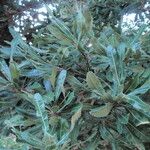
Banksia serrata
Red honeysuckle · Old man banksia · Saw banksia · Saw-tooth banksia · Creeping Banksia
Description
Source: leafsnapBanksia serrata, commonly known as the saw banksia, the old man banksia, the saw-tooth banksia or the red honeysuckle and as wiriyagan by the Cadigal people, is a species of woody shrub or tree of the genus Banksia, in the family Proteaceae. Native to the east coast of Australia, it is found from Queensland to Victoria with outlying populations on Tasmania and Flinders Island. Commonly growing as a gnarled tree up to 16 m (50 ft) in height, it can be much smaller in more exposed areas. This Banksia species has wrinkled grey bark, shiny dark green serrated leaves and large yellow or greyish-yellow flower spikes appearing over summer. The flower spikes, or inflorescences, turn grey as they age and pollinated flowers develop into large, grey, woody seed pods called follicles. B. serrata is one of the four original Banksia species collected by Sir Joseph Banks in 1770, and one of four species published in 1782 as part of Carolus Linnaeus the Younger's original description of the genus. There are no recognised varieties, although it is closely related to Banksia aemula. Throughout its range, it grows exclusively in sandy soil, and is usually the dominant plant in scrubland or low woodland. B. serrata is pollinated by and provides food for a wide array of vertebrate and invertebrate animals in the autumn and winter months, and is an important source of food for honeyeaters. It is a common plant of parks and gardens.
💡 The Old Man Banksia is a tree native to Australia. It produces an abundance of nectar, making it an essential food source for small mammals. These mammals, in turn, help pollinate the tree. While the Old Man Banksia can be severely damaged by wildfires, these fires also stimulate the germination of its seeds, enabling the tree to recover and thrive.
Care Guide
💧 Water
The Old Man Banksia, native to fire-prone regions of Australia, is known for its excellent drought tolerance. It typically needs watering only every 2-3 weeks. This plant thrives in well-draining soil and can suffer from root rot if overwatered. Ideally grown outdoors, the Old Man Banksia benefits from rainfall patterns that mimic those of its native environment.
How should I water my Old man banksia plant?
When it comes to watering your Old man banksia plant, you have flexibility in choosing the watering tool. Whether it's a watering can, hose, or even a cup, any common tool will work fine. It's important to water the soil directly, making sure to evenly moisten all areas to provide water to all parts of the root system. Using filtered water is helpful as it avoids harmful particles that may be present in tap water. Additionally, using water that is at or slightly above room temperature is ideal, as very hot or cold water can be a bit shocking to the plant. However, overall, the Old man banksia plant is generally happy with any kind of water you provide.
What should I do if I give my Old man banksia plant too much water or too little water?
Outdoor plants, especially newly planted ones or seedlings, are prone to not getting enough water. Remember to water them adequately for a few months until the tree is small or newly planted. This is because once the roots are established, Old man banksia trees can mostly rely on rain. When Old man banksia trees are planted in pots, it is more likely to overwater them. If you accidentally overwater your Old man banksia, you should take immediate action to fix the situation. Firstly, stop watering the plant right away to minimize the impact of overwatering. Then, remove the Old man banksia from its pot and check its roots. If there is no root rot, you can return the plant to its container. However, if you find signs of root rot, trim the affected roots and apply fungicide to prevent further damage. Lastly, repot the Old man banksia in well-draining soil. On the other hand, underwatering is easily fixable. If you notice that the plant's leaves are drooping, drying out, and falling off, water it more frequently. Adjust your watering frequency as soon as you realize the plant is being underwatered.
How frequently do I need to water my Old man banksia plant?
Most outdoor plants rely on rainfall for their water needs. If your area has limited rainfall, you'll need to water your plants every 2 weeks in the spring and fall, and more frequently in the summer. During winter, when plants grow slower and require less water, you should water them sparingly, or even not at all. However, if your Old man banksia is young or newly planted, it will need more frequent watering to help it establish and grow into a drought-tolerant plant. For potted Old man banksia plants, there are two main approaches to determine watering frequency. The first is to follow a set schedule, typically once a week or every other week. However, this may not always be accurate for the unique conditions of your plant's environment. Another option is to gauge watering based on soil moisture. Wait until the top two to four inches of soil have completely dried out before giving more water. It's important to note that during summer, when water needs are highest, a predetermined schedule may not be sufficient.
How much water does my Old man banksia tree need?
Watering your Old man banksia is not always about giving it a high volume of water. Instead, if only a few inches of soil have dried out since the last watering, just give it about five to ten ounces of water each time. You can also gauge the water volume based on soil moisture. Check how many inches of soil have dried out between waterings. To ensure the plant gets enough moisture, water it enough to moisten all the dry soil layers since the last watering. If over half of the soil has become dry, give it more water than usual. Keep adding water until you see excess water draining from the pot's drainage holes. If your Old man banksia is planted in an area with plenty of outdoor rain, it may not need additional watering. When the plant is young or establishing, it needs 1-2 inches of rain per week. As it grows, it can rely on rainwater, only needing a full watering when there is no rain for 2-3 weeks during hot weather to prevent stress.
How do I know if I'm giving enough water to my Old man banksia plant?
The Old man banksia is more commonly affected by overwatering, so it's important to know the signs. If it's overwatered, the leaves will turn yellow and some may fall off. Overwatering can also cause the plant to shrink and lead to root rot. On the other hand, if it's not getting enough water, it will start to wilt and its leaves may turn brown or become brittle. Whether you notice signs of overwatering or underwatering, you should take action to restore the plant's health.
☀️ Light Full sun
Old man banksia does best with abundant light. As a resident of environments with open access to sunlight, its growth and overall condition visibly improve in bright, sun-filled areas. Excessive or limited light typically does not bother it. Nonetheless, insufficient light can hinder its successful development.
What are the sunlight requirements for Old Man Banksia?
Old Man Banksia thrives best with an abundance of light, requiring over 6 hours of sunlight daily to ensure healthy growth and development. This plant is well-suited to environments that offer unobstructed access to sunlight. Observing the way sunlight moves through your garden and choosing spots that provide a perfect balance of light and shade can significantly benefit the plant, ensuring its happiness and well-being. Lack of sufficient light, however, can inhibit its growth.
How does artificial lighting benefit indoor plants, and what are the recommendations for Old Man Banksia?
Indoor plants, including Old Man Banksia, require adequate lighting for optimal growth, especially when natural sunlight is insufficient, such as during winter or in less sunny spaces. Artificial lighting provides a vital solution, promoting healthier and faster growth. LED lights are recommended due to their ability to be customized to provide specific wavelengths needed by plants. The general guideline suggests that full sun plants need 30-50W/sq ft, partial sun plants 20-30W/sq ft, and full shade plants 10-20W/sq ft of artificial light. The light source should be placed 12-36 inches above the plant to mimic natural sunlight, and most plants benefit from 8-12 hours of light per day.
What are the symptoms of light deficiency in Old Man Banksia?
Symptoms of light deficiency in Old Man Banksia include the growth of smaller new leaves, leggy or sparse growth, faster leaf drop, slower or halted new growth, lighter-colored new leaves, chlorosis, sunscald, leaf curling, wilting, and leaf scorching. These symptoms highlight the plant's struggle with insufficient light conditions, affecting its overall growth and health.
What are the solutions to address insufficient sunlight for Old Man Banksia?
To address insufficient sunlight for Old Man Banksia, gradual adaptation to brighter conditions is recommended. Indoors, moving the plant to a sunnier location each week until it receives at least 6 hours of direct sunlight daily, using a south-facing window, and keeping curtains open during the day are effective strategies. Additionally, using artificial light for at least 8 hours daily can supplement the plant’s light needs. Outdoors, gradually moving plants to better sunlight spots and avoiding sudden changes in light intensity can prevent sunburn. If necessary, reducing obstructions or transplanting to areas with ample sunlight and good drainage can significantly improve light exposure. It must be noted, however, parts of the plant affected by previous insufficient sunlight may not fully recover, but new growth post-adjustment should be healthy.
🌡️ Temperature 20–37.8°C
Old man banksia is native to temperate environments and does best in temperatures of 68 to 100 °F (20 to 38 ℃). Seasonal temperature changes are typically not required unless conditions move substantially outside this range.
What is the ideal temperature range for Old man banksia?
Old man banksia thrives best in a temperate environment with ideal temperatures ranging from 68 to 100 °F (20 to 38 °C). It flourishes in these conditions without the need for significant seasonal temperature adjustments. However, it's crucial to be aware that Old man banksia is extremely heat-loving, showing adverse reactions to cold temperatures. During winter, it is advisable to maintain temperatures above 20°C to promote plant growth, as temperatures nearing 0°C could harm the plant.
How does low temperature affect Old man banksia, and what are the solutions?
Old man banksia is sensitive to low temperatures and thrives when the temperature remains above 20°C. Exposing the plant to temperatures below -5°C may result in lighter-colored leaves which, following frost damage, can turn brown or black as the plant exhibits wilting and drooping symptoms. To protect the plant from cold damage, it is recommended to trim off the frost-damaged parts and move the plant indoors to a warm environment. Placing it near a south-facing window can ensure adequate sunlight, but it should be kept away from heaters or air conditioning vents to avoid excessive dryness.
What should be done if Old man banksia experiences high temperature?
During the summer, Old man banksia should be kept in temperatures below 38°C to prevent heat stress. Exposure to temperatures above 43°C could cause the leaves to lighten and increase the risk of sunburn. To mitigate the damage from high temperatures, trim away the sunburned and dried parts of the plant. Moving the plant to a shaded location, particularly from the midday and afternoon sun, and ensuring the soil remains moist with morning and evening watering, can help support the plant during hot conditions.
💨 Humidity
🪴 Soil 6-6
🌱 Fertilizer
Early spring, as an Old man banksia breaks dormancy, is the best time to fertilize. This supports overall growth and encourages flower development. Fertilization improves the foliage, stems, and branches, while encouraging large, vibrant, long-lasting flowers. It helps transfer nutrients from the roots to the blooms and enhances the plant’s health and disease resistance.
Why do I have to put fertilizer on my Old man banksia?
Ensuring the overall health and well-being of your Old man banksia is crucial, and fertilization plays a significant role. By supplying the right energy and nutrients, your plant will develop a healthy foliage and sturdy stems. Additionally, the flowers of an Old man banksia are highly prized by gardeners. Luckily, fertilization also promotes the production of large, vibrant, and long-lasting flowers. This is because the proper fertilizer facilitates the transfer of fuel from the roots to the flowers through the stems. Furthermore, proper fertilization improves the plant's overall health, enhancing its ability to resist diseases.
When should I put fertilizer on my Old man banksia?
The best time to fertilize an Old man banksia is during early spring as it transitions from dormancy to bud formation. This will provide ample energy to support growth and flower development. However, it is not the only suitable time for fertilization. Offering a smaller feeding at the end of the season, specifically in the fall months, can also benefit the plant. Additionally, some gardeners opt to fertilize during planting, but it is not always required.
When is the best time to not use fertilizer on my Old man banksias?
You do not need to fertilize your Old man banksia during the winter, as it is in a dormant phase and does not require much energy from the soil for new growth. Fertilizing in winter increases the risk of overfertilization. The best times to feed your Old man banksia are in early spring and fall. Therefore, during most of the spring and summer, fertilizer is not necessary. It is also advisable to refrain from fertilizing if the plant is exposed to extremely hot or dry conditions.
What kind of fertilizer does my Old man banksia plant need?
Using a general-purpose fertilizer with equal amounts of nitrogen, phosphorus, and potassium is usually fine. However, Old man banksia plants tend to do better with a specific type of fertilizer. Nitrogen and phosphorus are typically the most important nutrients for them, so the fertilizer should have higher amounts of those compared to potassium. A fertilizer with an N-P-K ratio of 10-10-8 or something similar should work well. Additionally, it can be helpful to use organic materials like compost for at least one feeding per year. If you decide to use fertilizer, granular fertilizer is commonly used for Old man banksia plants.
How should I fertilize my Old man banksia?
Fertilizing your Old man banksia is an easy task that even inexperienced gardeners can do. To apply granular fertilizer, simply sprinkle it on the soil after moistening it with water. You can also improve the soil by adding organic material like compost or manure. To do this, place the material on top of the soil and gently work it into the top few inches using a hand rake, being careful not to disturb the roots.
🪴 Pot & Repot
✂️ Pruning
The Old Man Banksia is known for its serrated leaves and vibrant flowers. To keep it healthy, prune it from early to late winter to remove any dead branches and encourage new growth. Trim young shoots back to the nodes, but avoid heavy pruning to prevent stressing the plant. Regular light pruning is beneficial as it improves air circulation and reduces the risk of disease, helping the plant maintain a healthy appearance.
🌿 Propagating
🐛 Diseases & pets
☠️ Toxicity
Characteristics
- Plant Type
- Tree, Shrub
- Life Cycle
- Perennial
- Genus
- Banksia
- Family
- Proteaceae
- Hardiness Zone
- 9-11
- Mature Height
- 15.85 m
- Mature Spread
- 6.1 m
- Leaf Color
- Green, Red, Brown
- Leaf Type
- Evergreen
- Flower Color
- Yellow
- Flower Size
- 8.89 cm to 11.43 cm
- Bloom Time
- Late winter, Early spring, Mid spring
- Planting Time
- Spring
- Harvest Time
- Late spring, Early summer, Mid summer