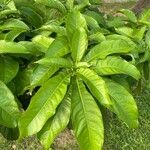
Barringtonia racemosa
Brackwater mangrove · Cassowary-pine · Freshwater mangrove · Powderpuff-tree · Mango-pine
Description
Source: leafsnapBarringtonia racemosa (powder-puff tree, Afrikaans: pooeierkwasboom, Zulu: Iboqo, Malay: Putat) is a tree in the family Lecythidaceae. It is found in coastal swamp forests and on the edges of estuaries in the Indian Ocean, starting at the east coast of Mozambique and KwaZulu-Natal (South Africa) to Madagascar, India, Sri Lanka, Malaysia, Maldives, Thailand, Laos, southern China, northern Australia, coastal Taiwan, the Ryukyu Islands and many Polynesian islands.The 1889 book 'The Useful Native Plants of Australia’ records that the Indigenous people of the Mitchell River District called this plant "Yakooro" and that "The root of this tree has a bitter taste, and is used by Hindoo [sic.] practitioners on account of its aperient and cooling qualities. The seeds and bark are also used in native medicine; the latter is of a reddish colour, and is said to possess properties allied to the Cinchonas. The pulverised fruit is used as snuff, and, combined with other remedies, is applied externally in diseases of the skin. (Treasury of Botany)."The Powder-puff tree is a protected tree in South Africa.
🌳 Yakooro has been used for water purification because its seeds contain saponins. These compounds act as surfactants and can help coagulate and settle suspended particles in water. This traditional knowledge could inform low-cost, sustainable water treatment practices, particularly in rural communities.
Care Guide
💧 Water Every 2 weeks
Yakooro thrives in tropical coastal environments, where it enjoys high humidity and frequent rainfall. Although it can withstand short periods of drought, it prefers a consistent supply of moisture, so watering every two weeks is ideal. To ensure optimal growth, plant Yakooro in well-draining soil, typically in an outdoor setting.
☀️ Light Full sun
Yakooro prefers full, unobstructed sunlight to thrive, though it can tolerate locations where sunlight is only partial. Native to regions with abundant sun, yakooro will show slow growth and poor foliage if it does not receive enough light.
What are the sunlight requirements for Yakooro?
Yakooro requires full sun, which means it needs above 6 hours of sunlight daily, though it can also tolerate partial sun, receiving about 3-6 hours of sunlight. The plant originates from areas with abundant sunlight, and without sufficient light, it may experience slow growth and unhealthy foliage. It's essential to observe how sunlight moves through your garden to ensure plants get the right balance of light and shade for optimal health.
How should Yakooro be cared for in terms of sunlight?
Care for Yakooro by ensuring it receives unobstructed exposure to sunlight for most of the day. In conditions where natural sunlight is insufficient, especially indoors or during winter, artificial lighting can be used to supplement light exposure. Indoor yakooro plants should receive 30-50W/sq ft of artificial light for full sun, 20-30W/sq ft for partial sun, and 10-20W/sq ft for full shade plants. It's vital to choose the right artificial light, set an appropriate distance from the plant (12-36 inches), and mimic natural daylight hours, usually 8-12 hours per day.
What are the symptoms of inadequate light for Yakooro?
Symptoms of light deficiency in Yakooro include smaller new leaves, leggy or sparse growth, faster leaf drop, slower or no new growth, lighter-colored leaves, chlorosis, sunscald, leaf curling, wilting, and leaf scorching. These signs indicate the plant isn't receiving enough sunlight, which is crucial for its health. Observing these symptoms early allows for quicker adjustments to the plant's light environment.
What solutions are available for Yakooro suffering from light deficiency?
For Yakooro suffering from light deficiency, gradually increasing sunlight exposure is key. Indoors, move the plant to a sunnier spot or use artificial light for at least 8 hours daily. Outdoor plants should be moved gradually to sunnier locations to prevent sunburn. Minimizing obstructions, such as pruning trees, can help increase sunlight exposure. For permanently located plants, consider transplanting during their dormant period to a sunnier location. It's important to note that parts of the plant already affected by light deficiency may not recover, but new growth should be healthy with improved light conditions.
🌡️ Temperature 20–37.8°C
Yakooro is a plant that grows best in temperatures of 68 to 100 °F (20 to 38 ℃). Native to temperate areas, it prefers the warmer conditions typical of its original habitat. With seasonal shifts, it may need temperature adjustments, particularly during the colder months.
What is the ideal temperature range for Yakooro?
Yakooro thrives in temperatures between 68 to 100 °F (20 to 38 °C), preferring warmer environments typical of its original temperate regions. It adapts to seasonal changes, requiring temperature adjustments in colder months. Extremely sensitive to cold, it's recommended to bring outdoor-grown Yakooro indoors during autumn, placing it near a bright window but away from heaters. Maintaining temperatures above 20°C during winter is beneficial, while any temperatures nearing 5°C or lower can be detrimental.
What are the symptoms of low temperature exposure in Yakooro?
Yakooro is not tolerant of low temperatures and shows optimal growth when the temperature is above 20°C. In winter, it's crucial to keep it above 5°C to prevent damage. Exposure to temperatures below 1°C can cause the leaves to lighten in color. Following frost damage, leaves may turn brown or black, and the plant may show signs of wilting and drooping.
How can you protect Yakooro from low temperature damage?
To protect Yakooro from low temperature damage, trim off the frost-damaged parts and immediately move the plant indoors to a warmer environment. Place it near a south-facing window for ample sunlight, ensuring it is not too close to heaters or air conditioners to avoid dry air.
What are the symptoms of high temperature exposure in Yakooro?
During the summer, Yakooro should be kept below 38°C to prevent heat stress. When exposed to temperatures above 43°C, the color of the leaves may lighten, and the plant becomes more susceptible to sunburn, indicated by lightened leaf color and susceptibility to damage.
How can you protect Yakooro from high temperature damage?
To mitigate high temperature damage to Yakooro, trim away the sunburned and dried-up parts and move the plant to a shaded location, particularly from the midday and afternoon sun. Watering the plant in the morning and evening helps keep the soil moist and prevents further stress.
💨 Humidity
🪴 Soil 6-7
🌱 Fertilizer
The best time to fertilize a Yakooro is in early spring, as it breaks dormancy. This encourages overall growth and flower development. Fertilization improves foliage, stems, and branches, while encouraging flowers that are large, vibrant, and long-lasting. It assists in moving nutrients from the roots to the flowers and enhances the plant's health and resistance to disease.
🪴 Pot & Repot
✂️ Pruning
Yakooro is known for its beautiful clusters of white flowers. To ensure healthy growth, it's important to prune the plant during its dormant period, which is from early to late winter. When pruning, remove any dead branches and thin out crowded areas to improve air circulation. Make sure to use clean, sharp tools to minimize stress on the plant and prevent infections.
🌿 Propagating
🐛 Diseases & pets
☠️ Toxicity
Characteristics
- Plant Type
- Tree
- Life Cycle
- Perennial
- Genus
- Barringtonia
- Family
- Lecythidaceae
- Hardiness Zone
- 10-11
- Mature Height
- 4.57 m to 15.24 m
- Mature Spread
- 4.57 m
- Leaf Color
- Green
- Leaf Type
- Evergreen
- Flower Color
- White, Pink
- Flower Size
- 5.08 cm to 7.62 cm
- Bloom Time
- Early summer, Mid summer
- Planting Time
- Spring, Summer
- Harvest Time
- Mid summer, Late summer
- Native Area
- Sri Lanka, Somalia, India, Malaysia, Vanuatu, South Africa, Philippines, Madagascar, Bangladesh, Fiji, Kenya, Tanzania, Brunei, China, Indonesia, Cambodia, Vietnam, Mozambique, Myanmar, Japan, Singapore, Thailand