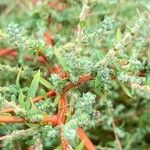
Bassia hyssopifolia
Five-horn smotherweed · Fivehorn smotherweed · Five-hooked brassia · Fivehook Bassia · Smotherweed
Description
Source: leafsnapBassia hyssopifolia, commonly known as the five-hook bassia or hyssop-leaved bassia, is a small annual plant belonging to the Amaranthaceae family. Native to North Africa and parts of Asia, it has since been introduced and naturalized in many regions worldwide. The plant grows up to 50 cm tall, featuring branching stems with small, narrow leaves that resemble those of hyssop. Its flowers are small, greenish-white, and arranged in clusters at the branch tips. Bassia hyssopifolia typically thrives in disturbed soils such as those found along roadsides, in fields, or in waste areas. While it can tolerate drought conditions, it prefers well-drained soils with moderate moisture levels. For centuries, various cultures have utilized this plant for its medicinal properties, particularly its anti-inflammatory effects. Additionally, it serves as a food source for livestock, such as sheep and goats. In summary, Bassia hyssopifolia is a resilient and adaptable annual plant found in diverse regions across the globe.
Care Guide
💧 Water Every 7 days
Fivehorn smotherweed originates from arid environments, making it highly drought-tolerant. It requires minimal watering—twice a week is sufficient. Adapted to low humidity and reliant on sporadic rainfall, this plant is perfect for xeriscaping and regions with water restrictions.
☀️ Light Full sun
Fivehorn smotherweed comes from bright, open habitats and does best in full sun. It can tolerate some partial shade but favors direct sunlight for optimal growth. This plant, which may be annual or biennial, is known for its preference for sunny conditions.
🌡️ Temperature 5–35°C
Fivehorn smotherweed can tolerate a wide range of temperatures, though its distribution can still be restricted by different combinations of moisture and heat. It performs best in warm summer climates with sufficient rainfall or watering. Long periods of cloudy, rainy weather, as well as extended high temperatures, raise the likelihood of Fivehorn smotherweed dying. In winter, adequate protection from cold can increase the plant's survival rate.
💨 Humidity
🪴 Soil 6-8
🌱 Fertilizer
Fivehorn smotherweed benefits from regular, light applications of fertilizer to encourage healthy leaf development. You should feed Fivehorn smotherweed about once a month in the summer. Nitrogen is essential for foliage, and providing nitrogen-rich sources helps Fivehorn smotherweed prosper.
🪴 Pot & Repot
✂️ Pruning
Fivehorn smotherweed flourishes when pruned strategically in early spring. Pruning at this time helps to boost growth and maintain the plant’s shape. Be sure to remove any dead stems and thin out crowded areas to improve air circulation. Regular pruning not only encourages healthy growth but also helps deter pests. Make sure your tools are sharp and sterilized to prevent the spread of disease.
🌿 Propagating
🐛 Diseases & pets
☠️ Toxicity
Characteristics
- Plant Type
- Herb
- Life Cycle
- Annual
- Genus
- Bassia
- Family
- Amaranthaceae
- Hardiness Zone
- 5-9
- Mature Height
- 30 cm to 91 cm
- Mature Spread
- 30 cm to 61 cm
- Leaf Color
- Green
- Leaf Type
- Evergreen
- Flower Color
- Green
- Flower Size
- 0.20 cm to 0.25 cm
- Bloom Time
- Mid summer, Late summer, Early fall
- Planting Time
- Spring, Summer, Autumn
- Harvest Time
- Early fall, Mid fall
- Native Area
- Saudi Arabia, Tajikistan, Armenia, Pakistan, Ukraine, China, Uzbekistan, Russia, Lebanon, Afghanistan, Iraq, Syria, Kyrgyzstan, Kazakhstan, Spain, Mongolia, Iran, Azerbaijan, Moldova, Turkmenistan