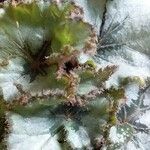
Begonia rex
Painted-leaf begonia · King begonia · Rex begonias · Rex begonia · Begonia
Description
Source: leafsnapBegonia rex, commonly known as the rex begonia or painted-leaf begonia, is a popular houseplant native to the tropical regions of Asia. As a member of the Begoniaceae family, it boasts over 1,000 species. The plant features large, showy leaves that are often variegated with shades of green, silver, pink, or purple. These asymmetrical leaves have a distinctive velvety texture. The rex begonia thrives in bright but indirect light and requires well-draining soil that remains moist but not waterlogged. It can be propagated through stem cuttings or by dividing its rhizomes. High humidity levels are essential for the rex begonia, and it benefits from regular misting or being placed on a pebble tray filled with water. Occasional fertilization during its growing season also helps the plant flourish. Rex begonias are prized for their ornamental foliage rather than their flowers, which are smaller compared to other Begonia species. They make excellent indoor plants due to their low maintenance requirements and their ability to add color and texture to any room. In summary, Begonia rex is an excellent addition for indoor garden enthusiasts seeking an easy-to-care-for yet visually stunning houseplant!
💡 The wild painted-leaf begonia is the ancestor of many cultivars collectively known as Rex begonias, which are often categorized separately from other types of begonias. Their brightly colored leaves make them popular houseplants; however, it's important to note that painted-leaf begonias are relatively toxic to cats and dogs, so care should be taken if you have pets.
🌳 Rex begonia, an exceptional plant, is more than simply an attractive piece of home décor. Its vividly patterned leaves hide a potential tied to biomimicry — a discipline that imitates natural designs to solve human problems. Scientists are studying Rex begonia’s leaf patterns to develop improved light-diffusing materials that could enhance solar panel technology and increase energy efficiency.
🎭 Be careful, remain attentive, imaginative nature, thankfulness, regard
Care Guide
💧 Water Every 7 days
The painted-leaf begonia flourishes in humid conditions, reflecting its origins in tropical rainforests. To keep it healthy, it needs balanced watering once a week, which ensures the right level of moisture. As an evergreen plant, the painted-leaf begonia retains water effectively throughout the year, making it a great choice for indoor settings where humidity can be managed.
When Should I Water My Painted-leaf Begonia?
The optimal time to water a painted-leaf begonia is when the soil's top 1 to 2 inches feel dry to the touch. Signs that your plant needs water include wilting or droopy leaves, faded or yellowing leaves, leaves that begin to curl or have dry patches, a significant decrease in the pot's weight, and it has been several days since the last watering. To avoid risks, do not water too early if the soil is still moist, as this can lead to root rot and other diseases. Watering too late when the soil has been dry for too long could cause temporary wilting or stunt the plant's growth, and in extreme cases, lead to plant death.
How Should I Water My Painted-leaf Begonia?
For optimal hydration of your painted-leaf begonia, use the bottom-watering method. This involves placing the plant in a tray of water, allowing it to absorb moisture from the bottom up, avoiding excess moisture on the foliage which minimizes the risk of fungal diseases. If you're using a watering can, choose one with a narrow spout to direct water flow to the base of the plant, preventing excessive wetting of the foliage and ensuring targeted hydration at the root level.
How Much Water Does Painted-leaf Begonia Really Need?
The amount of water needed for a painted-leaf begonia varies but a general rule is to give a medium-sized plant in a 6-inch pot about 1 cup (250 mL) of water, ensuring the potting medium is saturated until water drains out. This simulates the plant's natural moist tropical environment. Ensure the soil is evenly moist but not waterlogged. Overwatering can lead to root rot, while underwatering may cause leaf desiccation and slow growth. Healthy watering results in vibrant leaf color and sturdy growth.
What Kind of Water is Best for Painted-leaf Begonia?
Distilled water is best for painted-leaf begonia due to its lack of contaminants and minerals. Rainwater is a good alternative, followed by filtered water if distilled or rainwater isn't available. Tap water is least preferred because it may contain chlorine, fluoride, and other chemicals to which the plant is sensitive. To mitigate chlorine in tap water, let it sit for 24 hours before use or use a filtration system. Moderate water temperature (68-72°F or 20-22°C) is ideal to prevent shock to the plant.
How Do Painted-leaf Begonia's Watering Needs Change with the Seasons?
In spring, increase watering as new leaves and blossoms form. During the summer's active growth phase, maintain consistent soil moisture, adjusting for evaporation. In autumn, reduce watering frequency, allowing the top few inches of soil to dry out because the plant prepares for winter dormancy. In winter, water minimally, letting the soil dry out almost completely between watering sessions. Indoor heating can dry out the air; counteract this by increasing humidity around the plant.
☀️ Light Partial sun
Although rex begonia favors bright light, it can tolerate spots that are not fully sunlit because of its ancestral habitats. Excessive sunlight can scorch the leaves, while too little light can hinder healthy growth.
What are the sunlight requirements for painted-leaf begonia?
Painted-leaf begonia thrives in partial sun, requiring about 3-6 hours of sunlight daily, but it can also grow in full shade conditions where it receives less than 3 hours of sunlight. To ensure the plant's happiness, it's important to observe how sunlight moves through your garden and choose spots that offer a perfect balance of light and shade. Too much sunlight can lead to leaf burn, while too little may hinder its growth. However, painted-leaf begonia is adaptable and can tolerate varying light conditions due to its ancestral habitats.
How do I use artificial lighting for indoor painted-leaf begonia?
When natural sunlight is insufficient, especially during winter or in less sunny spaces, artificial lighting becomes crucial for indoor plant growth. LED lights are a popular choice as they can be customized to provide specific wavelengths needed by plants. Full sun plants should have 30-50W/sq ft of artificial light, partial sun plants need 20-30W/sq ft, and full shade plants require 10-20W/sq ft. Place the light source 12-36 inches above the plant to mimic natural sunlight and keep the lights on for 8-12 hours per day to simulate natural daylight hours.
What symptoms indicate inadequate light for a painted-leaf begonia?
Inadequate light can cause several symptoms in painted-leaf begonia such as slower or no new growth, leggy or sparse growth, faster leaf drop, chlorosis (leaves turning yellow), sunscald, leaf curling, wilting, and leaf scorching. These symptoms can affect the plant's overall health and appearance, indicating the need for adjustments in lighting conditions.
How can I address inadequate light conditions for painted-leaf begonia?
To optimize growth under inadequate light conditions, gradually shift your painted-leaf begonia to sunnier spots each week, aiming for 3-6 hours of direct sunlight daily. For indoor plants that are large or hard to move, consider using artificial light, such as desk, ceiling lamps, or professional grow lights, for at least 8 hours daily. Outdoors, move your plants to a sunnier location gradually to prevent sunburn. If parts of your plants have been affected by low light, they might not recover, but increasing light exposure will ensure new growth is healthy. Reducing obstructions like pruning trees or transplanting smaller plants to sunnier locations with good drainage can also help.
🌡️ Temperature 20–37.8°C
The rex begonia is native to warm, humid areas where temperatures generally range from 20 to 38 ℃ (68 to 100.4 ℉). It prefers a consistently warm, high-humidity environment and cannot tolerate temperatures below 12 ℃ (53.6 ℉). In cooler seasons, it is advisable to adjust conditions to keep temperatures within this preferred range to prevent harm to the plant.
What is the ideal temperature range for the painted-leaf begonia?
The painted-leaf begonia thrives in warm and humid conditions, with an ideal temperature range between 20 to 38°C (68 to 100.4°F). It’s a heat-loving plant that cannot withstand temperatures below 12°C (53.6°F). To ensure the plant's health during cooler seasons, it's recommended to keep it in environments that maintain temperatures within its preferred range. In winter, it's crucial to keep it above the minimum tolerable temperature to avoid cold damage.
What should I do with my painted-leaf begonia during autumn and winter?
As the painted-leaf begonia is very sensitive to cold, it is advisable to bring any outdoor plants indoors during autumn to protect them from cooler temperatures. Placing the begonia near a bright window ensures it receives enough light but be careful to keep it at a distance from heaters to avoid damage. Throughout winter, maintaining temperatures above its tolerable minimum is key to promoting healthy growth and preventing harm.
How do I handle my painted-leaf begonia if it's exposed to low temperatures?
If your painted-leaf begonia is exposed to temperatures below its growth limit, you may notice the leaves lighten in color, or after frost, turn brown or black with symptoms like wilting and drooping. Should this occur, trim off the frost-damaged parts and move the plant to a warmer indoor location promptly. Placing it near a south-facing window ensures ample sunlight, and keeping it away from heaters or air conditioning vents helps avoid excessive dryness.
What are the signs of high temperature stress in painted-leaf begonias, and how can it be mitigated?
In high temperatures, above the plant's suitable maximum, painted-leaf begonias may show signs of stress such as lighter leaf colors and increased susceptibility to sunburn. To mitigate high temperature stress, remove sunburned or dried parts of the plant and relocate it to a shaded area during peak sun exposure. Watering the plant in the morning and evening will help keep the soil moist and support the plant's health under high temperature conditions.
💨 Humidity normal (40-60%)
This plant will thrive in moderate humidity, which is probably the level in your home. However, misting it a few times a week can be very beneficial. Make sure the room has good ventilation.
🪴 Soil 5-6
🌱 Fertilizer
A Rex begonia needs the most fertilizer during its active growth period, which falls mainly in spring, summer, and early fall. Fertilizing supplies essential nutrients the soil might lack, supporting healthy root and stem development and the attractive foliage that is a defining feature of this plant.
Why do I have to put fertilizer on my Painted-leaf begonia?
All plants need soil nutrients for growth, including the Painted-leaf begonia. However, there's no guarantee that the soil will have all the necessary nutrients. Fertilization and soil amendments help provide basic and specific nutrients for plants in your garden. For the Painted-leaf begonia, fertilizer is crucial for healthy root and stem development, as well as creating visually appealing foliage, which is the plant's main decorative feature.
When should I fertilize my Painted-leaf begonia for the best results?
During the active growing seasons of spring, summer, and early fall, the Painted-leaf begonia requires the highest amount of fertilizer. Throughout winter, you should feed it every two to four weeks. As fall approaches, gradually decrease the amount of fertilizer until you stop completely in preparation for winter, when the begonia experiences less growth.
When is the best time to not put fertilizer on my Painted-leaf begonia?
For most of the year, including spring, summer, and most of the fall, it is important to regularly feed your Painted-leaf begonia. The only exceptions to this are if you have given it too much fertilizer or if you have fertilized it incorrectly, which can cause issues like fertilizer burn. In these cases, you should remedy the situation before resuming a regular feeding schedule. The only time you should avoid fertilizing a Painted-leaf begonia is during the winter. If you keep this plant indoors in a cold winter climate, it will enter a dormant phase during that time. Feeding the plant during its dormant phase is not only unnecessary and unhelpful for its growth, but it is also likely to cause fertilizer burn.
What kind of fertilizer should I use for my Painted-leaf begonia?
To properly fertilize a Painted-leaf begonia, it is important to use a specific blend of nutrients, each present in relatively low amounts. Ideally, the fertilizer should have an N-P-K ratio of 3-1-2. However, a general-purpose fertilizer with an even blend of nutrients can also be used, as long as the ratio numbers representing the volume of each nutrient are at 10 or lower. The fertilizer can be either granular or liquid-based. If a liquid-based fertilizer is chosen, it is recommended to dilute the strength by half. While granular fertilizer has few downsides, it is generally more practical to use liquid fertilizer, especially when watering the Painted-leaf begonia simultaneously.
How do I make my Painted-leaf begonia's soil more nutritious?
When purchasing fertilizer for your Painted-leaf begonia, you'll find application instructions that should be followed in most cases. For this particular plant, it's important to always fertilize before or during watering to avoid damaging the roots. If you're using slow-release granular fertilizer, simply sprinkle it on the soil and water immediately. If you're using liquid fertilizer, dilute it with water, apply it to the soil, and then water a little more. It's especially important to dilute the fertilizer by at least half in the spring and fall, when the plant's growth is increasing or slowing down, respectively.
🪴 Pot & Repot 2-3 years
When repotting a Rex begonia, choose a pot 1–2 inches (2.5–5.1 cm) larger with good drainage. Use a well-draining potting mix. Repot in spring or fall, making sure the root ball sits slightly below the rim of the flower pot. Water thoroughly after repotting and place it in a warm spot with indirect sunlight.
✂️ Pruning
For optimal growth, prune your painted-leaf begonia carefully, ideally between early and late spring. Remove dead leaves and leggy stems to encourage bushier growth. Be cautious not to over-prune, as this can stress the plant. Regular pruning enhances both the plant's appearance and health. Follow horticultural guidelines for the best results.
🌿 Propagating
🐛 Diseases & pets
☠️ Toxicity
Characteristics
- Plant Type
- Herb
- Life Cycle
- Perennial
- Genus
- Begonia
- Family
- Begoniaceae
- Hardiness Zone
- 10-11
- Mature Height
- 18 cm to 40 cm
- Mature Spread
- 49 cm
- Leaf Color
- Green, Red, Variegated, Silver
- Leaf Type
- Evergreen
- Flower Color
- Pink, White
- Flower Size
- 1.02 cm to 2.03 cm
- Bloom Time
- All year round
- Planting Time
- Spring, Summer, Autumn
- Harvest Time
- All year round
- Native Area
- India, Vietnam, Myanmar, Bangladesh, China