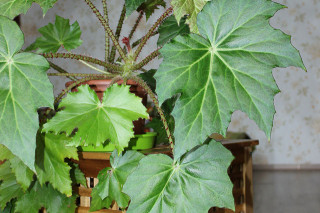
Begonia ricinifolia
Castor Bean Begonia · Star Begonia
Description
Source: leafsnapCastor Bean Begonia is an exotic, evergreen annual belonging to the Spurge Family(Euphorbiaceae), native to Mediterranean and tropical East Africa. It is herbaceous in nature and equally a fast growing plant that grows just upright from the beginning, and later develops branches to form a shrub with sturdy stems and a dense canopy. This plant grows alternate, star-shaped leaves on long petioles, with serrated edges and prominent central veins. Its flowers are produced in dense inflorescences which are usually 8-18 feet tall at the tops of the stems. It functions both as an ornamental plant and as a medicinal plant whose oil when processed can be used as a laxative for constipation.
Care Guide
💧 Water Every 5-7 days
☀️ Light
🌡️ Temperature
Castor Bean Begonia grows best in environments where temperatures remain fairly high in its growing season, and humidity range is on average level. So, in order for this plant to attain maximum growth, keep it under high temperature in its first 140 to 280 days, ensure 20-25°C in dry tropical regions and humidity range between 40-50%.
💨 Humidity
🪴 Soil
🌱 Fertilizer
This evergreen annual shrub requires frequent feeding with quality fertilizer from the sowing of the crop to its growing stages. Ideally, apply a base fertilizers such as full dose of P and K and half dose of N or in the ratio of 40:20:20 kg/ha. A half dose of N should be applied on the surface of the soil and plant one month after sowing. For the rest of its growing season, ensure to feed your Castor Bean plant once a month with a general, all-purpose fertilizer.
🪴 Pot & Repot
✂️ Pruning
Pruning is necessary to this fast growing plant because it helps to keep all the required parts in equal size, making them appear neat and healthy. To prune, use a sharp pruner to remove the summer-burnt leaves, as well as any shoots which look as if the winter frost has done its worst to them. Also remove visible bare stems and ensure that this pruning is done towards the end of Spring.
🌿 Propagating
🐛 Diseases & pets
☠️ Toxicity
The Castor Bean Begonia is known to be one of the most toxic plants, containing a toxin((RYE-sin) in their seeds which causes severe casualties in animals and humans who eat them. The leaves of the castor bean plant are also toxic, causing transitory muscle tremors, ataxia, and excessive salivation. For safety measures, endeavor to keep this plant out of reach of children and animals, and contact a veterinarian immediately if anyone around ingests the seed or leaves of this plant.
Characteristics
- Plant Type
- Annuals that can be grown as a houseplant
- Hardiness Zone
- 10-11
- Native Area
- South and Central America, Africa, southern Asia