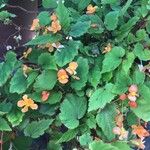
Begonia sutherlandii
Sutherland begonia · Garden Begonia · Cultivated Begonia
Description
Source: leafsnapBegonia sutherlandii, known as the Sutherland begonia and as iwozya in Kimalila, Tanzania, is a tuberous flowering perennial plant in the family Begoniaceae, growing to 0.5 metres (20 in) with fleshy pink stems from 10 to 80 centimetres (4 to 31 in) long. Leaves are commonly dark green and veined with red and covered with short hairs on the underside. They are asymmetrical in shape and the margin is toothed. Flowers, produced in pendent panicles throughout summer, are 20–26 millimetres (0.8–1.0 in) in diameter, and are usually orange or orange–red with yellow anthers. The plant is native to the southern highlands of Tanzania and is often found hanging over rocks in damp shady situations or on trees. It is also present in the Democratic Republic of the Congo and in South Africa. Begonia sutherlandii can be cultivated outdoors in frost-free areas. It has gained the Royal Horticultural Society's Award of Garden Merit.
Care Guide
💧 Water
The Sutherland begonia comes from humid, shaded regions and prefers consistent moisture with weekly watering. It thrives indoors in higher humidity conditions. To enhance its environment, especially during the growing season, consider using a pebble tray filled with water.
What should I do if I give my Sutherland begonia too much or too little water?
To determine if your plant has watering issues, closely observe it. Overwatering can cause the leaves to turn yellow and develop yellow-brown patches at the tips. In severe cases, the leaves may droop and curl due to root rot and the plant's difficulty in absorbing more water. If you have an indoor Sutherland begonia, overwatering is common and should be addressed early. Look for standing water or leaf changes, and stop watering immediately. Allow the soil to dry out for 3-5 days. For signs of root rot, act quickly by removing the plant from its pot or ground, washing off the roots, removing dead or decaying roots, and replacing the old soil with fresh soil. In addition to overwatering, underwatering is also a problem for Sutherland begonias. They are sensitive to drought and will decline rapidly without consistent watering. Signs of underwatering include curled, pendulous, lifeless leaves, gradual yellowing from the bottom, and browning edges. Increasing the frequency of watering will usually resolve underwatering. If the plant dries out quickly, increasing humidity can help retain moisture in the soil. Consider moving the plant if it receives excessive sunlight or is in a hot spot to prevent evaporation.
How frequently should I give water to my Sutherland begonia?
To ensure proper watering for your Sutherland begonia, here are some guidelines to follow. Generally, water the plant once per week during spring. However, in summer, increase the watering frequency compared to spring, and decrease it in winter. Keep in mind that timing may vary based on factors like humidity, temperature, and soil type. To determine the appropriate watering frequency for your begonia, use your finger or a Soil Moisture Meter to check the soil condition more often. Remember to keep the soil moist but not soggy. Water the plant after the top 1.5-2 inches of soil has dried out, and continually test the soil condition to establish a watering schedule. For potted plants, be cautious not to overwater them, as they are more prone to this than outdoor plants. Ensure the pot has proper drainage holes and well-draining soil. Check that there is no excess water in the plant tray before watering. If your Sutherland begonia is planted in the ground, natural rainfall will help its growth. Aim for about 1 inch of rain per week. If the rainfall is insufficient, additional watering may be needed once a week to support proper plant growth. Humidity also plays a role in keeping the plants properly watered. While the begonia can tolerate normal room humidity, it prefers higher humidity, ideally around 40 to 60 percent. Higher humidity levels help the soil retain moisture for longer. To increase humidity for indoor plants, consider placing a small humidifier nearby. For outdoor plants, misting the plant throughout the day can help maintain humidity.
How do I give my Sutherland begonia enough water?
Here are some practical ways to water your Sutherland begonia. If your plant is in a small indoor pot, take it to the kitchen sink and use the faucet to add water. Hold the pot and stop watering once water starts to drain out of the holes. Avoid doing this in winter or cold climates as it can harm the roots. If your tap water has high levels of fluorine, chlorine, or salts, consider using rainwater or lake water instead. You can also water the begonia by overhead watering or directly into the soil using a watering can, hose, or any other watering tool you prefer. For begonias planted in the ground, aim the hose at the root system for over 10 minutes when there's insufficient rainfall. It's important to know that the Sutherland begonia is sensitive to the type of water used. They prefer soft, acidic water, so if you have hard water, you can use a home water filter or let tap water sit for 24 hours to remove minerals and chemicals. Alternatively, filtered water or rainwater with a pH of 6.5 is ideal for the begonia. Store rainwater when it's available for your plant's watering needs.
When is the best time to water my Sutherland begonia plant?
The Sutherland begonia thrives in humid conditions that keep the soil moist, without allowing it to dry out completely. However, overly soggy soil can lead to root rot. To ensure proper hydration, it is advised to water the plants once the top 1.5-2 inches of soil have dried out. The recommended depth for testing soil moisture depends on the overall soil depth. For example, if the soil is around 5 inches deep, testing 1.5 inches (about one-third of the soil depth) is recommended, while larger pots may require more. If you have a Soil Moisture Meter, watering becomes simpler by inserting it into the soil. When the meter indicates a reading around 3, it is time to water. If the reading is still above 3, it is suggested to wait a little longer until the soil dries out more. Following this approach will help prevent overwatering your plants.
☀️ Light Partial sun
The Sutherland begonia performs best in spots with moderate sunlight, which supports healthy growth. Sunlight diffused by clouds or filtered through other foliage is ideal. The plant tolerates shady conditions. Too much sun can cause scorching, while too little can result in poor growth. It comes from habitats with these light conditions.
What are the sunlight requirements for Sutherland begonia?
The Sutherland begonia thrives in areas with moderate sun exposure, benefiting from sunlight that is either sheltered by clouds or filtered through foliage, making it suitable for shady environments as well. It requires about 3-6 hours of sunlight per day for optimal growth. However, too much direct sunlight can scorch the leaves, whereas insufficient light can lead to poor growth. It is crucial to monitor the movement of sunlight in your garden to ensure the plants are placed in locations that meet these light requirements effectively.
What should I know about artificial lighting for Sutherland begonia?
Indoor Sutherland begonia plants need adequate artificial lighting when natural sunlight is insufficient, especially during winter or in less sunny spaces. LED lights are recommended because they can be customized to provide specific light wavelengths that plants require. Full sun plants need 30-50 watts per square foot of artificial light, partial sun plants need 20-30 watts per square foot, and full shade plants need 10-20 watts per square foot. The light source should be placed 12-36 inches above the plant to mimic natural sunlight, and most plants need 8-12 hours of light per day.
What are the symptoms of improper lighting on Sutherland begonia?
When Sutherland begonia does not receive adequate light, it may exhibit symptoms such as smaller new leaves, leggy or sparse growth, faster leaf drop, slowed or ceased new growth, lighter-colored new leaves, chlorosis (yellowing leaves due to breakdown of chlorophyll from too much light), sunscald, leaf curling as a defense against too much sunlight, wilting from excessive water loss, and leaf scorching characterized by brown, dry, and crispy leaf edges. These symptoms indicate either too much or too little light.
How can I address lighting issues for an indoor Sutherland begonia?
For indoor Sutherland begonia facing lighting issues, gradually move the plant to sunnier spots each week until it receives the recommended 3-6 hours of direct sunlight daily for optimal growth. If moving the plant is not feasible due to its size, consider using desk or ceiling lamps for at least 8 hours daily or investing in professional plant grow lights. This gradual adaptation helps the plant adjust without getting sunburned.
What solutions are available for outdoor Sutherland begonia with insufficient sunlight?
For outdoor Sutherland begonia plants not receiving enough sunlight, gradually moving them to spots with better sunlight exposure can help. Incrementally transitioning the plants to sunnier locations weekly helps them adapt without the risk of sunburn. It's crucial to make these changes gradually to avoid any shock from sudden increases in light intensity.
🌡️ Temperature 20–37.8°C
Sutherland begonia shows good temperature adaptability, tolerating higher heat and fairly large temperature swings. In hot weather, care should be taken with watering and providing adequate shade to avoid sunburn. Conversely, Sutherland begonia is relatively intolerant of low temperatures. Although it can endure some cold, very low temperatures can cause frost damage.
💨 Humidity
🪴 Soil 5-6
🌱 Fertilizer Every 30 days
The best time to fertilize a Sutherland begonia is in early spring, when it is coming out of dormancy and starting active growth. Fertilizing supplies essential nutrients for healthy development. Although a Sutherland begonia has fairly low fertilizer requirements, applying fertilizer once a year can improve its survival and encourage better, longer-lasting flowers.
🪴 Pot & Repot 2-3 years
Repot your Sutherland begonia every 2 to 3 years in the spring to accommodate tuber growth. Choose a pot that is appropriately sized for the plant. After repotting, keep the soil moist and place the plant in indirect light to encourage optimal blooming and maintain healthy, patterned leaves.
✂️ Pruning
To encourage a Sutherland begonia to thrive, prune it from early to late spring. This involves removing dead stems and thinning out dense growth to improve air circulation and overall health. Additionally, regularly deadhead spent flowers to promote prolonged blooming. Use clean, sharp tools for all tasks to prevent disease and enhance the plant's vigor and appearance.
🌿 Propagating
🐛 Diseases & pets
☠️ Toxicity
Characteristics
- Plant Type
- Herb
- Life Cycle
- Perennial
- Genus
- Begonia
- Family
- Begoniaceae
- Hardiness Zone
- 9-11
- Mature Height
- 30 cm
- Mature Spread
- 30 cm
- Leaf Color
- Green
- Leaf Type
- Evergreen
- Flower Color
- Orange
- Flower Size
- 2.03 cm to 2.59 cm
- Bloom Time
- Summer, Early fall, Mid fall
- Planting Time
- Spring, Summer
- Harvest Time
- Late summer, Fall, Early winter