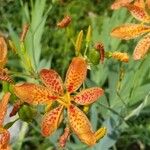
Belamcanda chinensis
Blackberry lily
Description
Source: leafsnapIris domestica, commonly known as leopard lily, blackberry lily, and leopard flower, is an ornamental plant in the family Iridaceae. In 2005, based on molecular DNA sequence evidence, Belamcanda chinensis, the sole species in the genus Belamcanda, was transferred to the genus Iris and renamed Iris domestica.
🌳 Blackberry lily has the unexpected ability to signal the presence of heavy metals in soil. As a result, it is employed in phytoremediation research to assess soil health. Its rhizomes are examined for their ability to absorb and store toxic metals, which can assist in environmental cleanup efforts.
🎭 Wisdom, hope and trust, royalty, depictions of victory and power
Care Guide
💧 Water
☀️ Light Full sun
The Blackberry lily flourishes when exposed to lots of light, which is reflective of its natural habitat. For optimal growth, it generally requires a substantial amount of daily sunlight. It can also cope with moderately lit conditions, although a severe lack of light might result in poor blooming and wilting. On the other hand, overexposure could potentially harm the leaves.
🌡️ Temperature 5–35°C
The preferred temperature of the blackberry lily changes throughout the various seasons. In spring and fall, it tends to favour a temperature scale of 50 to 65 ℉ (10 to 18 ℃). In contrast, during the sweltering summer period, it necessitates a temperature scale of 68 to 86 ℉ (20 to 30 ℃) to flourish. During winter, it can adapt to temperatures plummeting to as low as 23 ℉ (-5 ℃), albeit safeguarding the roots and retaining soil moisture is crucial.
💨 Humidity
🪴 Soil 6-7
🌱 Fertilizer
Typically, a one-time fertilization in spring is enough for Blackberry lily. However, for optimal growth, feeding the plant multiple times can be beneficial. This should be done every one to one and a half months. Through fertilization, the look and function of the leaves are improved, encouraging a steady color and a healthy texture. It also boosts the growth of roots and the plant's ability to absorb nutrients, contributing to its overall health in the long run.
🪴 Pot & Repot 2-3 years
When repotting Blackberry lily, pick a pot 1-2 inches (2.5–5.1 cm) larger with good drainage. Use a well-draining potting mix. Repot in spring or fall, making sure the root ball sits slightly lower than the rim of the flower pot. Water thoroughly after repotting and place it in a warm spot with indirect sunlight.
✂️ Pruning
🌿 Propagating
🐛 Diseases & pets
☠️ Toxicity
Characteristics
- Plant Type
- Herb
- Life Cycle
- Perennial
- Genus
- Belamcanda
- Family
- Iridaceae
- Hardiness Zone
- 5-10
- Mature Height
- 61 cm to 91 cm
- Mature Spread
- 25 cm to 61 cm
- Leaf Color
- Green
- Leaf Type
- Deciduous, Evergreen
- Flower Color
- Orange, Yellow
- Flower Size
- 4.06 cm to 5.08 cm
- Bloom Time
- Early summer, Mid summer
- Planting Time
- Spring
- Harvest Time
- Mid summer
- Native Area
- Russia, South Korea, China