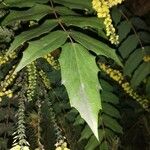
Berberis bealei
Leatherleaf mahonia · Beale's Barberry · Beale's Berberis · Beale's Mahonia · South China Barberry
Description
Source: leafsnapBerberis bealei, also known as leatherleaf mahonia, Beale's barberry, or Oregon grape, is a species of evergreen shrub native to mainland China. The species has been regarded as the same species as Berberis japonica, native to Taiwan, but the two differ consistently in certain floral and leaf characters. Both species are widely cultivated in many countries as ornamentals. Berberis bealei has reportedly escaped cultivation and become established in the wild in scattered places in the south-eastern United States from Arkansas to Florida to Delaware.
🌳 Leatherleaf mahonia is mainly appreciated for its ornamental qualities because of its yellow blossoms and red berries. Beyond its appearance, the berries provide food for birds and other local wildlife, forming an ecological niche. Although it is not widely used for other purposes, leatherleaf mahonia could be researched for its potential in producing natural dyes or for horticultural uses to attract particular wildlife, helping to support biodiversity.
🎭 Sourness of disposition. Sharpness
Care Guide
💧 Water
Leatherleaf mahonia thrives in moist, well-drained conditions that mimic its natural woodland habitat, and it can handle short periods of dryness. It should be watered every 1–2 weeks, ensuring the soil does not become waterlogged. As an evergreen, its waxy leaves help retain moisture, allowing for reduced watering frequency during cooler seasons.
How should I water my Leatherleaf mahonia plant properly?
Your Leatherleaf mahonia is not particular about the watering method you choose. You can use commonly available tools such as watering cans, hoses, or even cups to water it. It is important to water the plant directly at the soil level, making sure to evenly moisten all areas of the soil to provide sufficient water to all parts of the root system. Consider using filtered water to prevent any harmful particles present in tap water. It is also beneficial to use water that is close to room temperature, as extremely hot or cold water can be a bit harsh for the Leatherleaf mahonia. However, this plant generally responds well to any type of water.
What should I do if I give my Leatherleaf mahonia too much water or too little water?
Outdoor plants, especially newly planted ones, are prone to lack of watering. It is important to water them enough for the first few months, until the roots are established and can rely on rain. However, when Leatherleaf mahonia is planted in pots, overwatering is more likely. If you accidentally overwater your Leatherleaf mahonia, stop watering it immediately and check the roots. If there is no root rot, you can return it to the pot. Otherwise, trim the affected roots and apply a fungicide. Repot the plant in well-draining soil. On the other hand, if you underwater the Leatherleaf mahonia, its leaves will droop and dry out. Water it more frequently to fix this issue. Adjust your watering frequency as soon as you notice underwatering.
How often should I water my Leatherleaf mahonia plant?
To properly care for plants that grow outdoors, rainfall is usually enough. However, if your area doesn't get much rain, make sure to water your plants every two weeks in the spring and fall, and more frequently in the summer. In the winter, when plant growth slows down, you can water less often or even not at all. If you have a young or newly planted Leatherleaf mahonia, it's important to water it more frequently to help it establish and grow. For potted plants, there are two main ways to determine the watering schedule for your Leatherleaf mahonia. The first approach is to have a set watering schedule, such as once a week or once every other week. However, this method may not consider the specific growing conditions of your plant. Another option is to base your watering frequency on soil moisture. In general, it's best to wait until the top two to four inches of soil have completely dried out before giving more water. Keep in mind that during summer, when the plant needs more water, a predetermined schedule may not be sufficient.
How often should I water my Leatherleaf mahonia plant?
When watering your Leatherleaf mahonia, it's important to note that it doesn't always require a large amount of water. If only a few inches of soil have dried since the last watering, giving it about five to ten ounces of water is sufficient for healthy growth. You can also gauge the water volume based on the moisture level in the soil. If more than half of the soil has dried out, it's advisable to provide more water, ensuring that all the dry soil layers are moistened. In such cases, continue watering until you see excess water draining from the pot's drainage holes. If your Leatherleaf mahonia is planted in an area that receives ample rainfall, additional watering may not be necessary. However, when the plant is young or still establishing itself, it should ideally receive 1-2 inches of rain per week. As it grows and establishes, it can rely solely on rainwater, and only in hot weather or when there's no rainfall for 2-3 weeks should you consider giving it a full watering to prevent stress.
How do I know if I'm watering my Leatherleaf mahonia plant enough?
The Leatherleaf mahonia is more prone to overwatering, and there are clear signs to watch out for. If the plant is overwatered, its leaves will turn yellow and possibly fall off. Overwatering can also cause the plant's structure to shrink and lead to root rot. Conversely, an underwatered Leatherleaf mahonia will wilt and have brown or brittle leaves. Regardless of whether you see signs of overwatering or underwatering, taking action to revive the health of your Leatherleaf mahonia is crucial.
☀️ Light Partial sun
Leatherleaf mahonia favors sites where it can get moderate sunlight for a few hours daily and adapts to exposures from continuous sunlight to almost complete shade. In its native forest settings it prospered under the dappled light of the canopy. Too much sun can scorch the leaves, while too little can limit growth and lessen color vibrancy.
What are the sunlight requirements for leatherleaf mahonia?
Leatherleaf mahonia thrives in conditions ranging from moderate sunlight to nearly complete shade, ideally in locations that provide it with a few hours of sunlight each day. In its native forest environments, it prospered under the dappled light offered by the tree canopy. However, it's important to avoid exposing the plant to excessive sunlight as it can lead to leaf scorch, while insufficient light may stunt its growth and diminish its color vibrancy. For indoor plants, when natural light is not enough, particularly in winter or less sunny spaces, artificial lighting such as LEDs can be used. These need to be set at the correct distance and wattage depending on the plants' natural sunlight needs, and kept on for 8-12 hours a day to mimic natural daylight hours.
What are the symptoms of incorrect lighting for leatherleaf mahonia?
Leatherleaf mahonia shows various symptoms under incorrect lighting conditions, including smaller new leaves, leggy or sparse growth, faster leaf drop, slower or halted growth, paler or chlorotic leaves, sunscald, leaf curling, wilting, and leaf scorching. These symptoms indicate either excessive exposure to sunlight or insufficient light. Chlorosis, for example, results from too much sunlight, leading to a loss of chlorophyll and reduced photosynthesis, while sparse growth or smaller leaves result from too little light.
How can I address lighting issues for my leatherleaf mahonia?
To optimize growth for indoor leatherleaf mahonia facing lighting issues, gradually shift them to sunnier spots until they receive the recommended 3-6 hours of direct sunlight each day. If moving the plant isn’t feasible, consider supplemental artificial light like desk lamps or grow lights, ensuring they're turned on for at least 8 hours daily. Outdoors, gradually moving plants to sunnier locations each week can help avoid sunburn. Minimizing obstructions such as pruning branches or transplanting to sunnier spots during the plant's dormant period can significantly improve sunlight exposure. Note that parts of the plant affected by previous light conditions may not recover, but new growth should be healthier with improved light exposure.
🌡️ Temperature 15–35°C
Leatherleaf mahonia's native growth environment is a temperate climate, with a moderate temperature range of 15 to 35 ℃ (59 to 95 ℉). The plant prefers somewhat cooler conditions in winter and warmer conditions in summer. To accommodate seasonal changes, it is advisable to place the plant in a well-ventilated location during hot summer months and in a sheltered spot during winter months when frost is likely.
What is the ideal growth environment for leatherleaf mahonia?
Leatherleaf mahonia thrives in a temperate climate with a moderate temperature range of 15 to 35°C (59 to 95°F). It prefers slightly cooler temperatures during winter and warmer ones in summer. To adapt to changing seasons, it is recommended to place the plant in a well-ventilated area during hot summer months and in a sheltered area during winter, especially when frost is expected. Leatherleaf mahonia has some cold tolerance and does not usually require additional protection unless temperatures are expected to drop below -5°C, at which point temporary measures like wrapping with plastic film or fabric may be necessary until temperatures rise.
How does low temperature affect leatherleaf mahonia and what should be done?
Leatherleaf mahonia has a moderate tolerance to low temperatures and performs best when the temperature remains above 15°C. It should be kept above -5°C during winter months. If temperatures fall below -10°C, the leaves may droop, and although they can recover in mild cases, severe cold may result in permanent wilting and leaf loss. In such scenarios, frost-damaged parts should be trimmed off. Before encountering low temperatures again, the plant should be wrapped with non-woven fabric or cloth, and a wind barrier should be constructed to protect it from cold winds.
How does high temperature affect leatherleaf mahonia and what are the remedies?
During the summer, it's crucial to ensure that leatherleaf mahonia remains below 35°C. If the temperature exceeds 38°C, the plant may experience lighter leaf color, dry and withered leaf tips, leaf curling, and increased susceptibility to sunburn. To address this, sunburned and dried parts of the plant should be trimmed away. The plant should be moved to a shaded location, particularly away from the harsh midday and afternoon sun, or a shade cloth can be used. Furthermore, watering the plant in the morning and evening to maintain soil moisture is beneficial.
💨 Humidity
🪴 Soil 6-7
🌱 Fertilizer
Fertilize your Leatherleaf mahonia in early spring to encourage healthy growth. Regular feeding improves overall health, producing vigorous growth, greater resilience to harsh conditions, and enhanced resistance to diseases and pests. Keep to a specific fertilization schedule for your Leatherleaf mahonia to maintain vibrant foliage with deep color and a lush look.
Why should I put fertilizer on my Leatherleaf mahonia?
To promote the overall health and beauty of your Leatherleaf mahonia, it is important to regularly fertilize it. By providing the proper nutrients, your plant will have stronger growth and become more resilient to challenging growing conditions. Additionally, it will develop a better defense against diseases and pests. One of the most appealing aspects of the Leatherleaf mahonia is its foliage, so it is crucial to maintain it. This can be achieved by following a regular fertilization schedule tailored specifically for your plant. This will encourage the growth of vibrant, richly colored leaves, giving your Leatherleaf mahonia a lush and attractive appearance.
When should I fertilize my Leatherleaf mahonia?
To properly fertilize your Leatherleaf mahonia, start in late winter or early spring. This will give it the necessary nutrients to thrive once the weather warms up. If you live in a warm climate, it's also beneficial to fertilize again in early fall. This provides additional nutrients for the following growing season and helps your mahonia withstand winter cold without foliage damage. By fertilizing earlier, you allow new branches enough time to grow and become strong enough to endure the winter.
When is it a bad idea to fertilize my Leatherleaf mahonia?
There are specific times throughout the year when you should avoid fertilizing your Leatherleaf mahonia. Firstly, during the early and mid-winter months when the plant is dormant and doesn't require any feeding. Similarly, it is not recommended to fertilize this plant in the late spring and summer when the weather is hotter and drier. These conditions can cause a negative reaction to fertilization. To prevent such problems, it is best to follow a fertilization schedule that involves feeding only in early spring and early fall.
What kind of fertilizer does my Leatherleaf mahonia plant need?
The most important nutrient for a Leatherleaf mahonia is usually nitrogen, but phosphorus and potassium are also important. Your Leatherleaf mahonia needs a good amount of all three nutrients, so a balanced fertilizer like a 10-10-10 can work well. However, a more specific nutrient ratio can lead to better growth. Fertilizers with a slightly higher nitrogen content, like a 10-6-4 ratio, often work well. You can use either a granular or liquid fertilizer when fertilizing.
How should I add fertilizer to my Leatherleaf mahonia plant?
To fertilize your Leatherleaf mahonia, you have two options: using granular fertilizer or liquid fertilizer. For granular fertilizer, simply sprinkle it on the soil at the appropriate time. The slow-release nature of granular fertilizer will gradually release nutrients into the soil. It is recommended to lightly water your Leatherleaf mahonia before applying the fertilizer. Alternatively, you can use liquid fertilizer, although this is less common. To do this, mix the fertilizer with water and pour it onto the soil around the base of your Leatherleaf mahonia. If you want to be more thorough, consider performing a soil test before fertilizing. This will help you determine if any adjustments to the pH level are necessary.
🪴 Pot & Repot 2-3 years
When transferring a Leatherleaf mahonia to a new container, select a pot that is 1-2 inches larger (2.5–5.1 cm) with ample drainage. Use a well-draining potting mix. Repot in spring or fall, making sure the root ball sits slightly below the rim of the flower pot. Water thoroughly after repotting and place the plant in a warm spot with indirect sunlight.
✂️ Pruning
Pruning can enhance the vigor of leatherleaf mahonia, particularly when it is used as a hedge. To do this effectively, prune in the spring, removing no more than one-third of the canopy. Make sure to make angled cuts. Always disinfect your tools and wear gloves to prevent cross-contamination and to protect the plant’s delicate tissues.
🌿 Propagating
🐛 Diseases & pets
☠️ Toxicity
Characteristics
- Plant Type
- Shrub
- Life Cycle
- Perennial
- Genus
- Berberis
- Family
- Berberidaceae
- Hardiness Zone
- 8-9
- Mature Height
- 0.49 m to 3.96 m
- Mature Spread
- 0.91 m to 2.44 m
- Leaf Color
- Green, Blue, Bronze
- Leaf Type
- Evergreen
- Flower Color
- Yellow
- Flower Size
- 7.62 cm to 15.24 cm
- Bloom Time
- Early spring, Mid spring
- Planting Time
- Spring, Autumn
- Harvest Time
- Late spring, Early summer, Mid summer