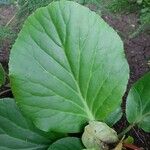
Bergenia cordifolia
Heartleaf Bergenia · Siberian-tea · Heart-leaved Bergenia
Description
Source: leafsnapBergenia cordifolia, commonly known as heart-leaved bergenia or elephant's ears, is a herbaceous perennial from the Saxifragaceae family. Native to central Asia, it thrives in the Himalayas, Siberia, and China. The plant reaches up to 30 cm in height and features large, glossy green leaves that are heart-shaped with slightly serrated edges. In autumn, these leaves turn a striking reddish-bronze. From late winter through early spring, Bergenia cordifolia produces clusters of pink or magenta flowers on tall stems that rise above the foliage. These bell-shaped flowers have five petals and emit a sweet fragrance. Valued as an ornamental garden plant, Bergenia cordifolia is favored for its attractive foliage and early spring blooms. It prefers moist soil conditions but can tolerate some drought once established. Additionally, the plant is noted for its medicinal properties and has been traditionally used to treat various ailments, including coughs, colds, diarrhea, and inflammation. Overall, Bergenia cordifolia is an easy-to-grow perennial that enhances any garden with its beauty and offers medicinal benefits for those who seek them out.
🌳 The leaves of heartleaf bergenia are not widely recognized for culinary purposes, yet in Russia they enhance local cuisine. They are fermented to create a preparation called "Bergenia Kvass," a variation of the traditional fermented drink kvass. This usage is noteworthy because it converts a hardy ornamental plant into a component of a long-standing food tradition, illustrating the plant's utility beyond decorative use.
Care Guide
💧 Water Every 7 days
Bergenia grows in consistently moist soil. They should only be watered when they have dried out. When an inch of the topsoil feels dry, thoroughly water your plant. Generally, bergenia growing in deep shade will require less watering and survive short periods of drought.
☀️ Light Partial sun
Heartleaf bergenia prefers a balance of sun and shade during the day, showing its ability to cope with different light levels. Native to areas where overhead foliage produces dappled light, it can tolerate full shade and endure substantial sunlight. Too much exposure can burn the leaves, while too little light may inhibit its growth.
🌡️ Temperature 0–32.2°C
Heartleaf bergenia is native to climates with temperatures from 32 to 90 °F (0 to 32 ℃). It prefers cooler temperatures but can tolerate warmer environments up to 90 °F (32 ℃). Seasonal adjustments may be required in extreme cold.
💨 Humidity
🪴 Soil 6-7
🌱 Fertilizer
Early spring, as the Heartleaf bergenia comes out of dormancy and starts active growth, is the best time to fertilize it. Fertilization supplies essential nutrients needed for healthy development. While Heartleaf bergenia has fairly low fertilizer requirements, applying fertilizer annually can improve its survival and encourage better, longer-lasting flowers.
🪴 Pot & Repot
✂️ Pruning
Bergenia plants need only little to no pruning. Deadheading will not stimulate further flowering, but you can remove spent blooms and old or dead foliage to maintain a tidy bergenia.
🌿 Propagating
🐛 Diseases & pets
☠️ Toxicity
Bergenia is toxic to dogs, but has not demonstrated toxicity to cats or people.
Characteristics
- Plant Type
- Herb
- Life Cycle
- Perennial
- Genus
- Bergenia
- Family
- Saxifragaceae
- Hardiness Zone
- 3-7
- Mature Height
- 15 cm to 31 cm
- Mature Spread
- 30 cm to 61 cm
- Leaf Color
- Green, Red
- Leaf Type
- Evergreen
- Flower Color
- Pink
- Flower Size
- 0.51 cm to 0.51 cm
- Bloom Time
- Mid spring, Late spring
- Planting Time
- Spring
- Harvest Time
- Early summer, Mid summer
- Native Area
- Russia, Kazakhstan, Mongolia, Koppen, China