Bergenia purpurascens
Purple bergenia
Description
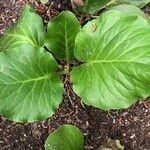
Source: leafsnapBergenia purpurascens, the purple bergenia, is a species of flowering plant in the family Saxifragaceae. It is a perennial herb and is native to Nepal, the eastern Himalayas, Assam, Tibet, south-central China, and Myanmar. The species, its putative variety Bergenia purpurascens var. delavayi, and its cultivar 'Irish Crimson' have all gained the Royal Horticultural Society's Award of Garden Merit. A useful feature in the garden is the visual interest that its foliage provides by turning a deep beet red during the winter. The Latin specific epithet purpurascens is in reference to the foliage that is purple in color.
🌳 Purple bergenia is a hardy perennial known for its pink flower clusters and leathery leaves that transition from green to dark red. It is ideal for borders, perennial flowerbeds, and as a groundcover. Its spreading growth habit makes it perfect for covering banks and slopes. Purple bergenia thrives in cottage, informal, and coastal gardens. Its shade tolerance also allows it to be an excellent underplanting choice for shrubs and roses.
🎭 Wellness and renewal
Care Guide
💧 Water
Purple bergenia thrives in cool, mountainous regions and prefers consistent moisture along with partial shade. To keep this plant healthy, water it weekly to prevent waterlogging. Using mulch can help retain soil moisture during its growing season. As an herbaceous perennial, purple bergenia is commonly grown outdoors and is known for its lush foliage.
☀️ Light Partial sun
Purple bergenia does well with substantial sunlight and can also prosper in full sun. These conditions would boost the plant's health. In its native habitat, bright light supported its healthy growth. However, too little or too much light can hinder its development.
What are the sun requirements for Purple Bergenia?
Purple Bergenia requires a considerable amount of sunlight to thrive. It can flourish in both partial sun, receiving about 3-6 hours of sunlight, and full sun, which is above 6 hours of sunlight each day. It's crucial to monitor the movement of sunlight through your garden to ensure that your plants are placed in spots with the ideal balance of light and shade. This careful placement guarantees their well-being and promotes healthy growth.
What are the essentials for growing Purple Bergenia successfully?
For successful growth, Purple Bergenia needs significant sun exposure. While it can prosper in full sun, it also does well with partial sun exposure. In its natural habitat, it flourishes under well-lit conditions which is crucial for its healthy development. However, both insufficient and excessive light can adversely affect its growth. To mitigate light-related issues, especially indoors where natural light may be limited, employing artificial lighting such as LED lights, which can provide tailored wavelengths, becomes vital. Depending on the plant's sunlight needs, 10-50W/sq ft of artificial light is appropriate, positioned 12-36 inches above the plant, with 8-12 hours of light per day emulating natural daylight hours.
How to identify if Purple Bergenia is getting inadequate light?
Insufficient light can trigger several symptoms in Purple Bergenia. These include smaller new leaves, leggy or sparse growth making the plant appear thin and weak, faster leaf drop as a conservation effort, slowed or halted growth, lighter-colored or pale new leaves indicating a lack of essential nutrients, and specific conditions like chlorosis, where leaves lose their green color. Excessive sunlight can also harm, leading to symptoms such as sunscald, leaf curling, wilting, and leaf scorching, all of which diminish the plant's health and growth capacity.
What solutions can help Purple Bergenia adapt to light conditions?
To help Purple Bergenia adapt to light conditions, gradually acclimate it to the optimal sunlight exposure, about 3-6 hours daily, especially if transitioning plants outdoors. For indoor plants too large or immovable for natural sunlight, supplement with artificial light sources like desk or ceiling lamps, or professional plant grow lights for at least 8 hours a day. To handle outdoor light adaptation, move your plants progressively to sunnier spots weekly, avoiding sudden, intense exposure to prevent sunburn. If sunlight is obstructed, consider pruning or relocating plants to sunnier, well-drained areas during their dormant period for better light access and growth.
🌡️ Temperature 5–32.2°C
The purple bergenia favors cool to mild temperatures between 41 and 89.6 ℉ (5 to 32 ℃). It comes from a temperate habitat and copes with seasonal temperature shifts fairly well. In summer, providing moderate shade is advised to prevent heat damage.
What are the ideal temperature conditions for Purple Bergenia?
Purple Bergenia (Bergenia purpurascens) thrives in cool to mild temperatures, ideally ranging from 41 to 89.6°F (5 to 32°C). It is well-adapted to the temperate environment of its native habitat and can adjust to seasonal temperature changes. During the summer, it's advisable to provide the plant with moderate shade to protect it from heat damage. Moreover, while the plant exhibits strong cold resistance, in extremely cold winter conditions where temperatures drop below -30°C, it is important to take measures to protect the plant, like covering it with soil or straw. Additionally, to combat potential drought and water scarcity during winter and early spring, watering the plant abundantly before the first freeze of autumn is recommended, ensuring the soil remains moist as it freezes.
How does Purple Bergenia react to extreme temperatures?
Purple Bergenia is notably cold-tolerant, with optimal health when temperatures are maintained above 5°C and caution advised if winters reach below -25°C. In the case of temperatures plummeting beneath -30°C, the plant may not exhibit immediate damage during winter, but you might notice a reduction or absence of sprouting in spring. To address lack of sprouting, it's suggested to remove the non-sprouting parts come spring. In contrast, during high temperatures, specifically above 32°C and peaking over 35°C, the plant's leaves may lighten, curl, show signs of sunburn, and the whole plant could potentially wilt and dry out. In such scenarios, trimming the damaged parts, relocating the plant to a shaded area during peak sun hours, or utilizing a shade cloth for protection, alongside morning and evening watering to maintain soil moisture, are advantageous steps.
💨 Humidity
🪴 Soil 5-7
🌱 Fertilizer
One fertilizer application in spring is generally enough for Purple bergenia, although repeated feedings can maximize growth. Feed every month to a month and a half. Fertilization improves the leaves’ appearance and function, maintaining even color and a healthy texture. It also encourages root development and nutrient uptake for long-term plant health.
🪴 Pot & Repot 2-3 years
When repotting Purple bergenia, select a pot 1-2 inches (2.5–5.1 cm) larger with ample drainage. Use a well-draining potting mix. Repot in spring or fall, ensuring the root ball is slightly lower than the rim of the flower pot. Water thoroughly after repotting and place it in a warm spot with indirect sunlight.
✂️ Pruning
Purple bergenia features large, rounded leaves and striking pink flowers. To promote vigorous growth and dense foliage, prune the plant from early to late spring after it has finished flowering. Be sure to remove any dead leaves to improve air circulation and always use clean tools to prevent the spread of disease. Following these steps will help you maintain a healthier plant.
🌿 Propagating
🐛 Diseases & pets
☠️ Toxicity
Characteristics
- Plant Type
- Herb
- Life Cycle
- Perennial
- Genus
- Bergenia
- Family
- Saxifragaceae
- Hardiness Zone
- 4-8
- Mature Height
- 13 cm to 52 cm
- Mature Spread
- 30 cm
- Leaf Color
- Green, Red, Purple
- Leaf Type
- Evergreen
- Flower Color
- Pink
- Flower Size
- 2.03 cm
- Bloom Time
- Mid spring, Late spring
- Planting Time
- Spring
- Harvest Time
- Early summer, Mid summer
- Native Area
- Nepal, India, Myanmar, Bhutan, China