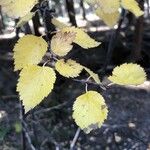
Betula occidentalis
Water birch · River birch · Western Birch · Black birch · Mountain birch
Description
Source: leafsnapBetula occidentalis, the water birch or red birch, is a species of birch native to western North America, in Canada from Yukon east to Northwestern Ontario and southwards, and in the United States from eastern Washington east to western North Dakota, and south to eastern California, northern Arizona and northern New Mexico, and southwestern Alaska. It typically occurs along streams in mountainous regions, sometimes at elevations of 2,100 metres (6,900 feet) and in drier areas than paper birch. It is a deciduous shrub or small tree growing to 14 m (46 ft) high, up to 25 centimetres (10 inches) thick. It tends toward epicormic growth, with many small limbs sprouting from the trunk and causing the wood to be full of small knots. The bark is dark red-brown to blackish, and smooth but not exfoliating. The twigs are glabrous or thinly hairy, and odorless when scraped. The leaves are alternate, ovate to rhombic, 1–7 cm (1⁄2–2+3⁄4 in) long and 1–4.5 cm (1⁄2–1+3⁄4 in) broad, with a serrated margin and two to six pairs of veins, and a short petiole up to 1.5 cm (1⁄2 in) long. The flowers are wind-pollinated catkins 2–4 cm (3⁄4–1+1⁄2 in) long, the male catkins pendulous, the female catkins erect. The fruit is 2–3 cm (3⁄4–1+1⁄4 in) long and 8–15 millimetres (1⁄4–1⁄2 in) broad, composed of numerous tiny winged seeds packed between the catkin bracts.The identity of similar birches in Alaska is disputed; some include them in B. occidentalis, while others regard them as hybrids between Betula neoalaskana and Betula glandulosa.The foliage is browsed by sheep, goats, and birds; some small birds also consume the seeds. Some Plateau Indian tribes used water birch to treat pimples and sores.
Care Guide
💧 Water
Water birch flourishes in well-hydrated environments and needs watering every two weeks to prevent waterlogging. Typically found in streamside habitats, it helps manage erosion in riparian areas and thrives on the dynamic water flow and soil moisture levels found there.
☀️ Light Full sun
Water birch prefers sites that get bright light for most of the day, though it can tolerate moderate light during part of the day. Native to habitats with those light conditions, its growth can be hindered by too little light or it can become stressed from too much exposure.
What are the sunlight requirements for Water Birch?
Water Birch requires full sun, which means it needs more than 6 hours of sunlight daily, but can also thrive in partial sun, receiving about 3-6 hours of sunlight. Ensuring the right balance of light and shade is crucial for the happiness and health of your plants. It's important to observe how sunlight moves through your garden to choose the best spots for planting.
Can Water Birch grow under artificial lighting?
Yes, Water Birch can grow under artificial lighting, especially when natural sunlight is insufficient, such as in winter or less sunny spaces. Indoor plants benefit from artificial lights, like LED lights, which can be customized to provide specific wavelengths needed for optimal growth. For full sun plants, 30-50W/sq ft of artificial light is recommended; partial sun plants need 20-30W/sq ft; and full shade plants need 10-20W/sq ft. The light source should be placed 12-36 inches above the plant to mimic natural sunlight, and the duration should mimic natural daylight hours, usually 8-12 hours of light per day.
What are some common symptoms of light deficiency or overexposure in Water Birch?
Common symptoms of light deficiency in Water Birch include smaller new leaves, leggy or sparse growth, faster leaf drop, slower or no new growth, and lighter-colored new leaves. Overexposure symptoms include chlorosis, where leaves lose their green color and turn yellow; sunscald, with damage appearing as pale, bleached, or necrotic areas; leaf curling as a defense mechanism against excessive sunlight; wilting due to increased water loss; and leaf scorching, characterized by brown, dry, and crispy leaf edges.
How can I address light-related issues with my Water Birch?
To optimize Water Birch's growth and address light-related issues, gradually move plants to sunnier locations to ensure they receive at least 6 hours of sunlight daily. For indoor plants, use artificial light if necessary, keeping a desk or ceiling lamp on for at least 8 hours daily or investing in plant grow lights. Outdoors, avoid sudden changes in light intensity to prevent sunburn. If sunlight is blocked, consider pruning obstructions or transplanting smaller plants to sunnier spots. Note that parts of the plant damaged by insufficient light might not recover, but new growth will be healthy with increased light exposure.
🌡️ Temperature 0–25°C
Water birch is an indigenous plant that thrives in conditions with temperatures ranging from 32 to 77 °F (0 to 25 ℃). In colder seasons, a moderate increase in temperature can aid its survival.
💨 Humidity
🪴 Soil 5-6
🌱 Fertilizer
Fertilize your Water birch in early spring to encourage healthy growth. Regular fertilization improves overall health, leading to vigorous growth, increased tolerance of harsh conditions, and enhanced resistance to diseases and pests. Stick to a specific fertilization schedule for your Water birch to keep the foliage vibrant, deeply colored, and lush.
🪴 Pot & Repot
✂️ Pruning
Pruning water birch trees in early spring encourages healthy growth and helps reduce the risk of disease. To do this, remove any dead or diseased branches and thin out crowded areas to improve air circulation. Be careful to avoid heavy pruning, as it can stress the tree. Instead, focus on regular light pruning to enhance the tree's structure and vitality.
🌿 Propagating
🐛 Diseases & pets
☠️ Toxicity
Characteristics
- Plant Type
- Tree, Shrub
- Life Cycle
- Perennial
- Genus
- Betula
- Family
- Betulaceae
- Hardiness Zone
- 2-4
- Mature Height
- 3.05 m to 12.19 m
- Mature Spread
- 4.57 m
- Leaf Color
- Yellow, Green
- Leaf Type
- Deciduous
- Flower Color
- Yellow, Green, Brown
- Flower Size
- 2.03 cm to 4.06 cm
- Bloom Time
- Early spring, Mid spring
- Planting Time
- Spring
- Harvest Time
- Late summer, Early fall, Mid fall