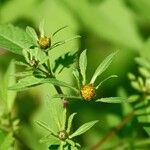
Bidens tripartita
دو دندان، گونه ای گل آفتاب رو، · Three-lobe Beggar-ticks · Trifid bur-marigold · Water-agrimony · Marigold-bur
Description
Source: leafsnapBidens tripartita, commonly known as three-lobe beggarticks, is a flowering plant in the Asteraceae family. Native to North America, it thrives in wetlands, marshes, and along the edges of streams and ponds. The plant can grow up to 3 feet tall and features a slender stem that branches into several smaller stems. Its green leaves are distinguished by their three lobes and serrated edges. Bidens tripartita produces small yellow flowers with five petals, which bloom from July to September. These flowers attract bees, butterflies, and other pollinators. The plant’s fruit is a small, burr-like structure containing several seeds that can adhere to clothing or animal fur for dispersal. Traditionally, Bidens tripartita has been used for its anti-inflammatory properties and to treat skin conditions like eczema and psoriasis when applied topically. In addition, it has been incorporated into herbal teas for its diuretic effects. In summary, Bidens tripartita is a fascinating wetland species that provides ecological benefits by creating habitats for wildlife. Its medicinal uses further underscore its importance both ecologically and medicinally.
🌳 Black-jack, a versatile entity, has moved well beyond its medicinal reputation, supplying natural yellow dyes from extracts rich in flavonoids. It also plays an unexpected ecological role, indicating elevated levels of certain toxic metals, such as nickel, in soil. This feature highlights its suitability for phytoremediation, the use of plants to clean up polluted environments.
🎭 Caution against jealousy and covetousness
Care Guide
💧 Water Every 3 days
The Three-Lobe Beggartick flourishes in moist environments, as it prefers consistent moisture and requires weekly watering. Although it can moderately withstand drought, it is adaptable to varying water levels, which is typical of its natural habitat. When grown outdoors, the Three-Lobe Beggartick thrives in full sun and damp soil, demonstrating strong growth when adequate water is available.
How should I water my Three-Lobe Beggartick plant?
To water Three-Lobe Beggartick, you have several options: a garden hose with a spray nozzle, a watering can, or any other common watering tool. This plant isn't particularly fussy about the type of water it receives; it can survive with rainwater, tap water, or filtered water. It's generally advised to avoid watering this plant from above as it can harm the leaves, flowers, and potentially cause disease. A drip irrigation system is often the best method for watering Three-Lobe Beggartick as it delivers water evenly and directly to the soil. For container-grown plants, you can use a cup, watering can, or tap water to directly water the soil.
What do I do if I give my Three-Lobe Beggartick plant too much or too little water?
To remedy underwatering for Three-Lobe Beggartick, simply water it more regularly when you notice it lacks moisture. Overwatering, on the other hand, is a more serious issue that can lead to diseases and death if not caught early. Prevent this by choosing a suitable location that receives ample sunlight, allowing the soil to dry out, and promotes good drainage. If your potted Three-Lobe Beggartick is overwatered, consider transferring it to a new pot with better drainage and loose soil.
How much should I water my Three-Lobe Beggartick?
To keep your Three-Lobe Beggartick healthy, it's important to water it regularly. In the spring, watering once a week should be sufficient. However, as the season progresses and it gets hotter, you may need to water two to three times per week. Be careful not to over-water, as this can harm the plant. Regardless of watering frequency, make sure the soil remains moist but not soaked. If you are growing the plant in a pot, you will likely need to water more often compared to when it's planted in the ground. Generally, watering a potted Three-Lobe Beggartick a few times per week should be enough, as pot soil can dry out faster.
How much water does my plant, Three-Lobe Beggartick, need?
Determining the appropriate amount of water to give your Three-Lobe Beggartick can be done in a few different ways. Some gardeners prefer to judge the water volume by checking the moisture level of the soil. In this method, you would water until you feel that the top six inches of soil are moist. Another approach is to use a specific measurement as a guideline. Typically, giving your Three-Lobe Beggartick about two gallons of water per week is recommended, taking into account factors such as temperature and soil dryness. However, it's essential to be cautious as adhering strictly to guidelines can result in overwatering if your plant needs less water. When growing your Three-Lobe Beggartick in a container, a different method is needed to determine watering amount. Ideally, you should water enough to moisten all layers of dry soil. You can easily test this by inserting your finger into the soil to check for moisture or by watering until a slight trickle of excess water drains from your pot's drainage holes.
How can I know if I am watering my Three-Lobe Beggartick plant enough?
Taking care of your Three-Lobe Beggartick plant can be a bit challenging when it comes to watering. On one hand, these plants have deep roots that need to be moistened every week. However, overwatering can easily lead to root rot and browning. Underwatering is less of a concern as these plants can survive without regular watering, but if you neglect watering for too long, they will start wilting and developing dry leaves.
☀️ Light Full sun
Black-jack does best with ample light yet tolerates a moderate amount of shade. Native to sunny environments, it has adapted to prosper under bright sunlight for optimal growth. Both insufficient and excessive sunlight can harm its health and interfere with its normal development.
What are the sunlight requirements for Three-Lobe Beggartick?
Three-Lobe Beggartick requires a substantial amount of sunlight to thrive, performing best in full sun conditions, which means it should receive above 6 hours of sunlight daily. It can also grow in partial sun, with about 3-6 hours of sunlight. However, to ensure the plant's happiness and health, it's crucial to observe how sunlight moves through your garden to find the perfect balance of light and shade. Over-exposure or under-exposure to sunlight can lead to issues like leaf discoloration.
How can I support Three-Lobe Beggartick's growth with artificial lighting?
For optimal growth, especially when natural sunlight is insufficient, artificial lighting can be a vital solution for indoor plants. Effective options include using LED lights, which can be customized to provide the specific wavelengths your plants need. Full sun plants require 30-50W/sq ft, partial sun plants need 20-30W/sq ft, and full shade plants require 10-20W/sq ft of artificial light. The light source should be placed 12-36 inches above the plant to mimic natural sunlight, and plants typically need 8-12 hours of light per day.
What symptoms indicate Three-Lobe Beggartick is getting inadequate light?
Inadequate light can cause several symptoms in Three-Lobe Beggartick, including smaller leaves than previously matured ones, leggy or sparse growth, faster leaf drop, slower or no new growth, lighter-colored new leaves, chlorosis (leaves turning yellow), sunscald, leaf curling, wilting, and leaf scorching. These symptoms can indicate whether the plant needs adjustments in its lighting conditions.
How can I address lighting issues for my Three-Lobe Beggartick?
To address lighting issues, gradually increase sunlight exposure for your Three-Lobe Beggartick by moving it to sunnier locations each week, with the goal of providing at least 6 hours of direct sunlight daily. For indoor plants, consider using artificial lights if the plant is large or not easily movable, keeping a light on for at least 8 hours daily or investing in professional grow lights. For outdoor plants, be cautious to avoid sudden light intensity changes to prevent sunburn. If sunlight is obstructed, consider pruning or transplanting smaller plants to sunnier locations.
🌡️ Temperature 10–37.8°C
Black-jack is naturally adapted to tolerate temperatures between 68 and 100 °F (20 and 38 ℃) because of its native growing environment. In cooler seasons, modify temperatures as needed to maintain healthy growth.
What are the ideal temperature conditions for Three-Lobe Beggartick?
Three-Lobe Beggartick thrives in temperatures ranging from 68 to 95 °F (20 to 35 °C), showing ease in adjusting to varying temperatures throughout the seasons. Rarely needing adjustment recommendations, it possesses strong cold resistance, typically not requiring special frost protection measures in winter. However, for extremely low winter temperatures below -25°C, it is important to provide cold protection by covering the plant with soil or straw and watering it abundantly before the first freeze in autumn to maintain soil moisture, thereby preventing drought and water scarcity during winter and early spring.
How does Three-Lobe Beggartick react to low temperatures, and what solutions are recommended?
Three-Lobe Beggartick is known for its cold tolerance, flourishing best when temperatures are above 20°C and should be kept above 0°C during winter. If temperatures fall below -25°C, the plant may not show noticeable changes during winter but may experience a decrease in sprouting or fail to sprout in spring. The recommended solution for spring is to remove any parts of the plant that have failed to sprout, aiding in its recovery and growth.
What effect do high temperatures have on Three-Lobe Beggartick, and how can these issues be mitigated?
In high temperature conditions, particularly above 35°C, Three-Lobe Beggartick's leaves may lighten in color, become prone to curling, susceptible to sunburn, and in severe cases, the entire plant may wilt and dry up. To mitigate these issues, sunburned and dried parts of the plant should be trimmed away. It's advisable to move the plant to a location that offers shade during the midday and afternoon sun, or use a shade cloth to protect it. Watering the plant in the morning and evening will help keep the soil moist, thereby supporting the plant's health in high temperatures.
What is the botanical name of Three-Lobe Beggartick?
The botanical name of Three-Lobe Beggartick is Bidens tripartita.
💨 Humidity
🪴 Soil 6-7
🌱 Fertilizer
Black-jack responds well to regular, light applications of fertilizer to encourage healthy leaf development. Fertilize Black-jack about once a month during the summer. Nitrogen is important for foliage, and providing nitrogen-rich sources helps Black-jack thrive.
🪴 Pot & Repot
✂️ Pruning
The Three-Lobe Beggartick has trifoliate leaves and grows in a bushy form. To promote its health, prune the plant from early to late spring. During pruning, remove any dead stems and thin out dense areas to improve air circulation. Regular pruning results in a stronger, more attractive plant and enhances its overall vitality.
🌿 Propagating
🐛 Diseases & pets
☠️ Toxicity
Characteristics
- Plant Type
- Herb
- Life Cycle
- Annual, Perennial
- Genus
- Bidens
- Family
- Asteraceae
- Hardiness Zone
- 6-12
- Mature Height
- 0.1 m to 1.83 m
- Mature Spread
- 20 cm to 91 cm
- Leaf Color
- Green
- Leaf Type
- Deciduous
- Flower Color
- White, Yellow
- Flower Size
- 0.51 cm to 1.52 cm
- Bloom Time
- All year round
- Planting Time
- Spring
- Harvest Time
- All year round
- Native Area
- Sri Lanka, Saudi Arabia, Egypt, Belize, Honduras, Mexico, Peru, Pakistan, Laos, Trinidad and Tobago, Panama, Jamaica, Lebanon, Uruguay, Colombia, Cuba, Haiti, Cameroon, Bolivia, Venezuela, Guyana, El Salvador, Nicaragua, Bhutan, South Korea, Suriname, Costa Rica