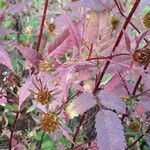
Bidens vulgata
Tall beggar-ticks · Big Devil's Beggartick · Tall Beggarsticks · Tall Beggarticks · Western Sticktight
Description
Source: leafsnapBidens vulgata is a species of flowering plant in the family Asteraceae known by the common names big devils beggarticks and tall beggarticks. It is native to eastern and central North America from Nova Scotia to northern Georgia and as far west as the Rocky Mountains. It is an introduced species on the West Coast of North America as well as parts of Europe.Bidens vulgata is an annual herb producing a hairy stem which generally grows 30 to 50 centimeters (12 to 20 inches) tall but often grows much taller, exceeding 100 cm (39 in). The leaves are made up of several lance-shaped leaflets each up to 8 centimeters long. The inflorescence produces several small flower heads with centers of yellow disc florets and a fringe of 3 to 5 yellow ray florets a few millimeters in length. Some heads lack ray florets. The fruit is a flattened achene with two sharp barbs at one end. The species grows primarily in wet locations such as swamps, marshes, streambanks, etc.
Care Guide
💧 Water
Tall beggarticks thrive in moist conditions and need regular watering, ideally on a weekly basis. While they can endure short periods of dryness, they benefit greatly from rainwater, which complements their natural water intake patterns and supports healthy growth.
☀️ Light Full sun
Tall beggarticks comes from bright, open habitats and does best in full sun. It will tolerate some partial shade but prefers direct sunlight for optimal growth. This plant, which may be annual or biennial, is noted for its sun-loving nature.
What are the sunlight requirements for Tall Beggarticks?
Tall Beggarticks thrives in bright, open environments and requires full sun, which is above 6 hours of sunlight, for optimal growth. It can also tolerate partial sun, approximately 3-6 hours of sunlight. Watching how sunlight moves through your garden and choosing spots with the perfect balance of light and shade is crucial for the plant's happiness.
How does artificial lighting benefit indoor plants like Tall Beggarticks?
Indoor plants, such as Tall Beggarticks, require adequate lighting for optimal growth, especially when natural sunlight is insufficient. Artificial lights, such as LED lights customized to provide specific wavelengths, offer a vital solution. Full sun plants need 30-50W/sq ft, partial sun plants 20-30W/sq ft, and full shade plants 10-20W/sq ft of artificial light. The appropriate distance for the light source is 12-36 inches above the plant, and most plants need 8-12 hours of light per day to mimic natural sunlight conditions.
What are the symptoms of inadequate light in Tall Beggarticks?
When Tall Beggarticks is grown indoors with inadequate light, it may show symptoms such as smaller new leaves, leggy or sparse growth, faster leaf drop, slower or no new growth, lighter-colored new leaves, chlorosis (leaves turning yellow), sunscald, leaf curling, wilting, and leaf scorching. These symptoms indicate light deficiency and can affect the plant's overall health and growth.
What solutions exist for light-related issues in Tall Beggarticks?
To address light-related issues in Tall Beggarticks, gradually move the plants to sunnier locations, aiming for at least 6 hours of direct sunlight daily. For indoor plants, use a south-facing window or consider artificial lighting, like desk or ceiling lamps, for at least 8 hours daily. Outdoor plants should be moved gradually to prevent sunburn. Additionally, if plants are shadowed, pruning obstructing branches or transplanting to a sunnier location with good drainage can help. Note that parts of the plant already affected might not recover, but ensuring increased sunlight exposure will promote healthy new growth.
🌡️ Temperature 15–35°C
Tall beggarticks can tolerate a wide range of temperatures, although its distribution may still be constrained by different combinations of moisture and heat. It grows best in warm summer climates with sufficient rainfall or irrigation. Extended periods of cloudy, rainy weather and prolonged high temperatures both increase the likelihood of Tall beggarticks dying. In winter, protecting it from cold can improve its chances of survival.
What are the ideal temperature conditions for Tall beggarticks?
Tall beggarticks is adaptable to a wide range of temperature conditions, showing strong cold resistance and a preference for warm climates during the summer with adequate rainfall or watering. It thrives best when the temperature is above 20°C. However, it is still important to provide cold protection if winter temperatures are expected to drop below -15°C, even though the plant has strong cold resistance. During summer, it is advised to keep the temperature below 35°C to prevent the plant from experiencing stress due to high temperatures.
How should Tall beggarticks be protected against extreme temperatures?
To protect Tall beggarticks against extreme cold, it is recommended to cover the plant with materials such as soil or straw if temperatures are expected to fall below -15°C. Additionally, watering the plant abundantly before the first freeze in autumn helps ensure the soil remains moist and enters a frozen state, which aids in preventing drought and water scarcity during winter and early spring. For protection against high temperatures, particularly when they exceed 41°C, sunburned and dried-up parts should be trimmed away. The plant can also be moved to a location that provides shade during the midday and afternoon sun or covered with a shade cloth. Keeping the soil moist by watering in the morning and evening is also beneficial.
What are the impacts of low and high temperatures on Tall beggarticks, and what solutions are recommended?
Low temperatures, especially below -15°C, could potentially lead to a decrease in sprouting or even no sprouting at all during spring, despite Tall beggarticks' cold tolerance. In such cases, it is advised to remove parts that have failed to sprout in the spring. On the other hand, high temperatures above 35°C, particularly exceeding 41°C, may cause the leaves to lighten in color, become prone to curling, suffer from sunburn, and in severe cases, lead the entire plant to wilt and dry. To mitigate these issues, trim away sunburned and dried parts, provide shade during peak sun hours, and ensure the soil remains moist by watering adequately in the morning and evening.
💨 Humidity
🪴 Soil 6-8
🌱 Fertilizer
Tall beggarticks respond well to regular, weak fertilizer applications to encourage healthy leaf growth. Fertilize tall beggarticks roughly once a month during the summer. Nitrogen is important for foliage, so adding nitrogen-rich sources supports the plants' thriving.
🪴 Pot & Repot
✂️ Pruning
Tall beggarticks are characterized by their tall structure and bright yellow flowers. To maintain their health and appearance, it's beneficial to prune them from early to late spring. Essential practices include deadheading and thinning, which help improve air circulation, stimulate growth, and prevent disease. For effective maintenance, use clean, sharp tools. This will ensure a vibrant display throughout the growing season.
🌿 Propagating
🐛 Diseases & pets
☠️ Toxicity
Characteristics
- Plant Type
- Herb
- Life Cycle
- Annual
- Genus
- Bidens
- Family
- Asteraceae
- Hardiness Zone
- 7-10
- Mature Height
- 0.61 m to 1.07 m
- Mature Spread
- 30 cm to 61 cm
- Leaf Color
- Green, Dark Green
- Leaf Type
- Deciduous
- Flower Color
- Yellow
- Flower Size
- 1.02 cm to 2.54 cm
- Bloom Time
- Mid summer, Late summer, Early fall
- Planting Time
- Spring, Summer
- Harvest Time
- Early fall, Mid fall