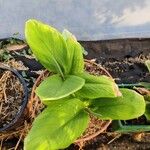
Boesenbergia rotunda
Chinese-keys · Rotund boesenbergia · Chinese Ginger · Fingerroot · Koncè
Description
Source: leafsnapBoesenbergia rotunda (Thai: กระชาย krachai, Khmer: ខ្ជាយ k'jeay, Indonesian: temu kunci), commonly known as Chinese keys, fingerroot, lesser galangal or Chinese ginger, is a medicinal and culinary herb from China and Southeast Asia. In English, the root has traditionally been called fingerroot, because the shape of the rhizome resembles that of fingers growing out of a center piece. Fingerroot is a kind of ginger (Zingiberaceae). It is an annual crop and indigenous to southern Yunnan Province, China, to west Malaysia, growing in tropical rain forest. It has an underground stem, known as a rhizome. This spreads into many bunches in the same way as banana, ginger, galangal and turmeric. These structures accumulate nutrients and the middle part is more swollen than the head and bottom part. The inner part has a range of colours and aromas depending on the variety of fingerroot. The above-ground part is composed of a leaf stalk that has a sheath covering it. The leaf sheaths are red, the blades are oval in shape and the apex of leaves are sharp. Chinese ginger is a herbaceous plant with a height of 61–91 centimetres (2–3 ft). The leaf is about 50 cm (20 in) long and 12 cm (4.7 in) wide. The middle of the petioles are deeply grooved. The flower appears between the leaf sheaths at the bottom of the trunk. The petals are white or light pink. Flowers bloom one at a time.
Care Guide
💧 Water
Rotund boesenbergia flourishes in humid environments, needing consistent moisture while avoiding waterlogging. Watering it weekly replicates natural rainfall, promoting optimal growth. Although it shows moderate drought tolerance, it thrives in moist soil, particularly during its active growing season. Its attractive foliage and culinary applications make it a popular choice for indoor cultivation.
☀️ Light Partial sun
Rotund boesenbergia comes from habitats like forest understories or rocky sites that have natural shade. It prefers partial sunlight but can withstand full sun when necessary. This flexibility lets it do well under a range of light exposures.
🌡️ Temperature 20–37.8°C
For Rotund boesenbergia, moderate temperatures are best, similar to what people usually find comfortable. It does well in conditions that are neither very hot nor very cold. The main problem with high temperatures is the danger of sunburn, so in summer it's recommended to provide some shade to prevent excessive heat. When temperatures fall, Rotund boesenbergia goes dormant. If continuous growth is wanted, higher temperatures must be kept during winter. Frost can damage the plant and should be avoided.
💨 Humidity
🪴 Soil 6-7
🌱 Fertilizer
For Rotund boesenbergia, choose natural organic materials like compost, grass clippings, or manure. A slow-release granular or commercial fertilizer can be applied sparingly. Work the organic fertilizer into the soil before planting. Usually, one to two fertilizer applications during the growing season are enough to yield a bountiful harvest.
🪴 Pot & Repot
✂️ Pruning
Regular pruning of rotund boesenbergia can significantly enhance growth and flowering. By removing dead leaves and thinning out older growth, you improve air circulation around the plant. The best time to prune is from early to late spring. It's important to use clean tools to prevent disease, ensuring that the plant remains healthy and attractive.
🌿 Propagating
🐛 Diseases & pets
☠️ Toxicity
Characteristics
- Plant Type
- Herb
- Life Cycle
- Perennial
- Genus
- Boesenbergia
- Family
- Zingiberaceae
- Hardiness Zone
- 10-12
- Mature Height
- 49 cm
- Mature Spread
- 49 cm
- Leaf Color
- Green
- Leaf Type
- Evergreen
- Flower Color
- Pink, White
- Flower Size
- 3.05 cm to 5.08 cm
- Bloom Time
- Summer, Early fall
- Planting Time
- Summer
- Harvest Time
- Late summer, Fall
- Native Area
- Indonesia