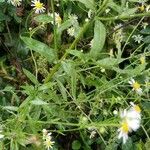
Boltonia asteroides
False starwort · White Doll's Daisy · Asterlike Boltonia · False Chamomile · Star Boltonia
Description
Source: leafsnapBoltonia asteroides, the white doll's daisy, false chamomile, or false aster, is a species of plant native to the United States and Canada. It is found primarily in the Mississippi Valley and Great Plains from Saskatchewan south to Texas and Florida, with isolated populations in the eastern United States. Reports of the species in New England, New York, and the Pacific Northwest appear to be introductions.Boltonia asteroides is a robust, 16″ to 78″ tall (40.6cm to 198.1cm), perennial. It spreads by stolons (horizontal stems running along the surface of the ground). It has many daisy-like flower heads with white or lavender ray florets and yellow disc florets.The species is sometimes cultivated as an ornamental plant because of its attractive flowers. VarietiesBoltonia asteroides var. asteroides - coastal regions Boltonia asteroides var. latisquama (A.Gray) Cronquist - Great Plains, Mississippi Valley Boltonia asteroides var. recognita (Fernald & Griscom) Cronquist - Great Plains, Mississippi Valley, Ohio Valley, Canadian Prairie Provinces; introduced in New England + Pacific Northwest
Care Guide
💧 Water Every week
False aster thrives in moist environments, favoring consistent moisture without being overwatered. A weekly watering schedule is sufficient to maintain its hydration. As a hardy perennial, false aster is adaptable to different moisture conditions, making it well-suited for periods of unpredictable rainfall during the growing season.
☀️ Light Full sun
False aster grows best when given abundant sunlight throughout the day, though it can also tolerate places with only moderate light. Its native habitat—naturally open areas—explains this trait. However, be aware that too much or too little sunlight can harm its health, reducing its vigor and blooming.
What are the sunlight requirements for a False aster?
False aster, or Boltonia asteroides, thrives best when exposed to generous sunlight throughout the day, requiring full sun, which is above 6 hours of sunlight, or partial sun, about 3-6 hours of sunlight, for optimal growth. This trait originates from its natural habitat in open environments. However, it's important to note that both too much and too little sunlight can negatively affect the plant's health, vigor, and bloom. When planning your garden, observe the movement of sunlight to ensure that your plants get a balanced mix of light and shade for their happiness.
What should I do if natural sunlight is insufficient for my False aster?
If your False aster is not receiving enough natural sunlight, especially during winter or in less sunny spaces, artificial lighting can be a beneficial solution. For indoor plants, choosing the right type of artificial light is crucial; LED lights are popular due to their ability to be customized to specific wavelengths needed for plant growth. The required artificial light intensity varies by plant sunlight needs: full sun plants need 30-50W/sq ft, partial sun plants need 20-30W/sq ft, and full shade plants need 10-20W/sq ft. Proper placement and duration are also important; lights should be 12-36 inches above the plant for 8-12 hours a day to mimic natural sunlight conditions.
What are the signs of insufficient light for a False aster and how can I address them?
Signs of insufficient light in False aster include small or lighter-colored new leaves, leggy or sparse growth, faster leaf drop, slower or halted growth, and symptoms of chlorosis or sunscald. To address light deficiency, gradually move your plant to a sunnier location or use artificial light sources, ensuring at least 6 hours of direct sunlight daily. For plants that are large or not easily movable, supplementing with a desk or ceiling lamp for at least 8 hours daily or investing in professional plant grow lights can help. Additionally, minimizing obstructions such as pruning trees or transplanting plants can improve sunlight access. It's vital to make these changes gradually to prevent sunburn and ensure new growth will be healthy.
How can I manage sunlight exposure for my False aster when grown indoors, outdoors, or in the ground?
Managing sunlight exposure for False aster involves ensuring the plant receives adequate light whether it's grown indoors, outdoors, or in the ground. Indoors, you can gradually introduce more sunlight by moving the plant closer to a south-facing window or using artificial lighting solutions, such as keeping a lamp on for at least 8 hours daily. For outdoor plants, it's crucial to move them gradually to sunnier spots to avoid shock and sunburn. When dealing with ground-planted False asters, reducing obstructions like pruning branches or transplanting to sunnier spots during the plant's dormant period can make a significant difference. Remember, adapting your plant to new light conditions gradually is key to preventing stress and promoting healthy growth.
🌡️ Temperature 0–35°C
False aster is native to habitats with temperatures from 32 to 95 °F (0 to 35 ℃). This plant prefers cooler conditions but can adjust to changing seasonal temperatures. Tip for coping with temperature: it prospers when given moderate watering during hotter periods.
What is the indigenous environment for False Aster?
False aster is native to environments where the temperature ranges between 32 to 95 °F (0 to 35 °C). This plant is suited to cooler climates and is capable of adapting to different seasonal temperatures. False aster thrives with moderate watering during warmer periods and has strong resistance to cold, usually not requiring special frost protection in winter. However, in instances where winter temperatures are anticipated to drop below -35°C, it is important to safeguard the plant against the cold by covering it with soil or straw. Additionally, it's beneficial to water the plant copiously before the first freeze in autumn to keep the soil moist, which helps prevent drought and water scarcity during the winter and early spring.
How does False Aster respond to low temperatures?
False aster demonstrates a significant tolerance to cold, flourishing best when temperatures remain above 0°C. During winter, it's suggested to maintain temperatures above -30°C for the plant. In the event that temperatures plunge below -35°C, while there might not be noticeable effects in winter, a decrease in sprouting or complete lack of sprouting may occur in spring. The proposed solution for any non-sprouting parts in spring is to remove them to promote healthier growth.
What should I do if the False Aster experiences high temperatures?
During the hotter months, it is crucial to ensure that the False aster does not get exposed to temperatures above 35°C. Exceeding 38°C can lead to the plant's leaves becoming lighter, prone to curling, suffering from sunburn, and in extreme cases, the entire plant may wilt and dry out. The remedy for such conditions includes trimming away sunburned and dried parts of the plant, relocating the plant to a shaded area during the midday and afternoon sun, or using a shade cloth for protection. Additionally, watering the plant in the morning and evening to maintain soil moisture can be beneficial.
What is the botanical name for False Aster?
The botanical name for False Aster is Boltonia asteroides.
💨 Humidity
🪴 Soil 6-7
🌱 Fertilizer
The best time to fertilize a False aster is in early spring, when it is coming out of dormancy and beginning active growth. Fertilizing supplies essential nutrients for healthy development. Although False aster has fairly low fertilizer needs, applying fertilizer annually can boost its survival and encourage better, longer-lasting blooms.
🪴 Pot & Repot
✂️ Pruning
The false aster is known for its vibrant, daisy-like flowers and bushy growth. To keep the plant healthy, prune it from early to late spring by trimming about one-third of its growth. This helps improve air circulation and prevents disease. Regularly deadhead the blooms to encourage continuous flowering. Be sure to use sterilized tools to make clean cuts, which enhances the plant's vigor and boosts its blooming potential.
🌿 Propagating
🐛 Diseases & pets
☠️ Toxicity
Characteristics
- Plant Type
- Herb
- Life Cycle
- Perennial
- Genus
- Boltonia
- Family
- Asteraceae
- Hardiness Zone
- 3-9
- Mature Height
- 0.91 m to 1.83 m
- Mature Spread
- 91 cm
- Leaf Color
- Green, Gray
- Leaf Type
- Deciduous
- Flower Color
- White
- Flower Size
- 2.54 cm
- Bloom Time
- Late summer, Early fall, Mid fall
- Planting Time
- Spring, Summer
- Harvest Time
- Fall