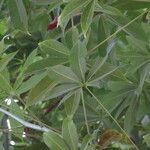
Bombax costatum
Red Silk Cotton
Description
Source: leafsnapBombax costatum, commonly known as the African Bombax or Red Silk Cotton Tree, is a deciduous tree native to tropical regions of Africa. This tree can grow up to 30 meters tall, with a wide trunk that can reach a diameter of up to 2 meters. During the dry season, it produces large, showy flowers that are red or pink. These flowers are followed by sizable seed pods filled with cotton-like fibers, which are often used for stuffing pillows and cushions. In many African countries, the African Bombax holds significant cultural importance. It is utilized for medicinal purposes and its timber is often used to craft furniture, drums, and various household items. Additionally, the tree has spiritual significance in some cultures, where it is believed to possess protective powers. The African Bombax thrives in well-drained soils and prefers full sun exposure, although it can tolerate some shade. It grows best in warm climates with high humidity but can also endure drought conditions once it is established. In summary, the African Bombax tree serves practical purposes by providing timber and cotton-like fibers, while also being an important cultural and spiritual symbol across many parts of Africa.
Care Guide
💧 Water Every 7 days
☀️ Light Full sun
The red kapok tree comes from open habitats, such as sunny meadows and forest edges that provide abundant light. It thrives in Full Sun but can also tolerate Partial Sun, adapting well to various sunlight levels.
🌡️ Temperature 20–37.8°C
The red kapok tree comes from tropical areas where the climate is usually warm and humid. As a result, it is well adapted to high temperatures and humidity. It does not tolerate sudden temperature changes and prefers a stable temperature, so avoiding indoor temperature fluctuations is important. It generally does not withstand cold and needs higher temperatures to grow. If the surrounding temperature drops too low, the plant may stop growing or even die.
💨 Humidity
🪴 Soil 6-7
🌱 Fertilizer
The best time to fertilize a red kapok tree is in early spring, as it breaks dormancy. This encourages overall growth and flower development. Fertilization improves foliage, stems, and branches, and supports the production of large, vibrant, long-lasting flowers. It helps transport nutrients from the roots to the flowers and enhances the plant’s health and disease resistance.
🪴 Pot & Repot
✂️ Pruning
To promote healthy growth and blooming in Bombax costatum, prune it in early spring. Begin by removing any dead branches. Next, thin out overcrowded areas to improve air circulation. Be careful not to prune too heavily, as this can stress the plant. Use clean, sharp tools for precise cuts to maintain the plant's structure and enhance its ornamental appeal.
🌿 Propagating
🐛 Diseases & pets
☠️ Toxicity
Characteristics
- Plant Type
- Tree
- Life Cycle
- Perennial
- Genus
- Bombax
- Family
- Malvaceae
- Hardiness Zone
- 10-12
- Mature Height
- 14.94 m to 24.99 m
- Mature Spread
- 7.92 m to 11.89 m
- Leaf Color
- Green, Dark Green
- Leaf Type
- Deciduous
- Flower Color
- Red
- Flower Size
- 10.16 cm to 15.24 cm
- Bloom Time
- Winter
- Planting Time
- Spring, Summer
- Harvest Time
- Spring
- Native Area
- Burkina Faso, Nigeria, Congo, Guinea, Guinea-Bissau, Niger, Chad, Benin, Mali, Sierra Leone, Cameroon, Togo, Ghana, Côte d'Ivoire, Gambia, Central African Republic