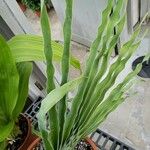
Boophone disticha
Bushman's poison bulb
Description
Source: leafsnapBoophone disticha is a bulbous tropical and subtropical flowering plant, endemic to Africa. Commonly called the century plant or tumbleweed, Boophone disticha was first collected in 1781 from South Africa by Swedish botanist Carl Peter Thunberg and described by Carl Linnaeus as Amaryllis disticha. Since that time it has been placed in the genera Brunsvigia and Haemanthus, finally coming to rest as Boophone. The genus itself was written in three ways (Boophone, Boophane and Buphane) by the author William Herbert, straining the procedures of the rules of nomenclature. The etymology of the genus is from the Greek bous = ox, and phontes= killer of, a clear warning that eating the plant can be fatal to livestock.The genus as currently understood includes two or possibly three species. B. disticha is one of the most widely distributed bulbous species in South Africa, readily identified by its fan-like appearance and its bulb half-protruding from the ground. The Khoi, Bushmen and Bantu were aware of its poisonous nature and used parts of the plant medicinally and as an arrow poison. The principal compounds are eugenol - an aromatic, volatile oil smelling of cloves and having analgesic properties, and the toxic alkaloids buphandrin, crinamidine and buphanine, the latter having an effect akin to that of scopolamine and if taken in quantity may lead to agitation, stupor, strong hallucinations and (if over-ingested) coma or death.This species produces a single inflorescence before the arrival of the season's new leaves. While maturing the fruiting head's pedicels undergo a stiffening process and remarkable elongation to some 300mm. When the fruiting head separates at its junction with the stalk, it is easily moved by light breezes, scattering seeds as it rolls.
Care Guide
💧 Water Every 3 weeks
The century plant flourishes in arid environments due to its high drought tolerance. It needs minimal watering, ideally every three weeks, allowing the soil to dry out between waterings. Its bulbous structure efficiently stores water, making it perfect for xeric landscapes and ideal for gardeners who are mindful of water usage.
☀️ Light Full sun
The century plant does best with constant sunlight, which is vital for its health. Coming from brightly lit habitats, it can endure periods of reduced brightness. Still, extended shade or low light can impede growth and result in poor health. Excessive light can also be damaging.
What are the sunlight requirements for a Century Plant?
The Century Plant (Boophone disticha) thrives under full sun, which is defined as receiving above 6 hours of direct sunlight daily, but it can also grow in partial sun, receiving about 3-6 hours of sunlight. It's important to watch how sunlight moves through your garden to choose spots that provide a perfect balance of light and shade, ensuring the plant's happiness. Originating from environments with abundant light, this plant can tolerate some periods of lesser luminosity, but prolonged exposure to shade can hinder its growth and lead to suboptimal health.
How can artificial lighting be used for indoor Century Plants?
For indoor Century Plants, adequate lighting is essential for optimal growth, especially when natural sunlight is insufficient, such as during winter or in less sunny spaces. Artificial lights, particularly LED lights, can be customized to provide specific wavelengths of light needed by the plant. Full sun plants require 30-50W/sq ft, partial sun plants need 20-30W/sq ft, and full shade plants 10-20W/sq ft of artificial light. The light source should be placed 12-36 inches above the plant, and most plants need 8-12 hours of light per day to mimic natural daylight hours.
What are the symptoms of insufficient or excessive light in Century Plants?
Symptoms of insufficient light in Century Plants include smaller new leaves, leggy or sparse growth, faster leaf drop, slower or no new growth, lighter-colored new leaves, and symptoms of excessive light include chlorosis (leaves turning yellow), sunscald, leaf curling, wilting, and leaf scorching. These symptoms indicate either a lack of chlorophyll and essential nutrients due to insufficient sunlight or damage and reduced health from excessive sunlight exposure.
What solutions are available for improving light conditions for Century Plants?
To optimize light conditions for Century Plants, gradually move them to sunnier locations until they receive at least 6 hours of direct sunlight daily. A south-facing window is ideal for indoor plants, keeping curtains open during the day. If the plant is large or not easily movable, consider using artificial lights, keeping them on for at least 8 hours daily. For outdoor plants, avoid sudden changes in light intensity to prevent sunburn. Minimize obstructions by pruning trees or moving plants to areas with more sunlight. Transplant smaller plants during their dormant period to locations with ample sunlight and good drainage. Note that while parts of the plant affected by insufficient light may not recover, new growth will be healthy with increased light exposure.
🌡️ Temperature 20–35°C
The century plant is native to temperate regions and does best at temperatures of 68 to 95 °F (20 to 35 °C). You may need to make seasonal adjustments to recreate these conditions. Ensure it is not exposed to freezing temperatures.
What is the native environment of the Century plant?
The Century plant, with the botanical name Boophone disticha, is native to temperate areas and thrives in temperatures between 20 to 35°C (68 to 95°F). To ensure the plant's health, it's important to mimic its native temperature conditions as closely as possible and avoid exposing it to freezing temperatures.
How should I care for my Century plant during winter?
During winter, the Century plant enters a dormant state and should be moved indoors if the outdoor temperature drops below 0°C to avoid freezing. Place it near a south-facing window to maximize sunlight exposure. If natural light is inadequate, consider using supplemental lighting. When temperatures fall below 20°C, reduce or stop watering to prevent root rot. For outdoor plants, halt watering entirely during cold spells. If possible, provide insulation through a temporary greenhouse or by wrapping the plant in plastic film or fabric.
What should I do if my Century plant is exposed to low temperatures?
If your Century plant has been exposed to temperatures below its tolerance level (below 20°C and especially under 0°C), it may become weak, wilt, or prone to root rot. In the event of mild frost damage, trim off affected areas. If roots are rotted, they should be removed, and the plant may be propagated from cuttings. Move the plant to a warmer indoor environment immediately and place it near a south-facing window for ample sunlight, using supplemental lighting if necessary.
How does high temperature affect the Century plant, and what are the solutions?
The Century plant should ideally be kept below 35°C during the summer. Exposure to temperatures above 41°C can halt its growth, cause water loss and wilting, and make the plant more susceptible to sunburn. To remedy this, remove sunburned or rotten parts and protect the plant from the harsh afternoon sun until it recovers. If the plant suffers from root rot, cease watering until new roots form and the plant begins growing again.
💨 Humidity
🪴 Soil 6-6
🌱 Fertilizer
For a Century plant, light doses of fertilizer once or twice a year during the growing season are sufficient. Avoid fertilizing in winter or summer when it is dormant. Reduce fertilizer for repotted plants and wait a couple of months after repotting before fertilizing. Fertilizing supports healthy growth and encourages blooms.
🪴 Pot & Repot Every 2 years
The century plant, known for its bulbous form, thrives when repotted every two years in the spring to align with its growth cycle. Select a pot that allows room for the bulb to expand. Place the plant in bright, indirect light and water sparingly to help it recover. Handle the century plant with care, as it is quite sensitive.
✂️ Pruning
🌿 Propagating
🐛 Diseases & pets
☠️ Toxicity
Characteristics
- Plant Type
- Herb
- Life Cycle
- Perennial
- Genus
- Boophone
- Family
- Amaryllidaceae
- Hardiness Zone
- 9-10
- Mature Height
- 61 cm
- Mature Spread
- 30 cm
- Leaf Color
- Green, Dark Green
- Leaf Type
- Deciduous
- Flower Color
- Pink
- Flower Size
- 20.32 cm
- Bloom Time
- Late summer, Early fall
- Planting Time
- Spring, Summer
- Harvest Time
- Mid fall, Late fall
- Native Area
- Malawi, Lesotho, Angola, South Africa, Zambia, Sudan, Namibia, Kenya, Uganda, Tanzania, Zimbabwe, Burundi, Mozambique, Eswatini, Congo (DRC), Botswana