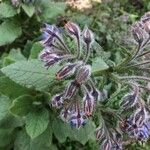
Borago officinalis
Borage · Beebread · Common borage · Beeplant · Talewort
Description
Source: leafsnapBorago officinalis, commonly known as borage, is an annual herb that belongs to the Boraginaceae family. Originally native to the Mediterranean region, it has become naturalized in many parts of the world. The plant can grow up to 60 cm tall and features hairy leaves and stems. Its star-shaped, blue flowers, which have five petals and can grow up to 2 cm long, make it a popular garden plant. Borage is particularly valued for its attractive blue flowers and its ability to attract pollinators like bees. Additionally, it has a long history of medicinal use, dating back thousands of years. Traditionally, it has been used to treat various ailments such as respiratory infections, inflammation, fever, anxiety, and skin conditions. One of the key components of borage is its leaves, which are rich in gamma-linolenic acid (GLA), an essential fatty acid critical for maintaining healthy skin. Borage oil, which is extracted from the seeds, contains high levels of GLA, making it popular for use in skincare products. In addition to its medicinal uses, borage also has culinary applications. Its young leaves can be eaten fresh or cooked, much like spinach, while its flowers can be used as a garnish or added to salads for their mild, cucumber-like flavor. Overall, Borago officinalis is an attractive and versatile herb with numerous uses both in medicine and cuisine. Not only does it enhance garden aesthetics, but it also offers medicinal benefits, particularly in skincare, due to the high levels of GLA present in borage oil. This oil has been shown to effectively reduce inflammation associated with conditions like eczema and psoriasis when applied topically over time.
🌳 Borage is not confined to culinary use; it is also valued for its claimed environmental benefits. With its high nectar content, it is very attractive to pollinators and contributes to supporting bee populations. Furthermore, borage can be used as a biomonitoring plant: it accumulates heavy metals, such as lead, in contaminated soils, thus signaling soil quality. Although this is not a common use, its potential to help with environmental clean-up highlights the plant’s practical diversity.
🎭 Bravery, romantic yearning, domestic peace
Care Guide
💧 Water Every 3 days
Common borage thrives in a Mediterranean climate, where it prefers moderate humidity and occasional dry spells. This plant needs consistent moisture, so it's best to water it twice a week. While it has some tolerance for drought, it grows best outdoors with evenly moist soil during its active growing season to maintain optimal health.
☀️ Light Full sun
Borage does best with plenty of sunlight, though it can tolerate suboptimal light and still grow well. Because it comes from areas with abundant light, reduced illumination may result in slower growth or paler leaves. Conversely, too much light can also be harmful, appearing as leaf burn.
What are the sunlight requirements for Common Borage (Borago officinalis)?
Common Borage requires full sun exposure, which means it needs above 6 hours of sunlight daily, although it can also grow in partial sun, receiving about 3-6 hours of sunlight. It's important to observe the movement of sunlight through your garden to find spots that provide the ideal balance of light and shade, ensuring the best growth conditions for your plants. Too little or too much sunlight can affect the plant's health, with insufficient light leading to slow growth or faded leaves, and excessive light causing leaf burn.
How does artificial lighting benefit indoor plants, and what are the guidelines for using it?
Indoor plants, including Common Borage, require adequate lighting for optimal growth, especially when natural sunlight is insufficient, such as in winter or less sunny spaces. Artificial lighting, such as LED lights, is vital for promoting faster, healthier growth by providing specific wavelengths of light needed by plants. For full sun plants, 30-50W/sq ft of artificial light is recommended; partial sun plants need 20-30W/sq ft, and full shade plants need 10-20W/sq ft. The light source should be placed 12-36 inches above the plant to mimic natural sunlight, and the duration should mimic natural daylight hours, typically 8-12 hours per day.
What are the common symptoms of inadequate light exposure in Common Borage?
Common Borage may show several symptoms when grown indoors with inadequate light, including smaller new leaves, leggy or sparse growth, faster leaf drop, slowed or halted new growth, and lighter-colored new leaves. Excessive sunlight can lead to chlorosis (leaves turning yellow), sunscald (pale, bleached areas on plant tissue), leaf curling or twisting, wilting, and leaf scorching (brown, dry patches on leaves). These symptoms indicate either a deficiency or excess of sunlight, affecting the plant's overall health.
What solutions can help manage light exposure for Common Borage to ensure healthy growth?
Optimizing light exposure for Common Borage involves several strategies. Indoors, gradually move plants to sunnier locations until they receive at least 6 hours of direct sunlight, using south-facing windows for maximum exposure, and use artificial light for additional support. Outdoors, adapt plants to sunlight gradually to avoid sunburn. Minimize obstructions such as tree branches to allow more sunlight, and consider transplanting smaller plants during their dormant period to sunnier locations with good drainage. Keep in mind that while parts of the plant that have suffered might not recover, new growth will be healthy with improved light conditions.
🌡️ Temperature 0–37.8°C
Borage originates from temperate regions. It prefers temperatures between 68 and 100 °F (20 to 38 ℃). While it can adjust as the seasons change, keeping temperatures within that preferred range is best for optimal growth.
What is the native climate for common borage and what temperatures does it prefer?
Common borage, scientifically known as Borago officinalis, is native to temperate climates. It thrives in temperatures between 68 to 100 °F (20 to 38 ℃). While it can adapt to changing seasons, it grows best when temperatures are kept within this preferred range. Borage has a notable cold resistance, meaning it usually does not require special frost protection measures during the winter. However, if temperatures are expected to drop below its growth limit, providing some form of cold protection by covering the plant with soil or straw is beneficial. Moreover, it's advisable to water the plant abundantly before the first freeze of autumn to ensure the soil remains moist and enters a frozen state, aiding in the prevention of drought and water scarcity for the plant during the colder months.
How does common borage react to low temperatures?
Common borage displays a significant tolerance to cold temperatures and ideally should be kept above its minimum tolerable growing temperature during winter. When temperatures fall below its growth limit, while there may not be visible effects during the winter, the plant could experience decreased sprouting or fail to sprout in spring. To mitigate any adverse effects from these conditions, it's suggested to remove any parts of the borage that have failed to sprout as the weather warms in spring.
What happens if common borage is exposed to high temperatures and how can these effects be mitigated?
During the summer months, it is crucial for the health of common borage to be kept below its maximum suitable growth temperature. Exposure to temperatures above its tolerable maximum can lead to the leaves becoming lighter in color, curling, becoming prone to sunburn, and in extreme cases, causing the entire plant to wilt and dry out. To alleviate the effects of high temperatures, it's advisable to trim away any sunburned and dried parts of the plant. Relocating the plant to a shaded area during the midday and afternoon sun or using a shade cloth can provide necessary relief. Additionally, watering the plant in the morning and evening helps keep the soil moist and supports the plant's well-being.
💨 Humidity normal (40-60%)
This plant will thrive in moderate humidity, which is probably the level in your home. However, misting it a few times a week can be very beneficial. Make sure the room has good ventilation.
🪴 Soil 6-7
🌱 Fertilizer
Borage benefits from regular, light applications of fertilizer to encourage healthy leaf development. Fertilize Borage about once a month during the summer. Nitrogen is important for foliage, and providing nitrogen-rich sources helps Borage thrive.
Why is it important to fertilize my Common borage plant?
All plants require nutrients to grow, but some types are capable of obtaining what they need without additional fertilizers. Common borage, like other plants, relies on nutrients to facilitate growth and internal processes. The main nutrients that plants utilize (nitrogen, phosphorus, and potassium) contribute to various essential plant functions. Specifically, nitrogen is crucial for supporting foliage growth. However, Common borage often struggles to acquire sufficient nitrogen from the soil, which is why many gardeners opt to supplement by providing a nitrogen source to feed the plant.
🪴 Pot & Repot
When repotting Borage, pick a pot that is 1-2 inches (2.5–5.1 cm) larger in diameter and that has good drainage. Use a well-draining potting mix, and consider adding perlite for extra drainage. Repot during spring or early summer, then water thoroughly, and place it in a shady spot to start.
✂️ Pruning
Common borage is known for its vibrant blue flowers and has various medicinal uses. To ensure healthy growth, prune the plant from early to late spring. This involves removing dead stems and improving air circulation. Pruning after the plant has bloomed can encourage a second flowering. Always use clean tools to prevent diseases and make effective cuts.
🌿 Propagating
🐛 Diseases & pets
☠️ Toxicity
Characteristics
- Plant Type
- Herb
- Life Cycle
- Annual, Biennial, Perennial
- Genus
- Borago
- Family
- Boraginaceae
- Hardiness Zone
- 2-11
- Mature Height
- 0.61 m to 1.22 m
- Mature Spread
- 23 cm to 61 cm
- Leaf Color
- Green
- Leaf Type
- Deciduous
- Flower Color
- Blue, Purple
- Flower Size
- 1.52 cm to 2.54 cm
- Bloom Time
- Late spring, Early summer, Mid summer
- Planting Time
- Spring, Autumn
- Harvest Time
- Early summer, Mid summer
- Native Area
- Libya, Tunisia, Turkey, Montenegro, Cyprus, Greece, Croatia, Slovenia, Morocco, Serbia, Lebanon, Portugal, Italy, Spain, Albania, Algeria, France