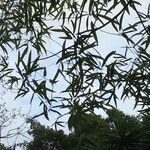
Brachychiton rupestris
Queensland bottletree · Queensland rattletree · Bottletree · Narrow-leaf bottletree · Kurrajong
Description
Source: leafsnapBrachychiton rupestris, commonly known as the narrow-leaved bottle tree or Queensland bottle tree, is a tree in the family Malvaceae native to Queensland, Australia. Discovered and described by Sir Thomas Mitchell and John Lindley in 1848, it gained its name from its bulbous trunk, which can be up to 3.5 metres (11 ft) diameter at breast height (DBH). Reaching 10–25 metres (33–82 ft) high, the Queensland bottle tree is deciduous, losing its leaves between September and December. The leaves are simple or divided, with one or more narrow leaf blades up to 11 centimetres (4 in) long and 2 centimetres (0.8 in) wide. Cream-coloured flowers appear from September to November, and are followed by woody boat-shaped follicles that ripen from November to May. No subspecies are recognised. As a drought deciduous succulent tree, B. rupestris adapts readily to cultivation and is tolerant of a range of soils and temperatures. It is a key component and emergent tree in the endangered central semi-evergreen vine thickets—also known as bottletree scrub—of the Queensland Brigalow Belt. Remnant trees are often left by farmers on cleared land for their value as shade and fodder trees.
🌳 The Queensland bottle tree has long been important to Indigenous Australians, valued not only for its unusual bottle-like shape but also for its practical uses. The soft, fibrous inner wood, called 'kurrajong,' is used as a source of fiber for making fishing nets and other items. It is also reported to serve as an emergency water supply during droughts, since the tree can store a substantial amount of water in its bulbous trunk. This distinctive adaptation benefits the plant and provides a lifeline for people and wildlife in arid conditions.
🎭 Drive away evil spirits
Care Guide
💧 Water Every 3 weeks
The Queensland bottle tree, native to the arid regions of Australia, is highly drought-tolerant and needs watering only every three weeks. Thriving in dry soil conditions, it is perfect for warm climates because it stores water in its trunk, making it an excellent choice for xeriscaping.
How should I water my Queensland bottle tree in the best way?
To promote excellent root development, place a garden hose at the base of your plants. Be careful not to directly spray the leaves, as they may need more water if they are outdoors and in direct sunlight. To moisten the roots, you can use bubblers for each plant or soaker hoses that cover the entire garden. When adding or removing plants, use soaker hoses to help the roots grow deep. After watering, make sure to drain any excess water and allow the soil to dry before watering again. To prevent diseases, always water at ground level. On a sunny day, consider spraying the whole bush with water. Whether your plants are potted or in the ground, keep in mind that the Queensland bottle tree prefers deep watering rather than light sprinkling.
What should I do if I give too much or too little water to my Queensland bottle tree?
If a Queensland bottle tree is overwatered, it can show signs such as yellowing leaves, leaf drop, and wilting. The plant may also appear unhealthy with mushy stems. To address these issues, it's recommended to adjust your watering schedule. Additionally, wilting can also be a symptom of under watering. In this case, the leaves may become crispy and dry instead of soft and wilted. When the soil is dry and regular watering is insufficient, a thorough watering should be provided. However, despite sufficient watering, the damaged root system may cause the tree to continue appearing dry with yellow leaves for a few days. Once it returns to normal, the yellowing of leaves will cease. For indoor Queensland bottle trees, always check the moisture levels in the pot and avoid overwatering. If black spots are present, allow the soil in the pot to dry out by refraining from watering for a few days. Overwatering can lead to root rot, so consider transferring the plant into a different pot, especially if discolored and slimy roots are observed. It is important to prevent root rot by avoiding excessively soggy soil. When planting a Queensland bottle tree outdoors, check the soil's moisture level by digging a little deeper. If the soil feels too dry, it could indicate underwatering, and appropriate watering is necessary for the plant's recovery.
How frequently do I need to water my Queensland bottle tree?
The Queensland bottle tree prefers deep, infrequent watering. When planted in pots, soak them with a gallon of water each time. Pots have limited water storage and the soil dries out quickly. In a cold region, water every 3 to 5 days. Water in the morning when the soil is dry. Check the soil inside to determine if watering is needed. When the top 2-3 inches of soil are dry, give the plant a full watering. During hot days, check the moisture daily as heat can dry out the soil in the pot. If you have a garden, irrigate the soil. In a hot climate, water once a week when the top 2-3 inches of soil become dry. Consider the amount of rainwater and avoid overwatering to prevent root rot. If there is sufficient rainfall, additional watering may not be necessary. When the Queensland bottle tree is outdoors, apply 3-4 inches deep of mulch to conserve water. Sandy soil needs more frequent watering as it drains faster. Clay soil requires less frequent watering, allowing the plant to dry out for 2-3 days without developing root rot. Mark the date on the calendar each time you water and watch for drooping leaves, as this may indicate a need for watering.
How much water should I give my Queensland bottle tree?
The Queensland bottle tree has specific watering needs. For potted plants, water them deeply until you see water dripping from the bottom of the pot, then wait for the soil to dry before watering again. Use a water calculator or moisture meter to track the amount given each week. During the flowering period, provide ample water but allow it to evaporate to prevent root rot. If the tree is planted outdoors and receives adequate rainfall, additional watering may not be needed. However, young or newly planted trees should receive 1-2 inches of rain per week. As the tree grows, it can survive solely on rainfall, except during extremely hot weather or prolonged droughts. In these cases, give the tree a full watering during cooler times of the day to avoid heat damage. Persistent dry spells will require additional watering.
Should I change how often I water my Queensland bottle tree depending on the time of year or the weather?
The Queensland bottle tree requires outdoor conditions with regular rainfall, but watering is only necessary during persistent dry weather. During the growing seasons of spring and fall, the soil should be kept moist but not soggy, alternating between dry and moist conditions to promote healthy growth. In the summer, hot weather and lack of rainfall can cause water to evaporate quickly, so more frequent watering is needed to keep the tree moist. Generally, less water is required during the winter when the tree goes dormant and drops its leaves. Using a well-draining soil mixture like terracotta can help water evaporate faster during this time. Once the tree begins to leaf out and go dormant in the spring, watering can be skipped as it can rely on fall and winter rains to survive. When flowering, it's important to ensure good drainage, especially during winter. In pots, the tree has limited root growth, so regular watering is necessary, especially in the summer. Avoid shallow sprinkles that only reach the leaves and encourage fungal growth. Even during dormancy in the fall or winter, the tree should not be allowed to dry out completely. Overwatering should also be avoided as the tree does not like sitting in water for too long. Applying mulch can help reduce stress, conserve water, and promote healthy blooms.
☀️ Light Full sun
The Queensland bottle tree does best with abundant sunlight, though it can tolerate locations receiving only moderate sun. Its native habitat is used to a high level of sun. For optimal development, provide steady sun exposure, because inadequate light can produce weak growth. Conversely, excessive sun can cause the leaves to become discolored.
What are the sunlight requirements for the Queensland bottle tree?
The Queensland bottle tree, known botanically as Brachychiton rupestris, flourishes under full sun conditions, requiring above 6 hours of direct sunlight daily. However, it can also tolerate partial sun exposure, defined as about 3-6 hours of sunlight per day. For the plant to reach its optimal growth, consistent sun exposure is crucial as inadequate light can lead to weak growth, whereas too much direct light may cause leaf discoloration. Observing the movement of sunlight through your garden helps in choosing spots that provide the perfect balance of light and shade necessary for the plants' growth and well-being.
How does artificial lighting support indoor Queensland bottle trees?
Indoor Queensland bottle trees benefit significantly from artificial lighting, especially when natural sunlight is lacking. During winter or in less sunny spaces, artificial lights are a vital alternative, promoting faster and healthier growth. The right type of artificial light, such as LED lights, can be customized to supply specific wavelengths needed by the plants. Full sun plants require 30-50W/sq ft, partial sun plants need 20-30W/sq ft, and full shade plants require 10-20W/sq ft of artificial light. The light source should be placed 12-36 inches above the plant, mimicking natural sunlight as closely as possible, and should be kept on for 8-12 hours per day to mimic natural daylight hours effectively.
What are the symptoms of inadequate sunlight for the Queensland bottle tree?
When Queensland bottle trees do not receive sufficient sunlight, several symptoms may emerge, indicating light deficiency. These include small or lighter-colored new leaves, indicating a lack of chlorophyll and essential nutrients. The plant may exhibit leggy or sparse growth, as well as a quicker leaf drop as a response to conserve resources. Growth may become slower or halt entirely as the plant enters survival mode. In cases of excessive sunlight, symptoms such as chlorosis, sunscald, leaf curling, wilting, and leaf scorching can occur. Chlorosis involves the leaves losing their green color and turning yellow, whereas sunscald appears as pale, bleached areas on the plant tissue. Leaf curling is a defense mechanism to minimize water loss, while wilting and leaf scorching indicate damage from overexposure to sunlight.
What solutions are available for Queensland bottle trees facing light-related issues?
To combat light-related issues in Queensland bottle trees, several strategies can be employed for indoor and outdoor settings. Indoors, gradually moving the plant to a sunnier spot each week until it gets at least 6 hours of direct sunlight daily is recommended. Utilizing a south-facing window and keeping curtains open during the day, or providing additional light through artificial means such as a desk or ceiling lamp for at least 8 hours daily, can help. For plants that are not easily movable, investing in professional plant grow lights offers a good solution. Outdoors, a gradual adjustment to sunlight by moving plants weekly to sunnier locations helps prevent sunburn. Reducing obstructions, like pruning branches that block sunlight, and transplanting smaller plants during their dormant period to locations with ample sunlight and good drainage, can significantly improve light exposure. It's important to note that while parts of the plant that have suffered due to insufficient light may not recover, new growth following these adjustments will be healthy.
🌡️ Temperature 20–41.1°C
The queensland bottle tree favors a native growth environment with temperatures between 68 to 105 ℉ (20 to 41 ℃). It prefers a narrower temperature range of 77 to 95 ℉ (25 to 35 ℃). During colder months, it's best to keep the plant at 50 to 68 ℉ (10 to 20 ℃), whereas in hotter months it can tolerate temperatures up to 113 ℉ (45 ℃).
What are the essential care tips for a Queensland bottle tree?
The Queensland bottle tree, or Brachychiton rupestris, thrives in temperatures ranging from 68 to 105°F (20 to 41°C), preferring a warmer climate of 77 to 95°F (25 to 35°C). In colder months, maintaining temperatures between 50 to 68°F (10 to 20°C) is crucial, while in hotter months, it can withstand temperatures up to 113°F (45°C). The Queensland bottle tree is extremely heat-tolerant but vulnerable to cold. During autumn and winter, it's advisable to bring outdoor plants indoors, placing them near a bright window but away from direct heat sources to ensure temperatures remain above 20°C for optimal growth. Exposure to temperatures around 5°C or lower is harmful to the plant.
How should you care for a Queensland bottle tree in low temperatures?
The Queensland bottle tree prefers warmer climates and does not fare well in cold temperatures. It is vital to keep the tree in an environment above 20°C during winter, avoiding exposure to temperatures below 5°C, as this can cause the leaves to lighten and, after frost damage, potentially turn brown or black, displaying signs of wilting and drooping. In case of frost damage, trim off the affected parts and move the tree to a warmer indoor location. Placing it near a south-facing window ensures it receives ample sunlight, but remember to keep it away from heaters or air conditioning vents to avoid dry air.
What should I do if my Queensland bottle tree experiences high temperatures?
During summer, it's essential to keep the Queensland bottle tree's temperature below 41°C (105.8°F). If the temperature rises above 45°C (113°F), the leaves may lighten in color and become more prone to sunburn. To manage heat stress, trim away sunburned or dried-up parts and relocate the plant to a shadier spot to protect it from midday and afternoon sun. Ensure the soil remains moist by watering in the morning and evening.
💨 Humidity dry (<40%)
This plant prefers dry conditions, so don't mist it. However, watering it less often can also thrive in higher humidity.
🪴 Soil 6-7
🌱 Fertilizer
Fertilizing is vital for the care of the Queensland bottle tree. Regular feeding throughout the growing season preserves the energy required for its showy leaves and supports overall growth. Neglecting fertilization can lead to unhealthy leaves, reduced ornamental appeal, and stunted or weak growth that is prone to breaking.
Why is it necessary to put fertilizers on my Queensland bottle tree?
Regular fertilization is important for Queensland bottle tree because their showy leaves require a lot of energy to produce and maintain. Without enough energy, the tree cannot keep its leaves healthy and attractive, which affects its ornamental appeal. Additionally, neglecting fertilization can hinder the tree's overall growth or cause weak growth that is prone to breakage.
When should I put fertilizer on my Queensland bottle tree?
The Queensland bottle tree will benefit from occasional feedings, so you don't have to stick to a strict feeding schedule when you plant one. One easy way to fertilize it is to apply fertilizer while watering it occasionally. During the growing season, the tree will also need a good amount of water. You can feed it once every two to three weeks, continuing this rate while it's producing new growth.
When is it not a good idea to put fertilizer on my Queensland bottle tree?
You can maintain a regular fertilization schedule for your Queensland bottle tree for most of the year. This means fertilizing during the active growing season of spring, summer, and early fall. However, during the winter, it is important to completely avoid fertilizer. This is because the Queensland bottle tree enters a dormant growth phase during this time. In this phase, the plant either does not produce any new growth or produces very little. Since the plant is using less energy during this period, fertilization is unnecessary.
What kind of fertilizer does my Queensland bottle tree require?
To ensure proper growth of a Queensland bottle tree, it requires a fertilizer with a specific blend of nutrients. This blend should have a ratio of 3 parts nitrogen (N), 1 part phosphorous (P), and 2 parts potassium (K). However, in some cases, a general-purpose fertilizer with an even nutrient blend can also be used effectively. It is important to note that even when using a balanced fertilizer, the volume of each nutrient should not exceed a ratio of 3. When choosing a fertilizer, you have the option of using either granular or liquid-based fertilizer. If you opt for a liquid-based fertilizer, it is recommended to dilute its strength by half. On the other hand, granular fertilizer is generally a good choice with fewer drawbacks. However, using liquid fertilizer is often a more sensible option, especially if you are providing water to your Queensland bottle tree at the same time.
How should I add fertilizer to my Queensland bottle tree?
To easily fertilize a Queensland bottle tree, you have a couple of options. Firstly, you can feed it whenever you water it. To do this, gather your fertilizer and a water container like a watering can. Mix the fertilizer with water to dilute it, then pour it onto the soil, allowing it to reach the roots. Alternatively, you could use a granular fertilizer. Just sprinkle some on the soil where your tree lives. Granular fertilizers are slow-release, so you won't need to fertilize as often as with a liquid fertilizer. Remember to water the tree while you feed it, regardless of the method you choose.
🪴 Pot & Repot 2-3 years
When repotting a Queensland bottle tree, select a pot 1–2 inches (2.5–5.1 cm) larger with good drainage. Use a well-draining potting mix. Repot in spring or fall, making sure the root ball is slightly lower than the rim of the flower pot. Water thoroughly after repotting and place it in a warm spot with indirect sunlight.
✂️ Pruning
The Queensland bottle tree is known for its unique, bottle-shaped trunk and its ability to adapt to various climates. For best results, prune the tree in early spring. Focus on removing dead or damaged branches and thinning out crowded areas. This will improve growth, enhance air circulation, prevent disease, and maintain the tree's overall health and balance.
🌿 Propagating
🐛 Diseases & pets
☠️ Toxicity
Characteristics
- Plant Type
- Tree
- Life Cycle
- Perennial
- Genus
- Brachychiton
- Family
- Malvaceae
- Hardiness Zone
- 10-13
- Mature Height
- 10.06 m to 24.99 m
- Mature Spread
- 6.1 m
- Leaf Color
- Green
- Leaf Type
- Semi-evergreen, Deciduous
- Flower Color
- Pink, Cream
- Flower Size
- 2.54 cm
- Bloom Time
- Early spring, Mid spring, Fall, Winter
- Planting Time
- Spring, Autumn
- Harvest Time
- Late spring, Summer