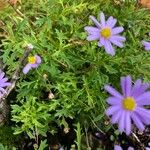
Brachyscome angustifolia
Description
Source: leafsnapBrachyscome angustifolia, commonly known as the Blue Daisy or Swan River Daisy, is a perennial herbaceous plant that belongs to the Asteraceae family. Native to Australia, it thrives in various habitats, including woodlands, grasslands, and rocky areas. The plant reaches up to 30 cm in height and features narrow leaves about 5 cm long. Its daisy-like flowers showcase blue or purple petals encircling a yellow central disk. These blooms appear from spring through summer, attracting bees, butterflies, and other pollinators. Brachyscome angustifolia is popular in gardens for its appealing flowers, making it an excellent choice for borders, rock gardens, or containers. It thrives in well-drained soil with full sun exposure but can also tolerate partial shade. Regular watering is necessary during dry periods, though overwatering should be avoided to prevent root rot. Pruning spent flowers will encourage additional blooms throughout the growing season. Overall, Brachyscome angustifolia is an easy-to-grow perennial herbaceous plant with striking blue daisy-like flowers. It adds vibrant color to any garden while also providing nourishment for pollinators like bees and butterflies.
Care Guide
💧 Water Every 3 days
The rock daisy flourishes in arid regions due to its remarkable drought tolerance and efficient water retention abilities. Although it is hardy, it requires weekly watering and prefers to grow in balanced humidity. Being an evergreen plant, the rock daisy keeps its leaves year-round, which helps it maintain water balance during dry periods.
☀️ Light Full sun
Rock daisy prefers sunny, well-drained locations and can tolerate moderate sunlight. In its natural habitat it grows best where sunlight is plentiful. Both too little and too much sunlight can harm its healthy growth.
What are the sunlight requirements for Rock daisy?
Rock daisy requires full sun, meaning it needs above 6 hours of sunlight daily to thrive, but it can also perform well in partial sun, which constitutes about 3-6 hours of sunlight. Observing how sunlight moves through your garden helps in choosing spots that offer a perfect balance of light and shade, ensuring the plants' optimal growth. It is crucial to adjust the plant's exposure to sunlight carefully to prevent any adverse effects on its health.
What essentials should be considered for growing Rock daisy?
Growing Rock daisy demands attention to its sunlight and soil drainage needs. Naturally prospering in well-drained, sunny regions, it can tolerate moderate sunlight but excels in environments with abundant sunlight. The use of artificial lighting, such as indoor LED lights, can supplement natural sunlight, especially in less sunny spaces or during winter. For full sun plants, 30-50W/sq ft of artificial light is recommended, 20-30W/sq ft for partial sun plants, and 10-20W/sq ft for full shade plants. The artificial light source should be placed 12-36 inches above the plant for 8-12 hours a day to mimic natural sunlight conditions.
What are the common symptoms of incorrect light exposure in Rock daisy?
Incorrect light exposure in Rock daisy can manifest several symptoms. Insufficient light may result in smaller new leaves, leggy growth, faster leaf drop, slower or halted growth, and lighter-colored or yellowing leaves indicating chlorosis. Excessive sunlight exposure can lead to symptoms like sunscald, leaf curling, wilting, leaf scorching, and a general decline in plant health. These symptoms highlight the importance of providing Rock daisy with the ideal amount of sunlight to ensure its health and vitality.
How can I manage and improve light conditions for Rock daisy?
To manage and improve light conditions for Rock daisy, consider gradually moving your plants to areas with better sunlight exposure. Indoor plants can be placed near south-facing windows or supplemented with artificial lighting for at least 8 hours daily. Outdoor plants should be gradually acclimatized to sunnier spots to prevent sunburn. Addressing obstructions that block sunlight, such as by pruning trees, can increase exposure. Transplanting smaller plants to sunnier locations during their dormant period also promotes better growth. Remember, parts of the plant that suffered due to insufficient light may not recover, but new growth will be healthier with improved lighting.
🌡️ Temperature 15–37.8°C
Rock daisy originates from regions where temperatures typically fall between 68 and 100 °F (20 and 38 ℃). It favors these warmer conditions. In cooler seasons, make sure it is sufficiently warmed to promote optimal growth.
What is the ideal temperature range for Rock daisy?
Rock daisy thrives in areas where the temperature generally ranges between 68 to 100 °F (20 to 38 °C), preferring warmer conditions. Despite its strong cold resistance, during the cooler seasons, it's important to ensure the plant is adequately warmed to optimize growth.
How should Rock daisy be protected during winter?
Rock daisy usually does not require special frost protection measures during winter due to its strong cold resistance. However, if winter temperatures are expected to drop below -15°C, it is important to provide cold protection by covering the plant with materials such as soil or straw. Additionally, before the first freeze in autumn, watering the plant abundantly to ensure the soil remains moist can help prevent drought and water scarcity during winter and early spring.
How does Rock daisy respond to low temperature conditions?
Rock daisy is cold-tolerant and thrives best when temperatures are above 20°C. During winter, it should be kept above 0°C to prevent damage. If temperatures fall below -15°C, there may not be noticeable changes during winter, but there could be a decrease in sprouting or even no sprouting during springtime. To address this, in spring, it's recommended to remove any parts of the plant that have failed to sprout.
What should be done if Rock daisy experiences high temperatures?
During summer, it's crucial to maintain Rock daisy's temperature below 38°C. If temperatures exceed 43°C, the plant's leaves may become lighter, prone to curling, susceptible to sunburn, and in severe cases, the entire plant may wilt and dry. To mitigate this, trim away the sunburned and dried-up parts, move the plant to a shaded location, especially from the midday and afternoon sun, or use a shade cloth. Ensure the plant is watered in the morning and evening to keep the soil moist.
💨 Humidity normal (40-60%)
This plant will thrive in moderate humidity, which is probably the level in your home. However, misting it a few times a week can be very beneficial. Make sure the room has good ventilation.
🪴 Soil 6-7
🌱 Fertilizer
The best time to fertilize a Rock daisy is in early spring, as it comes out of dormancy and starts active growth. Fertilization supplies essential nutrients for healthy development. Although Rock daisies have relatively low fertilizer requirements, an annual application can improve their survival and encourage better, longer-lasting blooms.
🪴 Pot & Repot 2-3 years
Repot your rock daisy in spring every 2-3 years, using a slightly larger pot to support its growth. Keep the soil moist and provide indirect sunlight to help it recover and encourage vibrant flowering. When repotting, handle its delicate roots with care.
✂️ Pruning
The Rock Daisy produces flowers that resemble a daisy and flourishes in well-drained soil. To encourage bushier growth and more blossoms, prune the plant in early spring or late winter. Regular, light pruning helps prevent the plant from becoming leggy, which improves its overall health and enhances its visual appeal before the growing season.
🌿 Propagating
🐛 Diseases & pets
☠️ Toxicity
Characteristics
- Plant Type
- Herb
- Life Cycle
- Perennial, Annual
- Genus
- Brachyscome
- Family
- Compositae
- Hardiness Zone
- 7-11
- Mature Height
- 40 cm
- Mature Spread
- 30 cm
- Leaf Color
- Green
- Leaf Type
- Evergreen
- Flower Color
- White, Lavender
- Flower Size
- 1.52 cm
- Bloom Time
- All year round
- Planting Time
- Spring
- Harvest Time
- All year round
- Native Area
- Australia