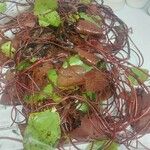
Brasenia schreberi
Schreber's Watershield · Water-shield · Water-target · Purple Wen-dock · Purple Wendock
Description
Source: wikipedia (CC BY-SA)Brasenia is a genus belonging to the family Cabombaceae, consisting of one species, Brasenia schreberi, commonly known as watershield. It is widely distributed in North America, the West Indies, northern South America, eastern Asia, Australia, the Indian subcontinent, and parts of Africa.
Care Guide
💧 Water
☀️ Light Full sun
Schreber's watershield thrives with steady, direct sunlight, which fosters robust growth. Excessive or insufficient sunlight can hamper its development. The species evolved in habitats where unimpeded sun exposure is typical, underscoring its requirement for sunlight.
What are the sunlight requirements for Schreber's watershield?
Schreber's watershield thrives in locations that receive full sun, meaning it needs above 6 hours of sunlight daily for optimal growth. It is crucial for this plant to have consistent, unfiltered exposure to sunlight, as it evolved in environments where direct solar rays are a common condition. Insufficient or excessive sunlight can inhibit its development. When choosing a spot for your Schreber’s watershield, observe how sunlight moves through your garden to ensure a balance of light and shade that supports healthy plant growth.
How can artificial lighting be used for indoor plants?
When natural sunlight is insufficient, especially during winter or in less sunny spaces, artificial lights can be a vital solution for indoor plants, promoting faster and healthier growth. LED lights are preferred for their ability to provide specific wavelengths suited for plant needs. For full sun plants, 30-50W per square foot is recommended, 20-30W per square foot for partial sun plants, and 10-20W per square foot for full shade plants. The artificial light source should be placed 12-36 inches above the plant to mimic natural sunlight and kept on for 8-12 hours per day, depending on the plant species' natural daylight requirements. This helps in ensuring the plant receives adequate light for its growth.
What are the symptoms of light deficiency or excessive sunlight in Schreber's watershield?
When Schreber's watershield receives inadequate light indoors, it may show subtle symptoms such as smaller new leaves, leggy or sparse growth, quicker leaf drop, slower or halted new growth, and lighter-colored or pale new leaves due to a lack of chlorophyll. Conversely, excessive sunlight can cause chlorosis (leaves turning yellow), sunscald (damaged leaves or stems from intense sunlight), leaf curling (as a defense mechanism to minimize water loss), wilting (from increased water loss and inadequate hydration), and leaf scorching (brown, dry, crispy leaf edges). These symptoms indicate the plant’s struggle with the current lighting condition.
What strategies can help manage light conditions for Schreber's watershield?
To manage light conditions effectively for Schreber's watershield, indoor plants should gradually be moved to a sunnier location, aiming for at least 6 hours of direct sunlight daily. A south-facing window with open curtains during the day is ideal. For plants that are large or not easily movable, consider using artificial lights, keeping them on for at least 8 hours a day. Outdoors, plants should be gradually moved to sunnier spots to avoid shock from sudden light intensity changes. If plants are grown in the ground and sunlight is obstructed, identify and reduce these obstructions, like pruning trees, or consider transplanting smaller plants during their dormant period to areas with better sunlight and drainage. It's important to note that parts of the plant affected by insufficient sunlight may not fully recover, but new growth should be healthy after adjusting light exposure.
🌡️ Temperature 0–35°C
Schreber's watershield originates from habitats with temperatures ranging from 32 to 95 °F (0 to 35 ℃). The plant prefers the cooler part of that range. Especially in extreme seasons, adjustments may be necessary to maintain its optimal temperature.
What temperature conditions are ideal for Schreber's watershield?
Schreber's watershield, scientifically known as Brasenia schreberi, thrives in temperatures ranging from 32 to 95°F (0 to 35°C), with a preference for the milder end of this scale. To ensure optimal growth, it's beneficial to maintain temperatures above 0°C during winter, avoiding exposure to freezing conditions. When outdoor temperatures drop to -5°C (25°F) in winter, it is advisable to move the plant indoors or protect it using a temporary greenhouse, plastic film, or fabric wraps to prevent freezing damage.
How does Schreber's watershield respond to low temperatures, and what are the solutions for cold damage?
Schreber's watershield exhibits moderate tolerance to low temperatures, thriving best between 0°C and 35°C. If temperatures plunge below -30°C, the leaves may darken and, at temperatures lower than -35°C, symptoms such as water-soaked necrosis, wilting, drooping, and eventual browning of leaves may occur. To mitigate frost damage, affected parts should be trimmed away, and the plant should be moved indoors to a warm setting or protected with a makeshift greenhouse. Ensuring the plant receives ample sunlight near a south-facing window or providing supplemental lighting is crucial for recovery.
What should be done if Schreber's watershield experiences high temperatures?
During hot summer months, it is important to keep Schreber's watershield below 35°C. Should temperatures exceed 41°C, the plant's growth might slow, the leaves may lighten in color and become susceptible to sunburn. In such cases, sunburned and dried parts should be trimmed away. Relocating the plant to a shaded area, particularly away from the harsh afternoon sun, and watering it during the cooler morning and evening hours, can help maintain the necessary moisture levels and protect the plant from heat stress.
💨 Humidity
🪴 Soil
🌱 Fertilizer
🪴 Pot & Repot
✂️ Pruning
To ensure healthy growth, Schreber's watershield benefits from pruning in the early to late spring. By removing dead or damaged stems, you can foster vigorous regrowth. Additionally, thinning crowded areas improves water circulation and helps prevent fungal problems. These practices lead to more vibrant and robust aquatic environments that are also aesthetically pleasing.
🌿 Propagating
🐛 Diseases & pets
☠️ Toxicity
Characteristics
- Plant Type
- Herb
- Life Cycle
- Perennial
- Genus
- Brasenia
- Family
- Cabombaceae
- Hardiness Zone
- 3-10
- Mature Height
- 2 cm to 5 cm
- Mature Spread
- 2.13 m
- Leaf Color
- Green, Purple, Lavender
- Leaf Type
- Evergreen
- Flower Color
- Purple
- Flower Size
- 2.54 cm
- Bloom Time
- Summer, Early fall
- Planting Time
- Spring
- Harvest Time
- Late summer, Fall
- Native Area
- Malawi, Belize, India, Angola, Mexico, Guatemala, South Africa, Zambia, Bangladesh, Kenya, Uganda, Jamaica, Tanzania, Russia, Zimbabwe, China, Cuba, Cameroon, Burundi, Japan, Venezuela, Guyana, El Salvador, Bhutan, Ethiopia, South Korea, Congo (DRC), Botswana