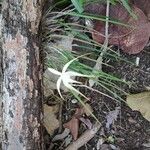
Brassavola cucullata
Daddy Longlegs Orchid · Rat's Tail Orchid
Description
Source: leafsnapBrassavola cucullata, commonly known as the hooded brassavola, is a species of orchid native to Central and South America. Its name comes from the distinctive shape of its flowers. The plant features long, thin leaves that grow in a fan-like pattern, reaching up to 30 cm in length. Its flowers are white or cream-colored and have a unique hood-like structure covering the column and lip. This orchid thrives in warm temperatures and high humidity, making it ideal for tropical climates or indoor cultivation with proper care. It requires bright but indirect light, regular watering during its growing season (spring through fall), and occasional fertilization. Brassavola cucullata has also been used in traditional medicine to treat a variety of ailments such as fever, coughs, colds, and headaches. Additionally, it has been applied topically for skin conditions like wounds and burns, thanks to its anti-inflammatory properties. Overall, Brassavola cucullata is an attractive plant with unique flowers that can be enjoyed both indoors and outdoors, provided it receives the appropriate care.
Care Guide
💧 Water Every 7 days
Brassavola's tubular leaves are engineered to limit water transpiration, making it drought resistant compared to many other orchids. As a result, unlike many other epiphytic orchids, the plants require less humidity and less frequent watering. Brassavola orchids are susceptible to chlorine and other contaminants in tap water, therefore use chlorine-free water when watering.
☀️ Light Partial sun
Daddy longlegs orchid is native to habitats like forest understories and rocky areas, where it typically grows in natural shade. It prefers partial sun but can also tolerate full sun or full shade, demonstrating its versatility and hardiness.
🌡️ Temperature 20–37.8°C
Daddy longlegs orchid prefers warm conditions. It grows best at moderately high temperatures but not when it is excessively hot and humid. Sunlight helps warm the plant and encourages flowering. However, prolonged direct sun in summer can cause sunburn, so the amount of light it receives should be controlled during that season. The plant generally does not tolerate cold well, so it needs adequate protection and higher temperatures in winter to avoid freezing.
💨 Humidity
🪴 Soil 5-6
🌱 Fertilizer
Proper fertilization is essential for the Daddy longlegs orchid’s health and appearance. Fertilize the Daddy longlegs orchid in summer, repeating the application monthly during that season. Nutrients power growth and help maintain the plant’s parts. Feeding the orchid improves its floral display, ensuring the best blooms.
🪴 Pot & Repot
When repotting a Daddy longlegs orchid, select a pot slightly larger with good drainage, preferably a clear orchid pot. Use a well-draining, orchid-specific mix that includes bark or moss. Gently clean the roots and trim any that are dead or rotting. Repot after flowering, usually in spring or fall, water thoroughly, and place in bright, indirect light. Once repotted, avoid disturbing the roots.
✂️ Pruning
Trim the spike only a modest amount if it is still green and healthy. Find the node beneath the lowest bloom and cut one inch below it. Cut back to the plant's root if the spike has become brown and mushy.
🌿 Propagating
🐛 Diseases & pets
☠️ Toxicity
While most domestic orchids are non-toxic, Brassavola orchids are slightly hazardous. They have the potential to produce contact dermatitis and other minor cutaneous responses.
Characteristics
- Plant Type
- Herb
- Life Cycle
- Perennial
- Genus
- Brassavola
- Family
- Orchidaceae
- Hardiness Zone
- 10-11
- Mature Height
- 0 cm to 1 cm
- Mature Spread
- 15 cm to 25 cm
- Leaf Color
- Green
- Leaf Type
- Evergreen
- Flower Color
- Green, Yellow, White
- Flower Size
- 6.35 cm to 10.16 cm
- Bloom Time
- Summer, Early fall, Mid fall
- Planting Time
- Spring, Summer, Autumn
- Harvest Time
- Fall, Early winter, Mid winter
- Native Area
- Colombia, Belize, Honduras, Mexico, Guatemala, Venezuela, Guyana, El Salvador, Nicaragua