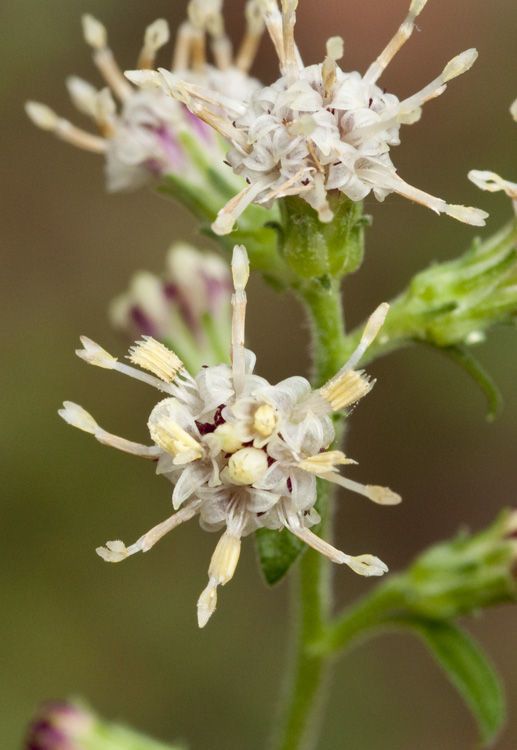
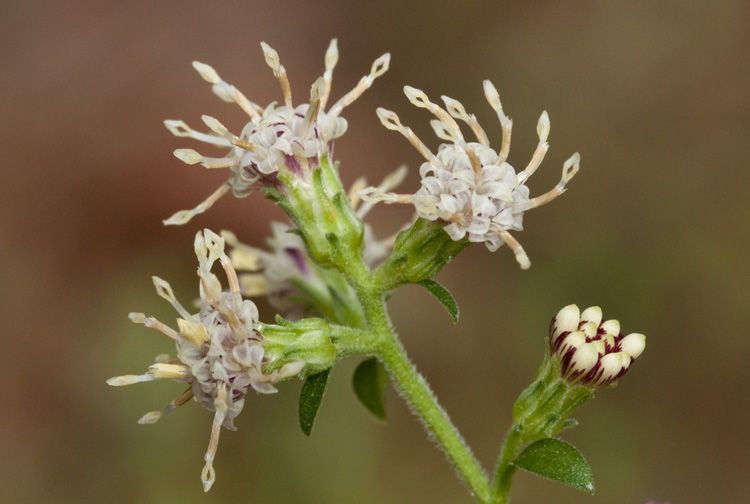
Brintonia is a monotypic genus of flowering plants in the sunflower family, containing the single species Brintonia discoidea, named for Jeremiah Bernard Brinton. It is known commonly as the rayless mock goldenrod. It is native to the southeastern United States, where it is distributed in Alabama, Florida, Georgia, Louisiana, and Mississippi.Brintonia discoidea is a perennial herb growing up to 1.5 meters tall from a thick rhizome. The erect, unbranched stem is lightly hairy. The alternately arranged leaves have rough-haired serrated blades up to 10 centimeters long on winged petioles. The inflorescence is a wide array of several flower heads. Each head contains up to 20 disc florets with bright green tubes and whitish or pinkish corollas and pinkish anthers. The fruit is a ribbed cypsela with a pappus of many white or purple-tipped bristles.The plant occurs on the Gulf Coastal Plain in sandy, swampy habitat.It is sometimes still treated as a species of Solidago, but DNA evidence and several aspects of its morphology support its separation from that genus.
Rayless mock goldenrod is fairly disease-resistant and generally not prone to diseases. However, it can be vulnerable to pests and diseases present in its surroundings. These infections are usually mild. In terms of care, the plant requires moderate maintenance. It should be pruned regularly to maintain a good appearance and healthy growth. Fertilizing can also help encourage flowering. Rayless mock goldenrod is suitable for anyone with an outdoor space, such as a garden or patio, and does not require extensive care experience. It may need more attention when grown indoors.
How to keep Brintonia Discoidea.
Fertilizer
Typically, a one-time use of fertilizer in the spring should be enough for the Rayless mock goldenrod, however, to boost its growth, it can be given nourishment several times. This should take place every month or every six weeks. Fertilizing improves the look and functionality of leaves, maintaining a uniform color and a healthy texture. Beyond that, it also promotes the development of roots and the uptake of nutrients, leading to the lasting health of the plant.
Botanical profile.
- Plant Type
- Herb
- Life Cycle
- Perennial
- Genus
- Brintonia
- Family
- Asteraceae
- Leaf Type
- Evergreen
Other names.