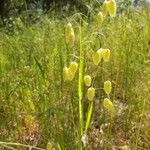
Briza maxima
Greater Quaking-grass · Great quaking grass · Large quaking grass · Big quaking grass · Blowfly grass
Description
Source: leafsnapBriza maxima is a species of the grass genus Briza. It is native to Northern Africa, Western Asia and Southern Europe and is cultivated or naturalised in the British Isles, the Azores, Australasia, the western United States, Central and South America, and Hawaii.This species has a large number of common names, including big quaking grass, great quaking grass, greater quaking-grass, large quaking grass, blowfly grass, rattlesnake grass, shelly grass, rattle grass, and shell grass.It grows to a height of 60 cm. The seeds and leaves are edible.
💡 Big quaking grass has been introduced to numerous countries; however, it has become a weed in many regions, especially in Australia and parts of the United States, negatively impacting the native plant life.
🎭 Psychic abilities, protection. It represents food, concealment and resilience.
Care Guide
💧 Water Every 7 days
Big quaking grass thrives in grassland-like environments with moderate moisture, benefiting from weekly watering. Its resilience and graceful movement make it a popular choice for outdoor ornamentation, especially in gardens that receive regular rainfall.
How should I water my Big quaking grass?
Big quaking grass can be watered using a garden hose, watering can, or any common watering tool. It is not particular about the type of water it receives, as rainwater, tap water, and filtered water all work fine. It is generally recommended to avoid overhead watering to prevent damage to the leaves, flowers, and potential disease. Using a drip irrigation system is often the best method as it applies water evenly and directly to the soil. For a Big quaking grass in a container, a cup, watering can, or tap water can be used to water directly into the soil.
What should I do if I give my Big quaking grass plant too much or too little water?
The remedy for underwatering Big quaking grass is simple: water it regularly when you notice it lacks moisture. Overwatering, however, can be a more serious problem. If you overwater your Big quaking grass, it can become susceptible to diseases that can lead to its decline and death. To prevent this, choose a growing location with ample sunlight to dry out the soil and good drainage to prevent water from pooling. If your Big quaking grass is in a pot and you have overwatered it, consider repotting it in a new pot with proper drainage. Use loose soil and a pot that drains efficiently.
How frequently should I give water to my Big quaking grass?
Big quaking grass requires regular watering throughout the growing season. In the spring, you should water it about once a week. As the season progresses and becomes warmer, you may need to water it two to three times a week. However, it's important not to exceed this rate as it can harm the plant. Regardless of how often you water, make sure the soil remains moist but not wet. When watering a Big quaking grass in a pot, you'll generally need to water it more frequently than one planted in the ground. Potted grass can heat up and dry out faster, so watering a few times a week is usually necessary compared to just once a week for an in-ground plant.
How much water does my Big quaking grass plant require?
Determining how much water to give to your Big quaking grass can be approached in a few different ways. One method is to gauge the soil's moisture by feeling it, and watering until the first six inches are moist. Another option is to use a set measurement, such as two gallons per week, depending on the temperature and how quickly the soil dries. However, following strict guidelines could result in overwatering if your plant actually needs less. When growing Big quaking grass in a container, you'll need to adjust the watering method. In this case, aim to moisten all layers of dry soil by testing with your finger or allowing excess water to trickle out of the pot's drainage holes.
How can I know if I'm watering my Big quaking grass enough?
Taking care of Big quaking grass can be a bit challenging when it comes to watering. On one hand, these plants need a weekly supply of water to keep their deep roots moist. On the other hand, they are highly prone to root rot and can experience browning if overwatered. Underwatering is not as much of a concern since these plants can survive without extra watering for a while, but if you neglect to water them for too long, they may start to wilt and develop dry leaves.
☀️ Light Full sun
Large quaking grass prefers exposure to the sun's full daily course across the sky. In its native environment, it thrives with unobstructed sunlight. Insufficient sun can stunt its growth, while extreme overexposure might harm it, though that is less likely.
What are the sunlight requirements for Big quaking grass?
Big quaking grass requires full sun, which means it needs more than 6 hours of sunlight each day to thrive. It's important to watch how sunlight moves through your garden, choosing spots that offer a perfect balance of light and shade to ensure the plants' happiness. In its natural habitat, Big quaking grass flourishes under unobstructed exposure to the sun’s rays. Both lack of ample sun and extreme overexposure could affect its growth, although it's less likely to be harmed by too much sun.
How does artificial lighting support Big quaking grass indoors?
Indoor Big quaking grass requires adequate lighting for optimal growth, especially when natural sunlight is insufficient. Artificial lights, particularly LED lights customized to provide specific wavelengths, can promote faster, healthier growth. For full sun plants like Big quaking grass, 30-50W/sq ft of artificial light is recommended. It's important to place the light source 12-36 inches above the plant and mimic natural daylight hours, typically requiring 8-12 hours of light per day.
What symptoms indicate inadequate sunlight for Big quaking grass?
Symptoms of light deficiency in Big quaking grass include smaller new leaves, leggy or sparse growth, faster leaf drop, slower or no new growth, lighter-colored new leaves, and symptoms of too much sunlight like chlorosis, sunscald, leaf curling, wilting, and leaf scorching. These symptoms indicate the plant's struggle with the light conditions, pointing towards a need for better light management.
What solutions are recommended for Big quaking grass facing light-related issues?
For indoor Big quaking grass facing light deficiency, gradually move it to a sunnier location until it gets at least 6 hours of direct sunlight, utilizing a south-facing window. If moving the plant isn't feasible, consider using artificial light, keeping a lamp on for at least 8 hours a day or investing in plant grow lights. Outdoors, it's crucial to move your plants gradually to sunnier spots and avoid sudden changes in light intensity. Pruning nearby trees and transplanting can help improve sunlight access. Note that parts of the plant affected by insufficient sunlight may not recover, but new growth should be healthy with improved light exposure.
🌡️ Temperature 5–32.2°C
Big quaking grass originates from a native habitat where temperatures typically range from 68 to 95 °F (20 to 35 ℃). As a result, it favors that temperature band for optimal growth. When seasonal temperatures drop below or rise above this range, appropriate measures should be taken to uphold it.
What is the optimal temperature range for Big quaking grass?
Big quaking grass flourishes in its native environment where temperatures typically range between 68 to 95°F (20 to 35°C). It thrives within this temperature span, requiring adjustments during seasons with lower or higher temperatures to maintain this preferred range. Its strong cold resistance negates the need for special frost protection measures during most winters. However, in cases where winter temperatures dip below -30°C, protective measures like covering the plant with soil or straw are recommended. Additionally, watering the plant abundantly before the first freeze in autumn helps keep the soil moist, aiding the plant through winter and early spring.
How does Big quaking grass react to temperatures below its optimal range?
Big quaking grass showcases commendable cold tolerance, flourishing best when temperatures remain above 20°C and ideally kept above 0°C during winters. In extreme cold, where temperatures fall below -30°C, the plant may not show immediate adverse changes during winter, but a significant decrease in sprouting, or even a total absence of it, can occur come spring. If such a case arises, removing the parts that failed to sprout in the spring is advised as a remedial measure.
What are the effects of high temperatures on Big quaking grass and how can they be mitigated?
During the summer months, it's crucial to ensure that the temperature around Big quaking grass does not exceed 35°C. Exceeding this threshold, especially temperatures over 38°C, can cause the leaves to lighten in color, curl, become prone to sunburn, and, in severe cases, lead to the wilting and drying of the entire plant. To mitigate these effects, it's recommended to trim away the sunburned and dried-up parts. Relocating the plant to a shadier spot or employing a shade cloth can protect it from the harsh midday and afternoon sun. Additionally, watering the plant in the morning and evening helps maintain soil moisture and overall plant health.
💨 Humidity normal (40-60%)
This plant will thrive in moderate humidity, which is probably the level in your home. However, misting it a few times a week can be very beneficial. Make sure the room has good ventilation.
🪴 Soil 6-7
🌱 Fertilizer
Once Big quaking grass has opened most of its blooms to full size, resume fertilizing. When the blooms are at their peak, apply fertilizer every three to four weeks, weather permitting. Then, once Big quaking grass begins producing fewer new blooms, discontinue fertilizing; there's no need to feed the plant if it can no longer produce additional blooms.
🪴 Pot & Repot
For big quaking grass to thrive in pots, it needs excellent drainage.
✂️ Pruning
Big quaking grass features delicate, nodding seed heads that add ornamental appeal. To promote new growth, prune it from early to late spring by removing any damaged stems. Removing spent flowers, or deadheading, helps prevent self-seeding and keeps the plant tidy. Regular and timely pruning enhances the plant's vigor and prolongs its decorative life.
🌿 Propagating
🐛 Diseases & pets
☠️ Toxicity
Characteristics
- Plant Type
- Herb
- Life Cycle
- Annual
- Genus
- Briza
- Family
- Poaceae
- Hardiness Zone
- 4-8
- Mature Height
- 10 cm to 61 cm
- Mature Spread
- 61 cm
- Leaf Color
- Green
- Leaf Type
- Deciduous
- Flower Color
- Yellow, Green
- Flower Size
- 1.02 cm to 5.08 cm
- Bloom Time
- Late spring, Early summer
- Planting Time
- Spring, Summer
- Harvest Time
- Early summer, Mid summer
- Native Area
- Libya, Turkey, Tunisia, Cyprus, Bulgaria, Greece, Croatia, Slovenia, Morocco, Lebanon, Portugal, Syria, Jordan, Italy, Spain, Israel, Albania, Algeria, France