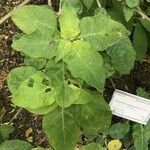
Brugmansia sanguinea
Red Angel's Trumpet · Red floripontio
Description
Source: leafsnapBrugmansia sanguinea, commonly known as the Scarlet Angel's Trumpet, is a flowering plant native to the Andes Mountains in South America. As a member of the Solanaceae family, it can grow up to 10 feet tall. The plant is renowned for its large, trumpet-shaped flowers, which are bright red or orange-red and emit a strong fragrance that becomes more intense at night. The leaves of Brugmansia sanguinea are dark green and can reach lengths of up to 10 inches. The plant thrives in moist soil and partial shade but can also tolerate full sun in cooler climates. For centuries, indigenous people have used Brugmansia sanguinea for medicinal purposes. The plant contains alkaloids that have been employed as painkillers, sedatives, and hallucinogens. However, it is important to note that all parts of Brugmansia sanguinea are toxic if ingested and should be handled with care. Despite its toxicity, the plant is widely cultivated as an ornamental due to its stunning flowers. In summary, Brugmansia sanguinea is an impressive flowering plant with beautiful blooms, but it requires careful handling due to its toxic nature.
Care Guide
💧 Water Every 7 days
The Red Angel's Trumpet is a plant native to the highlands of South America. It thrives in environments with consistent moisture and good drainage. To keep it healthy, water it weekly and provide it with cooler outdoor conditions, where it can benefit from natural rainfall. The plant's growth cycle is adapted to the availability of water, allowing it to efficiently use seasonal rains.
How should I water my Red angel's trumpet plant?
Watering your Red angel's trumpet is a flexible task. You can use common watering tools like watering cans, hoses, or even cups to moisten the plant's soil. Regardless of the tool you choose, it's important to water directly onto the soil, ensuring all areas receive equal moisture. Filtering the water is helpful to remove harmful particles, as tap water can contain them. Using water that is at or slightly above room temperature is ideal, as extremes can shock the plant. However, the Red angel's trumpet generally responds well to any kind of water.
What should I do if I give my Red angel's trumpet plant too much or too little water?
Outdoor plants, especially newly planted ones or seedlings, can be at risk of not being watered enough. It's important to continue watering them adequately for a few months while they are still small or newly planted. Once the roots are established, Red angel's trumpet plants can usually rely on rain for moisture. When Red angel's trumpet is planted in pots, overwatering is more likely. If you accidentally overwater your plant, take immediate action to resolve the situation. First, stop watering the plant right away to minimize the impact of overwatering. Then, remove the plant from its pot and inspect the roots. If there is no root rot, you can return the plant to its pot. However, if you find signs of root rot, trim away the affected roots and consider applying a fungicide. Finally, repot the plant in well-draining soil. On the other hand, underwatering is a common issue that can be easily resolved. If you notice drooping, drying, or falling leaves, simply water the plant more frequently. Adjust your watering frequency as soon as you notice the signs of underwatering.
How much water should I give my Red angel's trumpet plant?
When it comes to growing plants outdoors, they usually rely on natural rainfall. However, if you live in an area with limited rainfall, it's important to make sure your plants get enough water. During the spring and fall, watering every 2 weeks should be sufficient. In the summer, when plants need more water, you'll need to water them more frequently. In winter, when plants grow slower and need less water, you can water them less often or not at all. If you have a young or newly planted Red angel's trumpet, it's important to water it more frequently to help it establish and become more adaptable to drought. For potted plants, there are two main ways to determine how often to water your Red angel's trumpet. The first is to set a schedule, such as once a week or once every other week. However, this may not always be effective as it doesn't consider the specific conditions of your plant's environment. The other option is to check the moisture level of the soil. It's generally best to wait until the top two to four inches of soil have completely dried out before watering again.
How much water does my Red angel's trumpet plant require?
To water your Red angel's trumpet effectively, you don't always need to use a large amount of water. If only a few inches of soil have dried since the last watering, giving it about five to ten ounces of water each time will support healthy growth. You can also determine the amount of water based on the moisture level of the soil. Keep track of how many inches of soil have dried out between waterings. To ensure your Red angel's trumpet gets enough moisture, water enough to moisten all the dry soil layers since the last watering. If more than half of the soil is dry, consider giving more water than usual, until excess water drains from the pot's drainage holes. If your Red angel's trumpet is planted in an outdoor area with plenty of rain, it may not require additional watering. When the plant is young or establishing itself, make sure it receives 1-2 inches of rain per week. As it grows and becomes established, it can rely solely on rainwater, unless there is no rainfall for 2-3 weeks during hot weather. In that case, give your Red angel's trumpet a full watering to prevent stress.
How can I know if I'm giving enough water to my Red angel's trumpet plant?
The Red angel's trumpet is often overwatered, which can cause several noticeable signs. An overwatered plant will have yellowing leaves and may even lose some leaves. Additionally, overwatering can lead to the plant's structure becoming shriveled and may encourage root rot. On the other hand, an underwatered Red angel's trumpet will also start to wilt and may have brown or brittle leaves. Regardless of whether you see signs of overwatering or underwatering, it is necessary to take action and restore the plant's health.
☀️ Light Full sun
The red angel's trumpet does best with ample sunlight, which is necessary for healthy development. Although its native environment is usually bright and sunlit, it can tolerate lower light levels. Excessive sun can cause sunscald, and insufficient light inhibits growth; therefore, it prefers steady but moderate sun exposure.
What are the sunlight requirements for the Red angel's trumpet?
The Red angel's trumpet requires full sun, which means it thrives best with above 6 hours of sunlight, but it can also grow in partial sun, with about 3-6 hours of sunlight. It's vital to watch how sunlight moves through your garden to ensure the plants get a perfect balance of light and shade, which is crucial for their health. This plant is accustomed to extensive sun exposure in its native habitat, although it can tolerate some shade. Too much sun could lead to sunscald, while too little may stunt its growth, so moderate yet prolonged sun exposure is optimal.
What are some essential care tips for Red angel's trumpet regarding sunlight?
For indoor Red angel's trumpet plants, adequate lighting is essential for optimal growth. When natural sunlight is not sufficient, especially in winter or in less sunny spaces, artificial lighting serves as an important solution. The right type of artificial light, like LED lights, should be chosen as they can be tailored to provide the wavelengths needed by the plants. Full sun plants require 30-50W/sq ft of artificial light, partial sun plants need 20-30W/sq ft, and full shade plants need 10-20W/sq ft. The artificial light source should be placed 12-36 inches above the plant, mimicking natural sunlight's distance, and provided for 8-12 hours per day depending on the plant species' needs.
What are the symptoms of insufficient light in Red angel's trumpet?
When the Red angel's trumpet doesn't get enough light, especially indoors during winter, it shows several symptoms of light deficiency. These include smaller new leaves compared to mature ones, leggy or sparse growth with elongated spaces between leaves or stems, faster leaf drop as the plant tries to conserve resources, delayed or halted growth, lighter-colored or irregularly patterned new leaves indicating a lack of chlorophyll and nutrients, chlorosis or the loss of green color and yellowing of leaves, sunscald with damaged leaf or stem tissues from intense light exposure, leaf curling as a defense against excessive sunlight to reduce water loss, wilting due to water loss and decreased turgor pressure, and leaf scorching characterized by brown, dry edges on leaves from too much sunlight.
How can I address sunlight-related issues with my Red angel's trumpet?
To tackle sunlight-related issues in Red angel's trumpet, consider moving the plant gradually to a sunnier location each week to achieve at least 6 hours of direct sunlight daily if indoors. Use a south-facing window and keep curtains open for maximum sunlight exposure. If the plant is large or hard to move, supplement with artificial light for at least 8 hours a day. For outdoor plants, ensure a gradual transition to sunnier spots to prevent sunburn. For ground plants, reduce obstructions like tree branches to let more sunlight through or consider transplanting to a sunnier location, preferably during the plant's dormant period for minimal stress. Remember, while increasing light exposure encourages new healthy growth, parts of the plant already affected might not recover but can be supported towards new, healthy developments.
🌡️ Temperature 20–37.8°C
Red angel's trumpet is native to temperate regions, favoring temperatures of 68 to 100 °F (20 to 38 °C). In colder seasons, it is advisable to adjust temperatures to replicate its native environment.
What are the ideal temperature conditions for growing Red angel's trumpet?
Red angel's trumpet thrives in temperate regions, with optimal temperature ranges between 68 to 100 °F (20 to 38 °C). It is a heat-loving plant that can be negatively affected by cold temperatures. In the autumn, it's advisable to bring outdoor-grown plants indoors, placing them near a bright window while avoiding direct heat sources to maintain a suitable temperature above its minimum growth threshold. During winter, keeping the temperature above the plant's tolerable growing temperature minimum is crucial for its health.
How should I care for Red angel's trumpet in cold temperatures?
If exposed to temperatures below its growth limit, the leaves of the Red angel's trumpet may change color and the plant may suffer from wilting or drooping due to frost damage. The recommendation for cold protection includes trimming off the frost-damaged parts and moving the plant indoors to a warm environment. It's best to place the plant near a south-facing window for ample sunlight while avoiding proximity to heaters or air conditioning vents, preventing air dryness.
What are the symptoms of and solutions for high temperature exposure in Red angel's trumpet?
Red angel's trumpet should ideally be kept below its maximum suitable growth temperature during summer. Exceeding the tolerable maximum temperature can lead to lighter leaf coloration and increased susceptibility to sunburn. To alleviate these symptoms, it's advised to trim away any sunburned or dried-up parts of the plant. Moving the plant to a shaded location during intense midday and afternoon sun exposure and ensuring the soil remains moist with morning and evening watering are effective solutions.
💨 Humidity normal (40-60%)
This plant will thrive in moderate humidity, which is probably the level in your home. However, misting it a few times a week can be very beneficial. Make sure the room has good ventilation.
🪴 Soil 6-7
🌱 Fertilizer
The best time to fertilize a red angel's trumpet is in early spring, as it breaks dormancy. This encourages overall growth and flower development. Fertilizing improves the foliage, stems, and branches and supports flowers that are large, bright, and long-lasting. It helps move nutrients from the roots to the flowers and enhances the plant's health and resistance to disease.
Why should I fertilize my Red angel's trumpet plant?
Fertilization is crucial for the overall health and well-being of a Red angel's trumpet. By supplying the proper energy and nutrients, your plant will develop lush foliage and strong stems and branches. Additionally, fertilization plays a significant role in the formation of beautiful flowers, which are highly prized by gardeners. The right fertilizer facilitates the transfer of nutrients from the roots to the flowers, resulting in larger, brighter, and longer-lasting blooms. Furthermore, proper fertilization supports the plant's overall health, enabling it to resist diseases more effectively.
When should I fertilize my Red angel's trumpet for the best results?
To keep your Red angel's trumpet healthy and promote its growth and blooming, it's best to fertilize it during the early spring after its dormant phase. This will provide the plant with the necessary energy for its overall development. However, a second feeding during the fall months can also be beneficial, although it doesn't need to be as large as the first one. Some gardeners choose to fertilize the plant during planting, but it's not always necessary.
When is it not a good idea to add fertilizer to my Red angel's trumpet plant?
During winter, Red angel's trumpet goes into a dormant phase and does not require fertilization like many other plants. Fertilizing during this time increases the risk of overfertilization. The best time to feed the plant is in early spring and fall. Fertilization is not necessary during most of spring and summer. It is also advisable to avoid fertilizing if the plant is exposed to extreme hot or dry conditions.
What kind of fertilizer does my Red angel's trumpet plant need?
It is generally okay to use a general-purpose fertilizer with equal amounts of nitrogen, phosphorus, and potassium. However, Red angel's trumpet plants usually do better with a specific type of fertilizer. The most important nutrients for them are nitrogen and phosphorus, so you should use a fertilizer that has higher amounts of these compared to potassium. For example, a fertilizer with an N-P-K ratio of 10-10-8 or something similar would be suitable. Additionally, it can be beneficial to use organic materials like compost for at least one of your yearly feedings. If you decide to use fertilizer, granular fertilizer is the most commonly used for Red angel's trumpet plants.
How should I give fertilizer to my Red angel's trumpet?
Fertilizing your Red angel's trumpet is easy, even for beginner gardeners. To feed it with granular fertilizer, simply sprinkle it onto the soil after moistening it with water. You can also improve the plant's soil by adding organic material like compost or manure. Just place the material on top of the soil and gently work it into the first few inches with a hand rake, being careful not to disturb the roots.
🪴 Pot & Repot 2-3 years
Repot your red angel's trumpet every 2 to 3 years during spring to encourage rapid growth and refresh the soil's nutrients. Choose a large container to accommodate its roots and place the plant in bright, indirect light. Water it consistently to keep the soil moist. For the best results, use a rich, well-draining soil that will support its striking, trumpet-shaped blooms.
✂️ Pruning
To ensure the red angel's trumpet thrives, it is important to regularly prune it in late spring. This helps maintain its shape and promotes healthy growth. Start by removing any dead or damaged branches to improve airflow and prevent diseases. You can also lightly trim older stems to encourage new growth, which will enhance flowering and overall vigor. Be sure to use clean, sharp tools to prevent infections.
🌿 Propagating
🐛 Diseases & pets
☠️ Toxicity
Characteristics
- Plant Type
- Shrub
- Life Cycle
- Perennial
- Genus
- Brugmansia
- Family
- Solanaceae
- Hardiness Zone
- 9-11
- Mature Height
- 1.83 m
- Mature Spread
- 1.22 m
- Leaf Color
- Green
- Leaf Type
- Evergreen, Semi-evergreen
- Flower Color
- Red, Orange
- Flower Size
- 15.24 cm to 20.32 cm
- Bloom Time
- Late spring, Summer, Fall
- Planting Time
- Spring, Summer, Autumn
- Harvest Time
- Fall, Early winter, Mid winter
- Native Area
- Colombia, Bolivia, Peru, Ecuador, Costa Rica