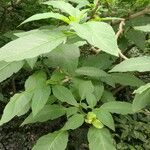
Brugmansia spp.
Trumpet flower · Datura · বাংলা
Description
Source: leafsnapThe Brugmansia spp. is a stunning flowering perennial shrub native to South America. Also called the trumpet of death, Angel’s trumpet, or moonflower, Brugmansia is well known for its lovely trumpet-shaped flowers that hang from the shrub in the summer or fall. The blooms can appear in various colors, including white, yellow, pink, orange, peach, and gold. The shrub’s long leaves are alternately arranged on the stems leading toward the drooping flowers. Angel’s trumpet is usually grown as a woody shrub but can be trained as a small tree. They are relatively fast-growers, with an additional 2 to 3 feet every year, but can be considered invasive in many areas. Angel’s trumpet attracts pollinators, like hummingbirds, with the shrub’s flowers and fragrance. But, it is toxic to people and pets.
Care Guide
💧 Water Every 2 days
Angel’s trumpet should be well-watered at all times, especially during warmer weather. As water-loving plants, they need at least 3 inches every week and might need watering up to twice daily during hot summers. Though they are thirsty plants, they don’t like being waterlogged, so ensure that the soil and container have ample drainage.
☀️ Light
🌡️ Temperature
Native to tropical locations, Angel’s trumpet grows well in moderate to warm climates. Once temperatures fall below 40°F (4°C), you’ll need to move plants indoors. Place them in a dark, frost-free area, like the garage, to protect them from the frost of fall and winter.
💨 Humidity
🪴 Soil
🌱 Fertilizer
Feed your Angel’s trumpet with a water-soluble fertilizer once a week. You can opt for a flower fertilizer to stimulate larger, brighter blooms. Larger shrubs will benefit from feedings up to 2 to 3 times every week, but you will want to avoid slow-release formulas as they don’t work fast enough.
🪴 Pot & Repot
✂️ Pruning
Angel’s trumpet typically doesn’t require pruning, but occasional trimming will encourage constant flower production. Cut older branches and stems to stimulate more branching. Flowers are more likely to appear at the ends of these new stems. When pruning, maintain at least 6-10 nodes on the branches. If you want to grow your Angel’s trumpet as a small tree, start pruning when the main trunk forms the first ‘Y’ and pick a central branch as the trunk.
🌿 Propagating
🐛 Diseases & pets
☠️ Toxicity
All parts of Angel’s trumpet plant are toxic to people and pets. The plant contains alkaloids that are considered poisonous and may induce hallucinations, memory loss, paralysis, and other fatal reactions when ingested. Even exposure to the shrub can lead to confusion, delirium, and restlessness. Keep Angel’s trumpet away from children and pets, and always wear protective equipment when handling it.
Characteristics
- Plant Type
- Perennial shrub
- Genus
- Brugmansia
- Family
- Solanaceae
- Hardiness Zone
- 9 to 11
- Bloom Time
- Sporadically from spring until late fall, with the heaviest profusion occurring in fall; year-round in warmer climates
- Native Area
- Tropical regions of South America