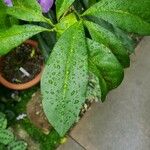
Brunfelsia pauciflora
Yesterday Today and Tomorrow · Brazil raintree · Kiss me quick · Morning-noon-and-night · Yesterday
Description
Source: leafsnapBrunfelsia pauciflora, commonly known as Yesterday-Today-and-Tomorrow, is a flowering plant native to South America. This small shrub can grow up to 6 feet tall and 4 feet wide. It produces clusters of fragrant flowers that change color over several days: starting as purple-blue on the first day, fading to lavender on the second day, and finally turning white on the third day. The plant features dark green, glossy, oval-shaped leaves. Brunfelsia pauciflora thrives in well-drained soil with partial shade or filtered sunlight. While it can tolerate some drought, it requires regular watering during dry periods for optimal growth and flowering. The plant is relatively low-maintenance but may benefit from occasional pruning to maintain its shape. In addition to its ornamental value in gardens and landscapes, Brunfelsia pauciflora has been used in traditional medicine for ailments such as fever reduction and pain relief, thanks to its anti-inflammatory properties. Overall, Brunfelsia pauciflora is a beautiful and unique addition to any garden or landscape. Its flowers, which change color over time, make it an intriguing conversation piece among garden enthusiasts.
Care Guide
💧 Water Every 7 days
Yesterday-today-and-tomorrow is a plant native to tropical regions, thriving in high humidity and consistent moisture. While it can tolerate moderate drought, it’s important to water it every 1-2 weeks, ensuring the soil stays lightly moist but not waterlogged. This plant does well outdoors, especially during the active growing season, when moisture levels are carefully managed.
How should I water my Yesterday-today-and-tomorrow plant?
You can water your Yesterday-today-and-tomorrow plant using any common watering tool. Watering cans, hoses, and even cups will work fine. Just make sure to apply the water directly to the soil and evenly moisten all areas. Using filtered water is better, as tap water may have harmful particles. The water should be at or slightly above room temperature to avoid shocking the plant. However, the Yesterday-today-and-tomorrow plant usually responds well to any kind of water.
What should I do if I give my Yesterday-today-and-tomorrow plant too much or too little water?
Outdoor plants, especially newly planted ones or seedlings, can be susceptible to lack of watering. It's important to consistently water them for a few months until the roots are established and the plant can rely on rainfall. When your outdoor plant is in a pot, overwatering is more likely. If you accidentally overwater your plant, you should act quickly to address the situation. First, stop watering the plant immediately to minimize the impact of overwatering. Then, remove the plant from its pot to inspect the roots. If there is no root rot, you can place the plant back in its container. However, if you find signs of root rot, trim away the affected roots and consider using a fungicide to prevent further damage. Finally, repot the plant in well-draining soil. In the case of underwatering, simply increase the frequency of watering. If you notice the plant's leaves drooping, drying out, or falling off, it's a sign of underwatering. After sufficient watering, the leaves will quickly regain their fullness. Adjust your watering schedule immediately if you notice underwatering.
How often should I water my Yesterday-today-and-tomorrow plant?
If you live in an area with regular rainfall, most outdoor plants can grow normally without any additional watering. However, if you live in a place with limited rainfall, you should water your plants every 2 weeks during spring and fall, and more often during summer. In winter, when plant growth slows down, you can water less frequently or not at all. If you have a young or newly planted Yesterday-today-and-tomorrow plant, you should water it more often to help it establish and become more drought tolerant as it matures. For potted plants, there are two main ways to determine how often to water your Yesterday-today-and-tomorrow. One way is to follow a predetermined watering schedule, such as once a week or once every other week. However, this may not always be accurate for your specific plant and growing conditions. Another option is to monitor the soil moisture. It's best to wait until the top two to four inches of soil or about ⅓ to ½ of the pot depth have completely dried out before watering again. Keep in mind that during summer, your plant's water needs will likely be higher than the predetermined schedule suggests. Adjust your watering frequency accordingly.
How much water does my plant need tomorrow?
Watering your Yesterday-today-and-tomorrow may not always require a large amount of water. If only a few inches of soil have dried since your last watering, give it about five to ten ounces of water. You can determine the water volume by checking how many inches of soil have dried out. To ensure proper moisture, water enough to moisten all the dry soil layers. If more than half of the soil is dry, consider giving more water until excess water drains from the pot's holes. If your plant is in a rain-prone area, it may not need extra watering. When young or establishing, provide 1-2 inches of rain per week. As it grows, it can rely on rainwater, only watering during hot, rainless stretches of 2-3 weeks to prevent stress.
How do I know if I'm watering my Yesterday-today-and-tomorrow plant enough?
Overwatering is a common issue for the Yesterday-today-and-tomorrow plant, and there are clear signs to watch out for. An overwatered plant will have yellowing leaves and may shed some. Additionally, overwatering can cause the plant to shrink and promote root rot. Conversely, if the plant is underwatered, it will start to wilt and its leaves may turn brown or become fragile. Whether you notice signs of overwatering or underwatering, it's important to take action and restore the plant's health.
☀️ Light Full sun
Yesterday-today-and-tomorrow grows best in locations with full sun exposure, though it can tolerate areas where sunlight is interspersed with shade. Excessive sun can cause leaf burn, while insufficient light may restrict its growth and blooming. It originally grew naturally in sun-drenched habitats.
What are the sunlight requirements for Yesterday-today-and-tomorrow?
Yesterday-today-and-tomorrow requires full sun, meaning it thrives in locations that receive more than 6 hours of sunlight daily. However, it can also tolerate partial sun, with about 3-6 hours of sunlight. It's important to watch how sunlight moves through your garden to ensure plants get the ideal balance of light and shade for optimal growth and flowering.
Can Yesterday-today-and-tomorrow grow in shaded areas?
While Yesterday-today-and-tomorrow naturally grows in sun-drenched habitats and thrives in an area exposed to complete solar rays, it is sufficiently tolerant to regions where sun illumination is interspersed with shade. However, overexposure to solar rays can result in leaf burn, and a deficiency in sunlight might hinder its growth and blooming.
What artificial lighting is required for indoor Yesterday-today-and-tomorrow plants?
When natural sunlight is insufficient, artificial lighting is essential for indoor Yesterday-today-and-tomorrow plants, especially in winter or less sunny spaces. LED lights, capable of providing specific light wavelengths, are recommended. Full sun plants require 30-50W/sq ft, partial sun plants need 20-30W/sq ft, and full shade plants need 10-20W/sq ft. The light source should be placed 12-36 inches above the plant, mimicking natural sunlight conditions for 8-12 hours per day.
What are the symptoms of insufficient light in Yesterday-today-and-tomorrow?
Symptoms of light deficiency in Yesterday-today-and-tomorrow include smaller new leaves, leggy or sparse growth, faster leaf drop, slower or halted growth, paler new leaves, chlorosis (leaves turning yellow due to a breakdown of chlorophyll), sunscald, leaf curling, wilting, and leaf scorching.
How can I improve light conditions for indoor Yesterday-today-and-tomorrow plants?
To improve light conditions for indoor Yesterday-today-and-tomorrow, gradually move the plants to a sunnier location to receive at least 6 hours of direct sunlight daily, preferably near a south-facing window. For large or immovable plants, use artificial light, such as desk or ceiling lamps on for at least 8 hours daily or invest in professional plant grow lights.
🌡️ Temperature 20–37.8°C
Yesterday-today-and-tomorrow comes from tropical areas, where the climate is generally warm and humid. Consequently, it is adapted to high temperatures and humidity. It dislikes sudden temperature changes and prefers a stable temperature environment, so avoiding temperature fluctuations indoors is important. It typically cannot tolerate cold and requires warmer conditions for growth. If the environmental temperature falls too low, the plant may stop growing or even die.
What is the common name of Brunfelsia pauciflora?
The common name of Brunfelsia pauciflora is Yesterday-today-and-tomorrow.
💨 Humidity
🪴 Soil 5-6
🌱 Fertilizer
The best time to fertilize a Yesterday-today-and-tomorrow is in early spring, as it breaks dormancy. This encourages overall growth and flower development. Fertilizing improves the foliage, stems, and branches, while encouraging large, vibrant, long-lasting blooms. It also helps move nutrients from the roots to the flowers and enhances the plant’s health and resistance to disease.
Why do I need to put fertilizer on my Yesterday-today-and-tomorrow plant?
To ensure your Yesterday-today-and-tomorrow plant produces beautiful blooms, it is important to fertilize it. Fertilizing in early spring is particularly beneficial as it promotes excellent flower growth during that season. Additionally, fertilizing in the fall or late spring gives the plant extra nutrients to store in the ground, which enables it to have more energy for active growth later on.
When should I fertilize my Yesterday-today-and-tomorrow plant?
Proper timing is essential for fertilizing Yesterday-today-and-tomorrow plants. If you apply fertilizer too early while the plant is still dormant, it won't be effective and will be washed away by rainwater, causing waste and pollution. It is recommended to apply the first round of fertilizer in early spring and continue fertilizing once a month until early summer.
When is the best time to not fertilize my Yesterday-today-and-tomorrow plant?
To ensure optimal growth and blooming of Yesterday-today-and-tomorrow, it is important to avoid excessive nitrogen in the fertilizer. This can result in an abundance of leaves but few blooms. Opt for a fertilizer with a lower nitrogen content compared to other nutrients. It is also crucial not to fertilize the plant after early autumn as this can lead to excessive growth before winter. Additionally, refrain from fertilizing during hot and dry periods, as the dry soil may not effectively deliver the fertilizer and stimulate growth that requires more water, potentially leading to water scarcity. It is best to apply fertilizer during cooler temperatures earlier in the season. Lastly, take into account that Yesterday-today-and-tomorrow can absorb nearby plant or lawn fertilizers, so be cautious to avoid unintentionally providing the plant with a double dose of fertilizer.
What kind of fertilizer does my Yesterday-today-and-tomorrow plant need?
To provide the best care for your Yesterday-today-and-tomorrow plant, there are a few options for fertilization. One approach is to use a fertilizer that contains a balanced mix of the three main plant nutrients, with slightly more phosphorus. Another option is to enrich the soil by adding organic materials like compost, worm castings, or manure. Experienced gardeners may also choose to supplement with water-soluble fertilizers containing phosphorus when the flower buds start to appear. This helps enhance flower development, leading to larger and longer-lasting blooms. When it comes to fertilizer type, liquid or powdered forms are among the top choices for Yesterday-today-and-tomorrow plants. Regardless of the form you choose, be sure to dilute the fertilizer and apply it while watering your plant.
How can I make my Yesterday-today-and-tomorrow plant grow better?
To properly fertilize your Yesterday-today-and-tomorrow plant, it is important to follow the directions for the specific type of fertilizer and do some research on how to use it. To avoid over-fertilizing, it is crucial to determine the correct amount of fertilizer to use. One general guideline is to use the age of the tree or the trunk diameter as a reference. You can estimate using about one-tenth of a pound of fertilizer per year or per inch of trunk, with a maximum of one pound. When applying granular fertilizers or organic ones like blood meal, sprinkle the substance around the base of the tree, making sure to cover the entire area up to where the branches reach. Be careful not to allow the fertilizer to touch the trunk. The granules will gradually break down and filter into the soil, eventually being absorbed by the roots. After fertilizing, spread a one-inch layer of compost around the base of the tree and water it thoroughly.
🪴 Pot & Repot 2-3 years
Repot the yesterday-today-and-tomorrow plant every 2 to 3 years during the spring. Use a slightly larger container to allow for root growth. After repotting, place the plant in indirect light and water it consistently to keep the soil moist. To enhance its unique, color-changing flowers, use a high-quality potting mix. This will ensure you can enjoy the plant's beauty continuously.
✂️ Pruning
The yesterday-today-and-tomorrow plant is known for its vibrant flowers that change colors each day. To encourage more blooms, enhance air circulation, and maintain a manageable size, it's best to prune the plant in early spring. Be careful not to over-trim, and make sure your cuts are clean to prevent disease. Consistent pruning supports healthy growth and lengthens the blooming period.
🌿 Propagating
🐛 Diseases & pets
☠️ Toxicity
Characteristics
- Plant Type
- Shrub
- Life Cycle
- Perennial
- Genus
- Brunfelsia
- Family
- Solanaceae
- Hardiness Zone
- 10-12
- Mature Height
- 2.44 m
- Mature Spread
- 1.52 m
- Leaf Color
- Green
- Leaf Type
- Evergreen
- Flower Color
- Purple, Lavender, White
- Flower Size
- 2.54 cm to 7.62 cm
- Bloom Time
- All year round
- Planting Time
- Spring, Summer, Autumn
- Harvest Time
- All year round
- Native Area
- Brazil