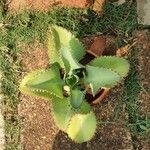
Bryophyllum laetivirens
Mother of Thousands
Description
Source: leafsnapBryophyllum laetivirens, commonly known as the paddle plant or red pancake, is a succulent native to Madagascar. Belonging to the Crassulaceae family, it is a popular ornamental plant due to its distinctive appearance and ease of care. The paddle-shaped leaves of Bryophyllum laetivirens are thick and fleshy, exhibiting a reddish-purple tint along their edges. These leaves grow in rosettes that can reach up to 30 cm in diameter. The plant also produces small clusters of pink or white flowers on tall stalks emerging from the center of each rosette. Bryophyllum laetivirens is an easy-to-grow houseplant requiring minimal care. It thrives in bright but indirect sunlight and prefers well-draining soil with occasional watering during its growing season in spring and summer. The plant can be easily propagated by taking stem cuttings or planting its fallen leaves directly into soil. Beyond its ornamental appeal, Bryophyllum laetivirens has been used for medicinal purposes for centuries due to its anti-inflammatory properties. Its leaves are thought to have healing benefits, both when applied topically and when ingested. In summary, Bryophyllum laetivirens is a fascinating succulent with unique characteristics, making it a popular choice among indoor gardeners seeking low-maintenance plants with potential health benefits.
🌳 Thriving by an unusual propagation method, the mother of thousands produces offspring called plantlets directly along the edges of its leaves. This vivipary strategy, uncommon among plants, bypasses the typical seed-dispersal process. Its attractive bright green color and distinctive single-leaf design have made it a popular choice for enhancing living spaces.
Care Guide
💧 Water Every 7 days
☀️ Light Full sun
Mother of thousands flourishes with abundant sunrays. Sufficient solar energy promotes rapid, vigorous growth. However, it can tolerate moderate sun if it is adequately rationalized. Excessive shade can reduce its vigor, while too much sun may scorch its leaves. Native to habitats with plentiful sunlight, its various growth stages do not significantly alter its sunlight requirements.
🌡️ Temperature 20–37.8°C
Mother of thousands is native to regions with temperatures ranging from 68 to 100 °F (20 to 38 ℃). The plant does best in warmth and prefers temperatures toward the higher end of that range. In colder seasons, make sure it remains warm to maintain optimal health.
💨 Humidity
🪴 Soil 6-7
🌱 Fertilizer
For the Mother of thousands plant, it's enough to apply a light amount of fertilizer 1-2 times annually during the growth phase. It's advisable to refrain from fertilizing during winter and summer when the plant is in a dormant state. After repotting, minimize the use of fertilizer and hold off on it for several months. The application of fertilizer aids in promoting robust growth and supports flowering.
🪴 Pot & Repot Every 2 years
For the re-potting process of Mother of thousands, choose a pot that is slightly bigger than the current one and ensure it has ample drainage. Utilize a succulent or cactus mix that drains well and has a gritty texture. Gently extract the plant from its previous pot, clean off surplus soil, and position it at the identical depth in the new pot. Let a few days pass before watering to let any root injuries recover. Perform the repotting in spring or autumn and place it in an area with plenty of light.
✂️ Pruning
🌿 Propagating
🐛 Diseases & pets
☠️ Toxicity
Characteristics
- Plant Type
- Succulent
- Life Cycle
- Perennial
- Genus
- Bryophyllum
- Family
- Crassulaceae
- Hardiness Zone
- 9-11
- Mature Height
- 30 cm
- Mature Spread
- 10 cm
- Leaf Color
- Light Green, Pale Green
- Leaf Type
- Evergreen
- Flower Color
- Pink, Purple
- Flower Size
- 2.54 cm
- Bloom Time
- Spring
- Planting Time
- Spring, Autumn
- Harvest Time
- Early summer, Mid summer
- Native Area
- Madagascar