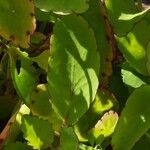
Bryophyllum pinnatum
Cathedral bells · Ghâmet · Leaf Of Life · Loveplant · Mala Madre
Description
Source: leafsnapBryophyllum pinnatum, commonly known as the air plant, cathedral bells, or life plant, is a succulent perennial herb belonging to the Crassulaceae family. Originally native to Madagascar, it is now widely found in many tropical and subtropical regions around the world. The plant features fleshy leaves arranged in a rosette pattern and can grow up to 30 cm in length. These leaves are green with distinctive purple spots on their undersides and have serrated edges. The flowers of Bryophyllum pinnatum are small, bell-shaped, and adorned with pink or white petals. A unique characteristic of this plant is its ability to reproduce vegetatively through its leaves. When a leaf falls from the parent plant onto moist soil or another suitable substrate, it can develop roots from its edges and grow into a new individual plant. For centuries, Bryophyllum pinnatum has been utilized in traditional medicine systems worldwide due to its anti-inflammatory properties. Additionally, it is popular as an ornamental houseplant thanks to its attractive appearance. However, it is important to note that this plant contains toxic compounds, such as cardiac glycosides, which can cause serious health issues if ingested by humans or animals in large quantities. In summary, Bryophyllum pinnatum is an intriguing succulent with unique features. Nevertheless, it should be handled with care due to its potential toxicity when consumed by humans or animals without proper precautions.
🎭 Sincere
Care Guide
💧 Water Every 7 days
☀️ Light Full sun
The life plant thrives when it gets plenty of sun exposure for healthy growth. However, it can also manage with moderate brightness. It originates from a place abundant with sunlight, thus getting too much of it can cause the leaves to scorch. Conversely, insufficient light can result in elongated growth and diminished leaf hues.
🌡️ Temperature 20–37.8°C
Life plants originate from tropical regions and flourish best in temperatures between 20 and 38℃ (68 to 100℉). Regular hydration is essential for these plants and they should be shielded from direct sunlight to avoid sun scald. In colder seasons, supplementary sources of heat are advised to uphold the plant's preferred temperature range.
💨 Humidity normal (40-60%)
This plant will thrive in moderate humidity, which is probably the level in your home. However, misting it a few times a week can be very beneficial. Make sure the room has good ventilation.
🪴 Soil 6-7
🌱 Fertilizer
For the Life plant, light applications of fertilizer once or twice a year during the growing season are adequate. Avoid fertilizing in winter or in summer when the plant is dormant. Cut back on feeding for plants that have been repotted, and wait a couple of months after repotting before you start fertilizing again. Fertilizing helps maintain healthy growth and encourages blooming.
🪴 Pot & Repot Every 2 years
While repotting the Life plant, choose a container that is slightly more substantial than its current one and ensure it has adequate drainage. Opt for a gravelly succulent or cactus blend with excellent drainage. Remove the plant from its previous pot with caution, dust off surplus soil, and reposition it at an identical depth. Hold off on watering for several days to let any damaged roots mend. Repot during spring or fall, and place it in an area with plenty of light.
✂️ Pruning
🌿 Propagating
🐛 Diseases & pets
☠️ Toxicity
Characteristics
- Plant Type
- Succulent, Herb
- Life Cycle
- Perennial
- Genus
- Bryophyllum
- Family
- Crassulaceae
- Hardiness Zone
- 10-12
- Mature Height
- 0.3 m to 2.13 m
- Mature Spread
- 34 cm
- Leaf Color
- Green, Red
- Leaf Type
- Evergreen
- Flower Color
- Pink
- Flower Size
- 1.02 cm to 2.03 cm
- Bloom Time
- All year round
- Planting Time
- Spring, Autumn
- Harvest Time
- Spring, Summer, Fall
- Native Area
- Madagascar, Kenya, Malaysia