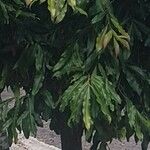
Buckinghamia celsissima
Buckinghamia silky-oak · Ivory-curl · Ivory-curl-flower · Ivory-curl-tree · Silky-oak
Description
Source: leafsnapBuckinghamia celsissima, commonly known as the ivory curl, is a species of trees, constituting part of the plant family Proteaceae. They are endemic to the wet tropics rainforests areas of northeastern Queensland, Australia. The species was described in 1868 by Ferdinand von Mueller in honour of Richard Grenville, 3rd Duke of Buckingham, from a collection of material made by John Dallachy near Rockingham Bay on 11 January 1865. Its specific epithet is Latin for "very tall". Common names include ivory curl flower and spotted silky oak.Buckinghamia celsissima reaches 30 m (98 ft) tall in its natural rainforest habitat, but is much smaller, reaching 10 m (33 ft) tall, in Australian east coast gardens. Glossy dark green above and whitish below, the leaves are quite variable. Juvenile leaves have one or more lobes while adult leaves are simple and entire, measuring 8 to 16 cm (3.1 to 6.3 in) long by 3–7 cm (1.2–2.8 in) wide. The white flower spikes appear over summer and autumn. Terminal and showy, these are drooping racemes up to 20 cm (7.9 in) in length. Flowers are followed by the development of woody follicles, 1.5–3 cm (0.59–1.18 in) long.In the wild they are found more frequently in drier rainforest from altitudes of 200 to 1,000 m (660 to 3,280 ft) above sea level. They often grow with kauri pine (Agathis robusta).The species is grown widely in Brisbane and thrives in Sydney and Melbourne, yet is shy to flower in Cairns. Frosts render it difficult to grow in Canberra. It can be propagated from seeds or cuttings of hardened new growth. Its flowerheads attract birds and insects.
Care Guide
💧 Water Every 2 weeks
The Ivory Curl Tree, which is native to Australia's rainforests, thrives in environments with high humidity and consistent moisture. It can tolerate short periods of dryness, so watering it every two weeks is sufficient. As an evergreen plant, it needs a stable watering schedule to support its continuous growth throughout the year. For optimal growth, it's best to cultivate the tree in outdoor settings that resemble its natural climate.
☀️ Light Full sun
The ivory curl tree grows best in locations with abundant sunlight. Its health and growth reach their peak in such conditions because of its native habitat's relationship to the sun. It has little tolerance for variations in light. Both too much and too little sun can harm the plant.
What are the sunlight requirements for the Ivory Curl Tree?
The Ivory Curl Tree requires full sunlight to thrive, with optimal growth seen in environments that provide over 6 hours of sunlight daily. Ensuring your garden has the right balance of light and shade is crucial for the happiness of your plants, including the Ivory Curl Tree. It's important to observe how sunlight moves through your garden and select locations that cater to the needs of your plants, providing them with the best conditions for growth.
What essentials should be considered for the Ivory Curl Tree's growth?
The Ivory Curl Tree flourishes in conditions where there is abundant sun exposure, which is vital due to its natural habitat. Its ability to adapt to different sunlight conditions is limited, making both excessive and insufficient sunlight detrimental. For indoor plants lacking natural sunlight, especially during winter or in darker spaces, artificial lighting becomes essential. LED lights, recommended for their ability to be customized to specific plant needs, should provide 30-50W/sq ft for full sun plants, 20-30W/sq ft for partial sun plants, and 10-20W/sq ft for full shade plants. The distance of the light (12-36 inches above the plant) and duration (8-12 hours per day) are critical for mimicking natural sunlight conditions.
What are the symptoms of inadequate lighting for the Ivory Curl Tree?
Symptoms of light deficiency in the Ivory Curl Tree include small or underdeveloped leaves compared to previous growths, leggy or sparse growth due to extended spaces between stems or leaves, premature leaf drop as the plant attempts to conserve resources, a halt in new leaf production, and leaves developing pale colors or irregular patterns indicating a lack of chlorophyll. Chlorosis, or the yellowing of leaves, can occur due to the breakdown of chlorophyll from excessive sunlight, impacting photosynthesis. Other symptoms like sunscald, leaf curling, wilting, and leaf scorching manifest from too much sunlight exposure, leading to damaged tissue and reduced plant health.
What solutions can alleviate light-related issues for the Ivory Curl Tree?
To combat light-related issues in the Ivory Curl Tree, gradually introduce plants to sunnier spots, ensuring they get at least 6 hours of direct sunlight daily. For indoor plants, consider moving them to south-facing windows or use artificial lighting like desk or ceiling lamps for a minimum of 8 hours a day. Professional grow lights can also provide sufficient light. For outdoor plants, it's crucial to acclimate them to changes in sunlight gradually to prevent sunburn. Reduction of sunlight obstructions is important for plants in the ground, involving pruning or transplanting to sunnier areas during dormant periods. Note that while parts of the plant damaged by insufficient light may not recover, new growth can be healthy with improved lighting conditions.
🌡️ Temperature 20–37.8°C
Ivory curl tree is naturally adapted to temperatures between 68 and 100 °F (20 to 38 °C). Native to a temperate environment, the plant thrives in these conditions. To ensure healthy growth, monitor and adjust the temperature, especially during seasonal changes.
What is the ideal temperature range for an Ivory curl tree?
The Ivory curl tree, also known scientifically as Buckinghamia celsissima, thrives in temperatures ranging from 68 to 100°F (20 to 38°C). Originating from temperate environments, it is extremely heat-loving and can be negatively affected by cold temperatures. During autumn, it's advised to move outdoor plants indoors to a location with plenty of light but away from direct heat sources. Maintaining a temperature above 20°C during winter benefits the plant's growth, as temperatures nearing 0°C can be harmful.
How does low temperature affect Ivory curl tree and what are the solutions?
Ivory curl trees prefer warm climates and are not tolerant to low temperatures, thriving best when the temperature remains above 20°C (68°F). Exposure to temperatures below 0°C can be damaging, and when temperatures fall below -5°C, the tree's leaves may become lighter, possibly turning brown or black with symptoms of wilting or drooping after frost damage. To address this, trim off the frost-damaged parts and move the tree to a warmer environment indoors. Placing it near a south-facing window ensures it receives enough sunlight while keeping it away from heaters or air conditioning vents to avoid air dryness.
What should I do if my Ivory curl tree is affected by high temperature?
During summer, it's crucial to ensure the Ivory curl tree remains below 38°C to avoid heat stress. Temperatures exceeding 43°C can lighten the leaves' color and increase the risk of sunburn. If this occurs, trim the sunburned or dried parts of the plant. Relocate the tree to a shaded area, particularly away from the harsh midday and afternoon sun. Watering in the morning and evening can help keep the soil moisture at an optimal level for the health of the plant.
💨 Humidity
🪴 Soil 6-6
🌱 Fertilizer
The best time to fertilize an Ivory curl tree is in early spring, as it comes out of dormancy. This encourages overall growth and the development of flowers. Fertilizing improves the foliage, stems, and branches, while encouraging large, vibrant, long-lasting blooms. It helps move nutrients from the roots to the flowers and enhances the plant’s health and resistance to disease.
🪴 Pot & Repot
✂️ Pruning
To promote the health and appearance of the ivory curl tree, it is beneficial to prune it during the winter. Focus on removing dead or overcrowded branches to improve air circulation and maintain a pleasing shape. Pruning during this dormant phase encourages vigorous growth and abundant flowering in the spring. It also helps to reduce pests and diseases. For detailed care instructions, consult reliable horticultural resources.
🌿 Propagating
🐛 Diseases & pets
☠️ Toxicity
Characteristics
- Plant Type
- Tree
- Life Cycle
- Perennial
- Genus
- Buckinghamia
- Family
- Proteaceae
- Hardiness Zone
- 9-11
- Mature Height
- 10.06 m to 29.87 m
- Mature Spread
- 3.05 m to 4.88 m
- Leaf Color
- Dark Green, Forest Green
- Leaf Type
- Evergreen
- Flower Color
- White
- Flower Size
- 1.52 cm to 3.05 cm
- Bloom Time
- Summer
- Planting Time
- Spring, Summer, Autumn, Winter
- Harvest Time
- Late summer, Early fall, Mid fall